
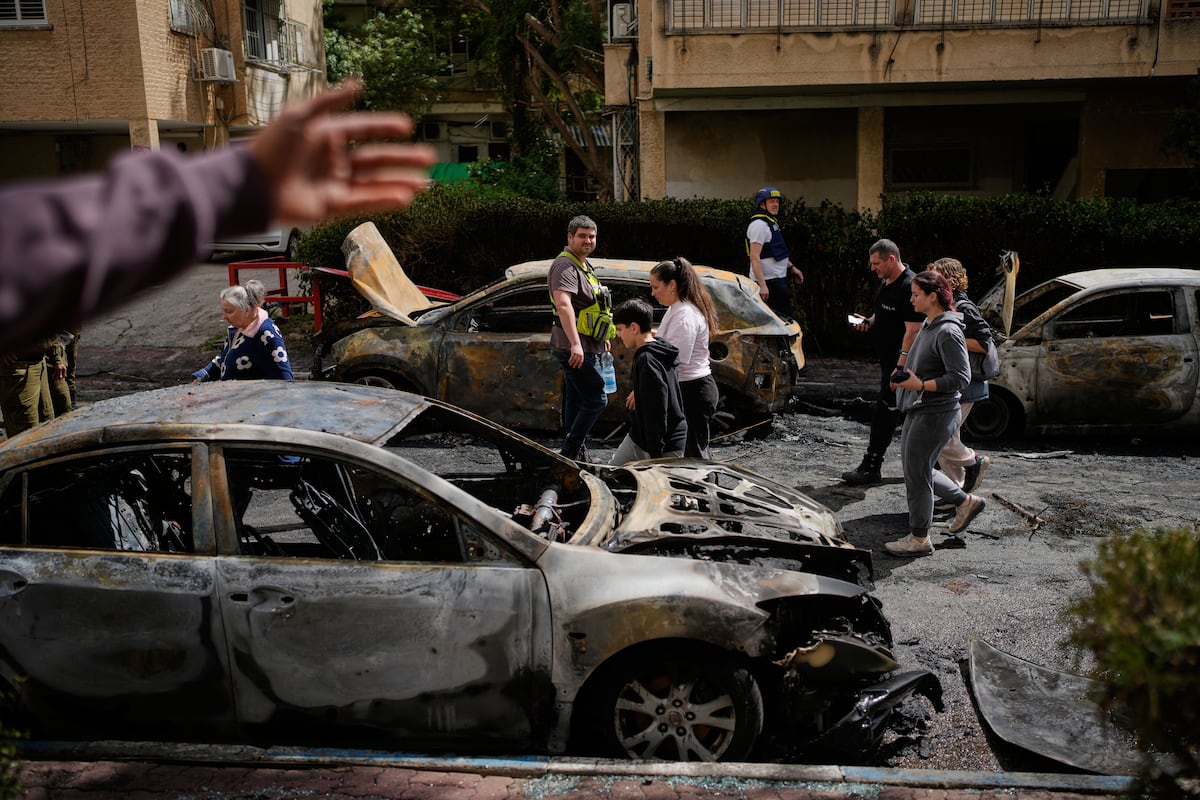
On March 22, Israeli news broadcasts were filled with images of the wounded, ambulances, and houses without walls. In just two hours, two missiles launched from Iran had directly impacted the towns of Arad and Dimona, the heart of Israel’s nuclear weapons program. They left nearly 200 wounded and the certainty that chance prevented a massacre, as they did not directly hit a building. In a country with cell phone alerts, air raid sirens, and a missile defense system with a 90% effectiveness rate — according to the Israel Defense Forces (IDF) — the failure to intercept two missiles in quick succession generated concern and, immediately, questions about the capacity to wage a war of attrition with Iran, longer and more extensive than the 12-day conflict last June. The IDF eventually admitted that they were not special missiles, but rather that they had attempted to shoot them down with a modified version of a cheaper and more readily available system (David’s Sling), instead of the Arrow 3, originally designed for such attacks from over 1,200 miles away.
Each Arrow system interceptor costs between $2 and $3 million. David’s Sling costs $1 million. It’s a sensitive issue because it touches on an unwritten pact of protection between the army and the civilian population, but it’s unavoidable in this and other wars. It’s also rife with rumors: Israeli military censorship prevents the publication of details it deems useful to the enemy.
Eyal Pinko is a lieutenant-colonel in the Israeli army reserve, head of development programs, and a senior weapons and missile systems engineer with 12 years of experience. He is also a senior researcher at the Begin-Sadat Center for Strategic Studies at Bar-Ilan University. He refers to a mix of economic, logistical, and technical considerations that allow Israel to “continue fighting for a long time.” “It’s important to have enough interceptors and to understand what is critical to intercept with an Arrow missile and what is less so and can be intercepted with the Iron Dome,” he explains over the phone.
 The Israeli air defense system intercepts an Iranian missile over the city of Beer Sheva last Sunday.ATEF SAFADI (EFE)
There is a cost-saving dimension, but also one of inventory. Israel entered the current conflict with its Arrow missile reserves depleted from the previous war, despite the intense effort of its military industry to replenish them. It is one of the best anti-missile munitions in the world and intercepts long-range ballistic missiles that leave Earth’s atmosphere. Israel also uses an earlier version, the Arrow 2, for medium- and long-range missiles.
For short-range rockets, such as those fired by Hamas and Hezbollah, it uses the Iron Dome, with much cheaper interceptors. Israel has improved it (as well as David’s Sling) to intercept longer-range projectiles, as it attempted to do in Arad and Dimona.
Various threats
The Iron Dome is a multi-layered defense system, integrated with the American one and generally developed jointly. It’s like an onion, where each layer defends against a different threat and recommends which interceptor to use in each case, based on the trajectory detected by the sensors.
The IDF’s spokesperson for Spanish-language media, Roni Kaplan, points out that the recent interception failures are not due to operational changes, but rather “simply a matter of statistics.” Their success rate has not changed and remains “around 90%,” he adds.
To “saturate” Israeli air defenses, as it is called in the jargon, Iran opted in the conflict last July for combined attacks, with salvos at the same time from drones and cruise and ballistic missiles.
This time, with fewer resources and without a unified command, it has changed its strategy, Pinko explains. Its plan is to maintain a flow — smaller but constant — of missiles, not only against Israel, but also against the Arab Gulf states and U.S. bases in the region.
That’s where what Tal Inbar — an expert with nearly 30 years of experience in Israeli missile, drone, and space programs — calls the “big question” comes in: how many high-level interceptors, like the Arrow 3, does Israel have left? “Nobody will give you the number because it’s not information Iran should have,” he says in a video call interview.
 Israeli Prime Minister Benjamin Netanyahu visits an Arrow unit at an air force base in June 2025. Amos Ben-Gershom (DPA/Europa Press)
In the middle of March, the news outlet Semafor reported that Israel had informed the U.S. of “critically low” reserves. Benjamin Netanyahu’s government was quick to deny it, something any country at war would do, regardless of the veracity of the claim.
Inbar emphasizes the importance of using the systems rationally: “When you have a finite number of interceptors, you have to be very calculating about which ones and how many you’re going to use. The longer the war lasts, the more missiles Iran will try to launch against Israel, and the more difficult it will be for the defense.” In Israel, he adds, “all the factories are working around the clock” to build defensive missiles, but “the process is lengthy” even with dedicated funding.
Inbar sees the problem (which the Gulf countries also face) as intimately linked to the other side of the equation: Iran’s capabilities. “It still has many missiles, but Israel and the United States are attacking its depots, launchers, and production facilities,” he notes. He defines it as an offensive action based also on “defensive logic,” because “every missile that can be eliminated in Iran is one less to intercept over Israel,” thus reducing the pressure on the multi-layered system.
Israel attacks launchers daily, either just before or immediately after each attack. Tehran “understands there is a high probability that they will be destroyed, so it is being much more cautious” about exposing them, Pinko notes.
Cluster bombs
Iran’s main weapon in this war is cluster bomb missiles. Using them in civilian areas (which Israel has also done in Gaza and Lebanon) is illegal because they are indiscriminate by nature and can end up scattering mines throughout the area. The warhead is designed to open about four miles above the ground, dispersing smaller bombs over a radius of up to five miles.
Although they are responsible for a third of the 16 deaths so far in Israel in the current conflict, the IDF is not trying to shoot down every single one of these small cluster bombs. The idea is to avoid expending interceptors on munitions equivalent to the short-range rockets used by Hezbollah and the militias in Gaza. “It’s not always smart to intercept every bomb […] It’s not so urgent to try with each and every one,” Inbar summarizes.
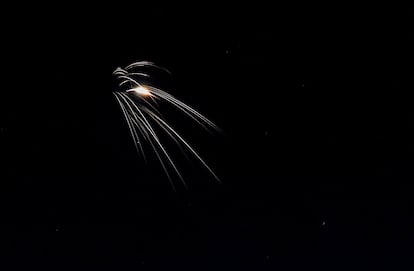 An Iranian cluster bomb missile over Tel Aviv on March 24.Ronen Zvulun (REUTERS)
A typical ballistic missile carries a warhead weighing between half a ton and a ton, while the explosive charge of these mini-bombs is relatively small: up to seven kilograms. Israel assumes they will rarely cause casualties if the population follows the instructions of the military command when they receive an alert (go to the shelter or, failing that, to reinforced rooms) because bombs of that caliber are unlikely to penetrate concrete.
The problem is that not everyone follows the rules, nor do they all have equal access to protection. There is a de facto hierarchy, with the country’s economic heartland and upper-class buildings better equipped than the periphery and poorer neighborhoods. Shelters are almost nonexistent in Arab towns and cities, which are structurally discriminated against compared to Jewish ones.
Added to this is the socioeconomic difference between outdoor jobs (such as construction or agriculture) or jobs in modern buildings with shelters, which has once again become evident.
Last week, a cluster bomb killed a Thai migrant on a plantation. He had only been in Israel for 10 months. Three weeks earlier, another bomb killed two Israeli construction workers at the site where they were working in Yehud. The metal structure destroyed by the projectile sparked debate about whether they failed to seek shelter due to their own negligence or that of the contractor. Last Saturday, a security guard was killed by the same type of munition after finishing his shift. According to relatives, he was waiting for a friend to pick him up because he couldn’t afford the trip back home. And in the West Bank (which has no shelters or air-raid sirens), another cluster bomb killed four Palestinian women in a makeshift beauty salon.
Sign up for our weekly newsletter to get more English-language news coverage from EL PAÍS USA Edition