
Last summer, I was visiting a friend at his antique and souvenir shop, located on the demarcation line between the Armenian and Jewish Quarters inside the walls near Zion Gate in the Old City of Jerusalem. A tourist and his wife, both religiously observant Jews, entered the shop to buy souvenirs for their children in the U.S. The wife asked my friend to show her examples of the Jewish menorah and the Star of David, which he did. Suddenly, her eyes fell on a cross made of olive wood, and she began shouting at my friend,
“Why do you sell and keep Christian religious symbols in your shop?”
He replied, “We are Armenians, and we sell religious symbols for the three religions: Judaism, Islam and Christianity. “In our present time, it is this very cross that protects your people; for the support that Christian countries provide to the State of Israel is immense and inexhaustible — yet you do not appreciate it. You are ingrates.”
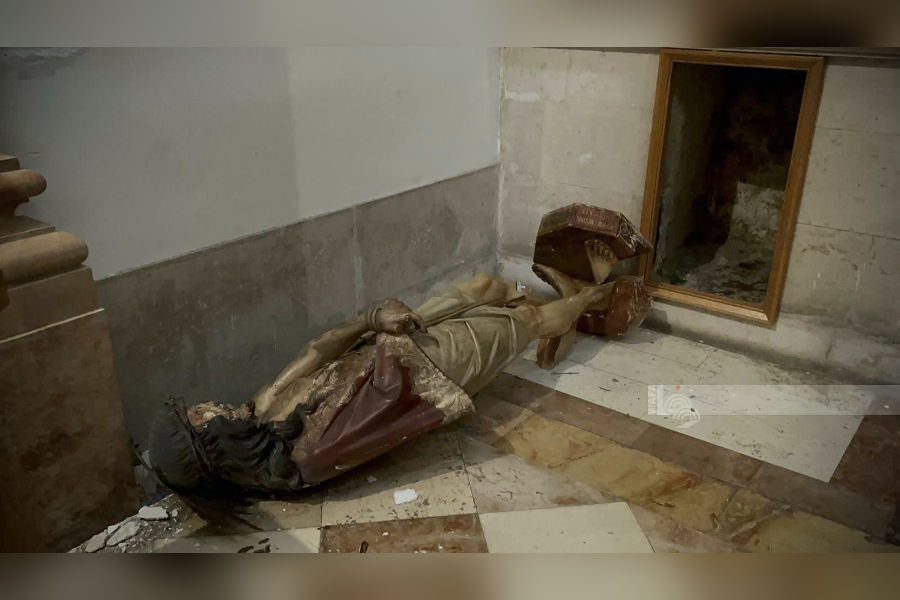
They left the shop angrily without buying anything, and the husband spat in the direction of the shop. There are many examples of incidents in which Christian religious symbols were vandalized, spat on and insulted in cities across the state of Israel (inside and outside the Green Line) since its establishment in 1948. However, this article will limit its discussion to the phenomenon of spitting in Old Jerusalem.
Is the act of spitting on the cross by some religious Jews a custom or a religious obligation? Is it an act against Christ, the religious and social reformer who broke away from Judaism? Is it an expression of anger at the persecution Jews faced in Christian Europe, or a form of modern religious repression? And why do these individuals engage in this behavior openly only in Israel — and nowhere else in the world?
Advertisement

On Oct. 4, 2023, Israeli National Security Minister Itamar Ben-Gvir said in an interview: “I still think spitting at Christians is not a criminal case. I think we need to act on it through instruction and education. Not everything justifies an arrest.”
It should be noted that in the past (before assuming the position of minister of national security) Ben-Gvir, in his capacity as a lawyer, defended a number of right-wing extremist activists suspected of terrorism and hate crimes, justifying spitting on Christians as an “ancient Jewish custom.”
Ancient rituals
For centuries, hundreds of thousands of Jews in Europe were subjected to forced conversion by the Catholic Church under threat of expulsion or death. Those who remained were forced to convert under duress. Countless Jews were tortured or massacred for refusing to renounce their faith.
For example, on March 31, 1492, a decree of expulsion ordered all Jews to leave Spain by the end of July of that year. Those who remained were forced to convert to Christianity. Most of those expelled migrated to North Africa, Italy, Turkey and the Middle East, while others faced further persecution elsewhere, such as the expulsion of Jews from Portugal shortly afterward.
This hostility toward Jews has instilled a collective trauma and resentment toward Christians worldwide. This remains a powerful force in the minds of many religious Jews, fueling a desire for revenge against Christians.
Some Jewish historians note that, initially, this anger was expressed through semi-covert acts of aggression against Christianity in the countries to which they had fled; perhaps the most notable of these acts became the gesture of spitting upon Christian religious symbols.
Following the establishment of the state of Israel — and the security and freedom Jews came to enjoy within their nascent state — some began to engage in acts of aggression that were more overt and audacious. These acts were often committed directly under the gaze of Israeli government officials and police officers. Examples include spitting directly upon religious symbols and vandalizing property of a Christian character.
These hate crimes reached a peak on July 19, 2018, after the Knesset passed the nation-state law, which specifies the country’s significance to the Jewish people. Some Jewish extremists began committing acts, such as spitting and physically abusing the clergymen, urinating in front of the main gates of churches, and writing anti-Christian graffiti on walls.
In Haifa in January 2019, the Haifa Museum of Art displayed a sculpture depicting the McDonald’s mascot as the crucified Jesus Christ. This life-sized sculpture, titled “McJesus,” showed the Ronald McDonald clown on a cross as part of an exhibition exploring consumerism and religion. Other pieces depicted Jesus and the Virgin Mary as Ken and Barbie dolls.
Many Jews view Jesus as a figure who broke away from and criticized Judaism. He established a religion that rivaled Judaism and he succeeded in convincing many Jews and non-Jews to embrace his teachings, many of which were at odds with Judaism.
The situation in Jerusalem
Although Jerusalem is considered a holy city for Christians, as of the end of 2017, its Christian population numbered only 16,000, making it the third-largest Christian community in Israel.
On Dec. 25, 2025, an article published in The Times of Israel reported that approximately 184,200 Christians live in Israel, representing 1.9% of the country’s population, according to the Israeli Central Bureau of Statistics. Nazareth has the largest Christian population with 18,900, followed by Haifa (18,800), Jerusalem (13,400) and Nof HaGalil (10,800).
Hate crimes against Christians are frequently observed in cities where there is significant interaction and close contact between Jews and Christians, often accompanied by daily religious practices and rituals. East Jerusalem, and specifically the Old City, is a prime example. Some Ultra-Orthodox Jews have been reported to have a decades-old practice of cursing and spitting on Christian clergymen in Jerusalem.
Every day, we witness Christian pilgrims walking the Via Dolorosa — which stretches from the first station inside the walls of the Lions’ Gate to the Church of the Holy Sepulchre — carrying large crosses. This is in addition to the daily processions of clergymen from various Christian denominations heading from their monasteries to the Church of the Holy Sepulchre and then back.
It is worth noting that these processions were held during the Ottoman era, the British Mandate and Jordanian rule of Jerusalem, without any incident of hostility toward Christians being recorded. Reports indicate that incidents of spitting have been recorded on the street stretching from Jaffa Gate to Zion Gate and Dung Gate. Anyone wishing to walk to the Armenian Orthodox Monastery, the Catholic Benedictine Abbey and the Western Wall must use this street.
Here, Jewish and Christian communities and pilgrims frequently mingle. Reports indicate that Jewish settlers from outside the city are a major factor in stirring unrest, particularly in front of the Armenian Cathedral of St. James. The religious situation in Jerusalem exemplifies the oppression of the ruled by the rulers. There are indications that successive Israeli governments may have secretly encouraged extremist Jews — in the occupied territories in general, and in Jerusalem in particular — to persecute, harass, intimidate and provoke Christians as a means of driving them out of the Jewish state.
On Dec. 18, 2021, Francesco Patton, the custos of the Holy Land for the Catholic Church, wrote an article in The Daily Telegraph titled “Christians in the Holy Land are Threatened with Extinction,” in which he warned of the dangers of Israeli extremism, stating: “Despite 2,000 years of faithful service, our existence is fragile and our future is at risk.” Fr. Patton noted that “while we once constituted 20% of Jerusalem’s population, today the Christian community represents less than 2%.”
He accused radical Jewish groups with extremist ideologies of making the lives of many Christians unbearable by repeatedly committing hate crimes and offences against priests, monks and worshipers alike. Some assert that encouraging extremist Jews to attack Christian communities became public after Itamar Ben-Gvir took office as minister of national security in 2022. He declared his support for Jewish settlers in their repeated attacks on the Christian village of Taibeh and its church in the West Bank.
Taibeh is the only entirely Christian Palestinian village. It is the ancient Ephraim, the location mentioned in the Gospel of John where Jesus took refuge after the resurrection of Lazarus (Jn 11:54), and where the Christian community has ancient roots. The village is home to three churches — Latin, Greek Orthodox and Melkite.
In addition, Ben-Gvir has publicly shown laxity in deterring anti-Christian acts committed by Jewish settlers in the Old City of Jerusalem in general and in the Armenian Quarter adjacent to the Jewish Quarter in particular. In October 2023, he opposed the imprisonment of Jewish extremists who spit on Christians in Jerusalem, considering their behavior not to be criminal
The annual report by the Jerusalem-based Rossing Center for Education and Dialogue documented 111 anti-Christian incidents in 2024. An accompanying survey found that nearly half of Christians under the age of 30 want to emigrate from Israel. Among the 111 documented cases of harassment, physical assaults emerged as the most common category. Spitting was the most common form of physical harassment, and clergy are now regularly harassed in public spaces, particularly in areas such as the Old City of Jerusalem. In summary, spitting is the most common form of abuse perpetrated against Christians by extremist Jewish groups in Jerusalem.
Hatred is the primary motivation behind this behavior. Although the phenomenon of spitting near churches or priests by Ashkenazi Jews is not new, it has evolved into an act of public defiance, humiliation and insult directed against Christian believers. After the establishment of the state of Israel, Christians began to leave due to the religious persecution they faced.
The Christian community faces significant challenges, including a declining population and a shrinking presence due to reports of escalating violence by settlers and Ultra-Orthodox Jewish groups, which makes life difficult for Armenian Christians.