
Temple Israel president Tom Anger said if he knew exactly what has allowed the congregation to last so long, enduring everything the world has thrown at the Jewish people, and reach its 180th anniversary, he would bottle it up, sell it to all the other congregations out there and retire. But while he can’t fully explain what has allowed for the synagogue’s success, Anger does know the recipe that they’ve used to help guide them along the way.
“The key we’ve found is being responsive to your community,” he told the Columbus Jewish News. “We’ve changed buildings five times over the years, and we’ve done that so we can remain close to our people and serve the community where we find them. Not only do we make ourselves accessible from a geographic perspective, but from a membership one as well. We want everybody who wants to and does join comfortable. There’s such a culture of openness with the temple.”
Temple Israel was formed in 1846 as the first Jewish congregation in Central Ohio. It was called Bene Jeshurun and it was formed by a group of eleven families with German backgrounds. Services were led by Rabbi Simon Lazarus and held in rooms above shops on High Street, then later in homes and rented halls. The first documented Jewish wedding in Columbus took place at Bene Jeshurun in 1948, according to the synagogue.
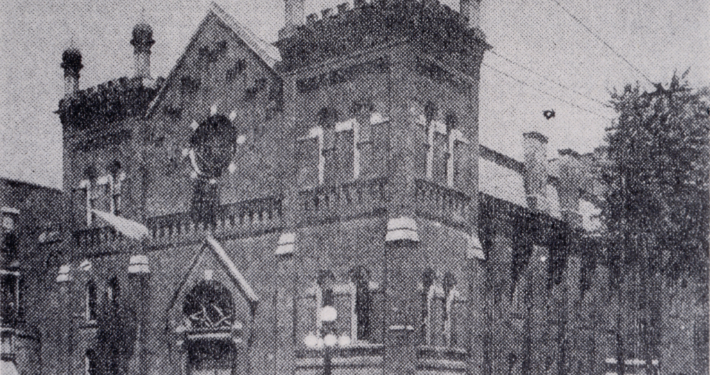
During the spring of 1868, a Reform congregation was organized. And by 1871, Bene Jeshurun was dissolved and a new congregation, B’nai Israel took its place. A lot was purchased for the building and construction began at Friend and Third streets. It was decided the new congregation would conduct its services in English instead of Hebrew as it had previously done. By 1900, over 100 families had joined the congregation.
The congregation continued to grow and, in 1903, a cornerstone for the new synagogue, which changed its name to Temple Israel, was laid on Bryden Road.
Rabbi Jerome Folkman came to the Temple Israel pulpit in 1947 and would go on to become its longest-serving rabbi. By 1950, the congregation exceeded 750 families and its first girl to become Bat Mitzvah did so that year.
In 1958, construction began on a new building that would become the synagogue’s home at 5419 Broad St., increasing the space for the expanding congregation. The congregation’s first cantor was hired in 1980 and the music program expanded. In 1996, a five-year renovation began on the Temple Israel building with remodeled worship spaces, a new learning center and an expanded social hall.
In 2021, Temple Israel moved into its current location at 3100 East Broad Street.
“I can’t even begin to say what an honor it is to be the rabbi at this moment for our humble but very mighty Temple Israel,” Rabbi Sharon Mars, senior rabbi at Temple Israel, told the CJN. “It’s unfathomable what the world has gone through and the changes we’ve gone through as an institution, but we are on stronger ground than ever. Despite the madness in the world, here we are feeling strong and secure.”
Anger, who joined the temple in 2000 after moving to Columbus, said the congregation currently has 600 families and noted Temple Israel has had a steady growth rate even through the ebb and flow of religious participation in the country, a fact he called “outstanding.”
“Eighteen is such an important number in Judaism, and having the incredible luck to have made it ten times chai is amazing,” he said. “It is such an honor for me to have the tremendous good luck to be president as we round into the anniversary like that. It’s like winning the lottery, and is the thrill of a lifetime.”
Mars has been with Temple Israel for 12 years, joining as the associate rabbi and becoming the senior rabbi four years later. She said she feels “blessed” to have ended up with the temple.
“People are so faithful to Temple Israel because it’s been around this long,” Mars said. “We have the reputation of being a serious Jewish institution that has its heart open to every person who wants to find their home in Jewish life and wants to find a more liberal Jewish home.”
The temple and its congregants have been forced to endure many challenges over the years. Mars noted in her eight years as senior rabbi that they were faced with the COVID-19 pandemic, the Oct. 7, 2023, Hamas-led attack on Israel, and the various ups and downs of both the United States and Israel.
“Just as the first Trump administration was starting, we were moving from our location that we had been in for many, many years down at 5419 E. Broad Street,” Mars said. “We were taking a bit of a gamble and moving closer to Bexley, where so many Jews live. We were doing a makeover of a building that had been a church, and we were living in the wilderness for several years before being able to move in here. We moved in right after COVID started, and every day I come to this place I think what a miracle the tenacity of this community has been. It’s tremendous.”
One of Mars’ favorite moments from her time at the temple has come through the evolution during Yom Kippur. The rabbi made it clear to her congregants that it’s traditional to keep the Aron Kodesh, the Holy Ark, open and to allow people to come closer to it as they feel comfortable in their own time over the course of the neilah service.
“Over the past couple of years we have seen that grow, and the whole place is crowded on the bimah,” she said. “There is a comfort and joy and this love that can be felt from there in that moment: this community coming together and whatever barriers are between people are gone. To me it says so much about who we are and are trying to be: this very welcoming place where you can find God and find humanity created in the image of God.”
Mars said the temple has become such a welcoming place that aspects such as their LGBTQ+ group doesn’t even need to be called out anymore.
“It’s a given that that’s who we are,” she said. “You want a place where you can feel comfortable being who you are? Temple Israel. You want to be able to come with your diverse family? Temple Israel. We’ve pushed to grow and learn Jewishly, and that’s what makes me so happy to be here because it’s super dynamic and ever changing.”
The vibrant congregation and milestone gives Temple Israel reason to celebrate, Mars said. The celebration will be held from 6 to 9:30 p.m. May 2 at the temple, and will feature music and dancing, festive food stations, an archives exhibition and a silent auction. Rabbi Rick Jacobs, president of the Union for Reform Judaism, will be the event’s featured speaker for the evening.
Tickets are $92.80 and can be purchased at shorturl.at/49toK.
“I am looking forward to having a great time eating, drinking, dancing, singing and talking about how great we are because I really believe it,” Mars said. “The best selling point is that the rabbi loves her job and the people. I feel so proud and so lucky to be in this moment.”