
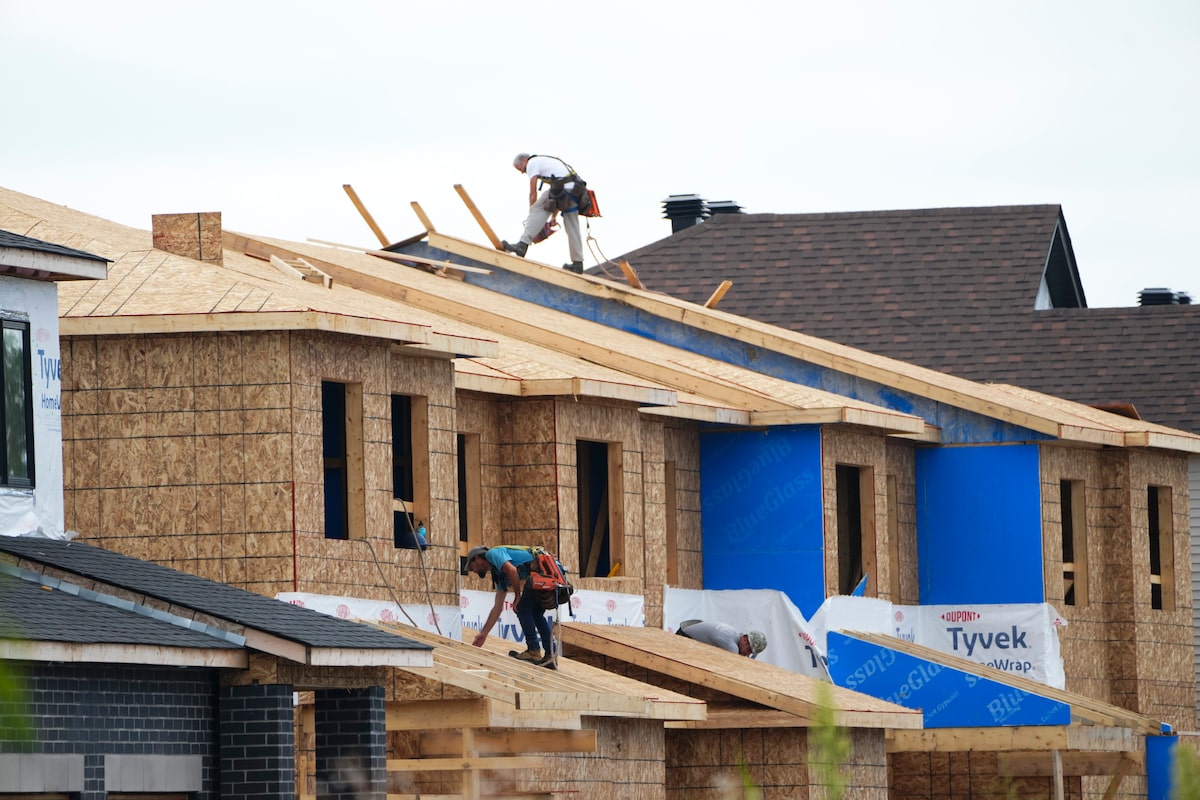
New homes are constructed in Ottawa in August, 2023.Sean Kilpatrick/The Canadian Press
An Ontario proposal to allow land to be subdivided into smaller parcels for new housing developments could mean big changes for cities and towns in the province.
Over the past week, the province announced a raft of measures aimed at boosting the housing supply: from harmonized sales tax incentives for buyers of newly built homes to sweeping plans to cut in half the development charges levied on the builders of those homes. On Monday, a newly tabled bill proposes to give the province the power to impose a single standard for minimum lot sizes that would be lower than is typical in most urban areas.
“The housing industry has been on its back,” said Rob Flack, Minister of Municipal Affairs and Housing, at a news conference announcing the introduction of Bill 98, Building Homes and Improving Transportation Infrastructure Act, 2026. “We’re trying to create the conditions so people take their thumb off the pause button.”
The new regulation would set 175 square metres, or about 1,884 square feet, as the new minimum for subdivided land across the province. “Today, inconsistent local standards often force larger lots than necessary, which can reduce housing supply and affordability,” reads a technical briefing provided Monday.
A 175-square-metre minimum is significantly smaller than many of the current planning rules allow in the suburban communities around Toronto, where the median lots tend to be twice as large, or more. For instance, Pickering, Ont., has bylaws that set a minimum lot size of 1,390 square metres in its “residential cluster” zones (seven times larger than the new standard), with some such “estate” zones defining the minimum lot as 6,000 square metres (34 times larger). The smallest lot the city allows is 250 square metres in its “residential single” zones, designated for townhouses and dense housing like it, but that, too, is still too large for the new provincial target.
Federal, Ontario governments to spend $8.8-billion to cut municipal development charges
The province seeks to create rules that all municipal official plans would have to comply with, and give cities a limited amount of time to amend their bylaws.
The proposal is both more and less than what many stakeholders were asking for in comments posted to the Environmental Registry of Ontario (ERO) last fall, when Mr. Flack’s ministry sought feedback as part of the Fighting Delays, Building Faster Act, 2025.
The pro-housing community group More Neighbours Toronto argued that lot minimums should be completely removed, as has happened in jurisdictions such as Texas and New Zealand. However, Damien Moule, a member of the group’s policy committee, said 175 square metres is a good starting point.
“A two-storey house where each floor is 600 square feet – that would fit comfortably on [175 square meters], plus a backyard,” said Mr. Moule, who is a volunteer and a nuclear engineer with a passion for getting more housing built in Toronto. He said some of the most desirable parts of the city, such as Trinity Bellwoods, have homes on lot sizes of this scale or smaller. “It would look a lot like the fabric of the oldest parts of the city; your standard bay and gable Victorians,” he said.
Toronto city councillor Stephen Holyday said he was still assessing the impact the changes could have on suburban areas like his Etobicoke constituency, but was clear on the likely political reaction. “The loosening of standards in existing detached neighbourhoods is generally not supported by residents, as demonstrated with other initiatives, making this change important to monitor closely,” he said.
Opinion: Young adults can’t afford homes to raise families, and city governments are at fault
Andria Leigh, chair of council for The Ontario Professional Planners Institute, said the organization hasn’t taken a position on the 175-square-metre target but said that, as the government continues its consultations, it may find a higher number is more achievable.
“The objective should be creating a range of housing and options,” said Ms. Leigh, who is also director, planning and growth for the Town of Innisfil. “Homeowners don’t all want to live in the same type of home,” she said. In Innisfil, the minimum lot size is 275 square metres, similar to that of cities such as Mississauga. She said that some municipalities are asking if that size might not be a more acceptable alternative to the province’s planned 175 square feet. “Really, they are saying: ‘Tell us why that number won’t work,’” she said.
In comments submitted to the ERO, different municipalities took different approaches to try and defend larger lots. Toronto’s planning department warned that reducing the minimum lot size might hurt the creation of new high-density housing, “by enabling the severance of large lots into multiple small lots that are only able to accommodate a small, single-unit house.” Other regions such as Peel, to the west of Toronto, opposed the idea of lowering lot sizes because it could interfere with everything from stormwater management to utilities servicing.
“To a lot of our members, this is one step: It can’t really happen in isolation,” said Kirstin Jensen, vice-president of policy, advocacy and relationships with the Ontario Home Builder’s Association. She said her organization would prefer that lot minimums disappear altogether. She noted that other planning bylaws, such as those that set ratios on the amount of floor space a home can have depending on the lot size, could make building impossible on small lots unless those rules change as well. But she’s optimistic that the government is moving in the right direction.
“Rather than doing a little tinkering, what we’ve seen over the last year is government making integral changes to the Planning Act to move forward on things like affordability, and to expedite ways to get housing built,” Ms. Jensen said.