
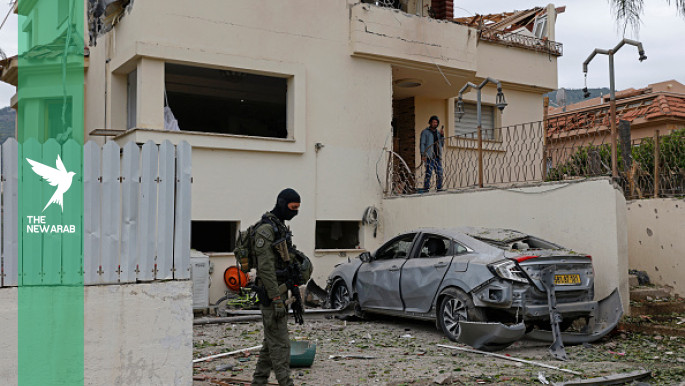
An Israeli security personnel stands guard at the site of a Hezbollah missile strike that targeted a house in the northern Israeli town of Kiryat Shmona near the border with Lebanon on 1 April [Getty]
Israel is no longer treating the disarmament of Hezbollah as a goal of its current war in Lebanon, according to Israeli military officials, signalling a shift from earlier statements that had emphasised that objective.
The comments came as the Israeli army reiterated claims that it has killed around 1,000 Hezbollah fighters in Lebanon over the past month, including several senior commanders and members of the elite Radwan force. It also said it had attacked “more than 3,500 targets” across Lebanon.
In a statement, the military said it was continuing “intensive operations in southern Lebanon as part of focused ground activity in several areas”, alongside air, sea and land attacks targeting alleged Hezbollah sites.
It added that the 91st, 146th, 36th and 162nd divisions were leading a concentrated ground offensive in southern Lebanon, involving “precise raids”, the destruction of Hezbollah infrastructure and the targeting of its fighters, “while deepening the blow to the organisation’s capabilities and pushing it out of the area”.
The army also said it had targeted “central assets and financial warehouses” belonging to the Al-Qard Al-Hassan association, as well as “five key bridges”, which it claimed were used to transfer weapons and fighters from the north to the south of the country.
According to Israeli media reports citing military officials, Israel’s war objectives were now focused on significantly weakening Hezbollah, establishing a deep “security buffer zone”, and destroying dozens of homes along the frontline villages.
Military officials said that “modesty was required” regarding the prospect of disarming Hezbollah, noting that neither the Lebanese government nor the Lebanese army is capable of doing so, and that only the Israeli army could theoretically achieve it.
However, they added that such an effort would require advancing from village to village and town to town across Lebanon, making it unfeasible under current conditions.
Officials within Israel’s security establishment said that fully disarming Hezbollah would require occupying all of Lebanon and reaching every village, adding that setting such a goal in the current situation would be unrealistic, with the focus instead on “weakening” the group.
Israel’s public broadcaster Kan said the security cabinet was expected to address whether to maintain a security belt inside Lebanon through fixed military positions or adopt a more flexible “mobile defence” approach that would not require a permanent presence on the ground.
Hezbollah ‘prepares for prolonged conflict’
Meanwhile, Hezbollah sources say the group expects the conflict to last between four and six months, more than a month after the latest phase of the war began.
While closely monitoring developments related to Iran, particularly amid indications from Iranian officials that Lebanon would not be sidelined in any potential agreement with the United States, Hezbollah is said to be assessing the situation as a largely separate front.
Within internal discussions, the group has expressed confidence in its position on the ground in southern Lebanon, where it has concentrated its efforts, as Israeli strikes continue to target the Bekaa Valley and Beirut’s southern suburbs, limiting their operational use.
Hezbollah officials say the group regained the initiative when it launched its initial rocket salvo overnight on 2 March, triggering the current phase of confrontation, after months in which it had been widely described as weakened militarily.
Although Israel responded swiftly with heavy strikes, drawing criticism from some Lebanese factions who accused Hezbollah of provoking escalation in support of Iran, the group believes it has since adapted and begun to impose its own rhythm on the battlefield.
According to these sources, Hezbollah has drawn lessons from the period between October 2023 and November 2024, including removing previous restrictions on the use of more advanced missiles. The group now views the conflict as existential and says it is prepared to escalate further if needed.
It cited the launch of two long-range Scud missiles towards Ashdod and Ashkelon earlier this week, while signalling that more attacks could follow.
Hezbollah has also upgraded its anti-tank capabilities, particularly Kornet missiles, which it sees as a key counter to Israeli Merkava tanks. It has also shifted to smaller, more mobile units tasked with luring Israeli forces into prepared ambushes inside Lebanese territory.
The group claims its losses have been lower than in previous confrontations, despite Israeli allegations of hundreds killed, and points to increasing intensity and frequency in its attacks on Israeli forces inside Lebanon and across the border.
Israeli forces have acknowledged casualties along the border, while Hezbollah sources say fighting at close range is expected to increase those numbers.
Hezbollah officials say their strategy is to draw Israel into a prolonged war of attrition, in contrast to Israel’s traditional reliance on rapid, decisive strikes.
They also point to political timelines, including upcoming elections in both the United States and Israel, as factors they believe could influence the trajectory of the conflict.
At the same time, divisions within Lebanon over the escalation continue to deepen, with some questioning the cost of the confrontation and its uncertain outcome.
Hezbollah, however, has defended its decision to enter the conflict, arguing that it acted after waiting more than a year for the Lebanese state to address unresolved issues, including the near-daily attacks and ceasefire violations by Israel.