
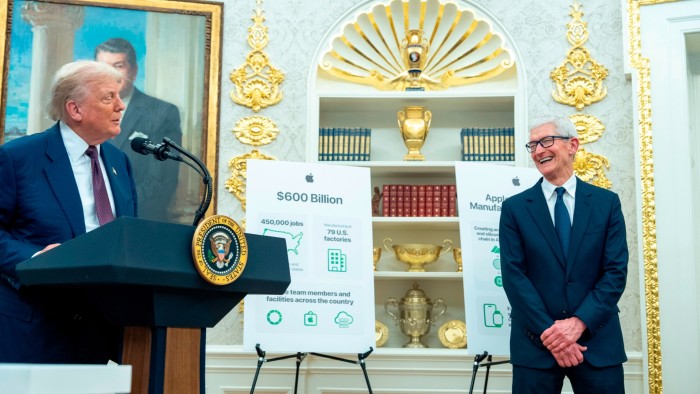
Apple chief executive Tim Cook has struck a deal with Donald Trump to invest $600bn in the US over the next four years to foster an “end-to-end” American chip supply chain, but the precise scale of its commitment is difficult to measure.
In securing much-needed tariff relief, Cook has built on a strategy he adopted during the president’s first term: pledge to invest a large sum of money for US manufacturing without completely upending Apple’s supply chains, which are heavily geared towards Asia.
Analysts have celebrated the breakthrough, while questioning how such eye-popping figures are calculated — and whether a real transformation is under way.
What exactly has been promised?
Cook on Wednesday pledged an additional $100bn, on top of a $500bn four-year spending plan announced in February. Apple has long outsourced manufacturing to suppliers, and as part of the plan, it will lean heavily on existing partners, including chipmakers TSMC, Broadcom and Texas Instruments.
Apple’s commitment involves a mix of local procurement, spending on data centres and other research-related expenditure, as well as direct employment and Apple TV+ productions across 20 states. The company said the sum did not count share buybacks or acquisitions in the total.
It includes a $2.5bn investment in glassmaker Corning, which it says will supply the glass for all iPhones and Apple Watches, and inked a multiyear deal with laser supplier Coherent — two long-standing component providers.
There is a strong emphasis on silicon in the new $100bn investment, which Cook said would contribute to the production of 19bn chips in 24 factories in 12 states this year, although he did not specify the exact amount dedicated to chip production.
He underlined that “final assembly” of the iPhone “will be elsewhere for a while”, with Trump conceding that the idea of iPhone product lines in America is not an immediate prospect.
Didn’t Apple promise something like this in Trump’s first term?
Yes, in January 2018 Apple pledged $350bn for US manufacturing over five years, which it said included direct investment as well as spending on suppliers. It avoided tariffs on its products during Trump’s first term.
In November 2019 Trump and Cook toured a Texas factory of Apple supplier Flex, building the Mac Pro. At the time, Trump said it was the beginning of a “very powerful and important plant” and celebrated a “very special day”. While he appeared to think he was opening the facility, it had opened in 2013.
Who are Apple’s partners to deliver on its pledge?
One of the biggest changes is that Apple’s chip suppliers will source silicon wafers from a GlobalWafers facility in Texas that opened last May with a $406mn grant from the Biden administration’s Chips Act. Wafers are the fundamental building blocks on which circuits are imprinted and then sliced up into individual chips.
As part of a “new partnership”, Apple said GlobalWafers’ 300mm wafers, which use US-sourced silicon, would be used by TSMC and Texas Instruments to produce chips for iPhones.
Apple also said the largest US-based semiconductor equipment provider, Applied Materials, would “boost the production” at its site in Austin, Texas. Applied is also making a new $200mn investment to build a component production facility in Arizona.
And Apple said it was working with Samsung’s semiconductor facility in Austin “to launch an innovative new technology for making chips, which has never been used before anywhere in the world”. Broadcom and GlobalFoundries will work on making 5G chip components.
People familiar with the deal said the South Korean chipmaker would be supplying Apple with image sensors for the iPhone 18, expected to be released next year, likely replacing a part that Sony previously produced in Japan.
How much of this is new investment?
Much of what was in Apple’s release on Wednesday had already been unveiled and relies on previously announced investments from foreign chip suppliers, such as TSMC.
The Taiwanese chipmaking giant, which holds a virtual monopoly over cutting-edge semiconductor production, was already producing “tens of millions of chips” for Apple from its new facility in Arizona, Apple said.
TSMC announced its plans to build its first advanced chipmaking facilities in the US in 2020, at the tail-end of Trump’s first term, to help supply American chipmakers, including Apple, Nvidia, AMD, Broadcom and Qualcomm. Production began in Phoenix late last year, with Apple as its “first and largest customer”.
These facilities, which TSMC said in March formed part of a $165bn investment in the US, were essential to Apple’s ability to court Trump with such expansive plans for domestic production of its products.
Samsung and South Korean rival SK Hynix are also investing billions of dollars in advanced manufacturing facilities in the US, helping them to avoid Trump’s threatened 100 per cent tariffs on semiconductors.
What do analysts say?
Jefferies analysts were sceptical of Apple’s $600bn claim, saying it was “hard for us to understand how Apple could invest” such a sum given its existing cost structure. They speculated on whether it could also include, for example, spending on acquisitions.
While disclosing some specific sums such as the $2.5bn commitment to Corning in Kentucky, Apple has not provided a breakdown of its $600bn investment plan.
Gaurav Gupta, semiconductor analyst at tech consultancy Gartner, said it was difficult to take Apple’s announcement “completely literally”.
“‘End-to-end’ is a very vague term,” he said. “The complete [semiconductor] supply chain will not move here — that’s not possible in the next four years.”
Analysts at HSBC said Apple’s plan allowed it to win over Trump without having to radically reshape its supply chain. The news “supports a scenario where the status quo prevails, with no additional damage” to Apple’s bottom line, HSBC wrote in a note to clients.
Recommended

Bank of America analyst Wamsi Mohan said he saw the potential for Apple to profit from the move.
“We believe there is the potential for Apple gaining smartphone market share in the US if competitors are exposed to tariffs while iPhones were to remain exempt.” South Korea’s Samsung is Apple’s main smartphone competitor in the US.
Gene Munster at Deepwater Asset Management wrote that “Apple will not be assembling products in the US. This is a win for [Apple] investors, given it means margins should remain stable over the next few years.”
Additional reporting by Christian Davies and Song Jung-a in Seoul