
The Trump administration is out with its initial bid for the prospects of a 2027 federal pay raise — which, unless Congress intervenes, likely means most civilian federal employees will not see a salary increase next year.
The fiscal 2027 budget request, which the White House released Friday morning, makes no mention of a federal pay raise for civilian employees next year. A spokesperson from the Office of Management and Budget confirmed there is no civilian pay raise included in the new budget request.
In most years, the president’s budget request sets the opening proposal for the following year’s pay raise, typically for both civilian federal employees and military members.
The Trump administration is requesting a 5-7% pay raise for military members in 2027, based on rank.
]]>
“This enduring investment, far higher than the standard annual military pay raise, builds on the president’s recruiting and retention success and gives our men and women in uniform the resources they deserve,” the White House wrote.
The budget request highlights the administration’s priorities, but actual appropriations are determined by Congress. In some past years, lawmakers have intervened to put forward a different pay raise amount than the president’s request for federal employees.
Most civilian federal employees received a 1% pay raise for 2026 — the smallest pay increase federal employees have received since 2021. Federal law enforcement personnel saw a larger 3.8% raise this year, in line with the military’s pay raise for 2026.
Democrats have called for a substantially larger federal pay raise in 2027. The FAIR Act, led by Rep. James Walkinshaw (D-Va.), would provide a 4.1% pay increase for civilian federal employees next year.
“For 15 months, the Trump administration has attacked federal employees through reckless DOGE policies, used them as political leverage through two shutdowns and offered a meager 1% raise in the current fiscal year,” Walkinshaw said Friday. “This budget continues that pattern with an insulting pay freeze, chainsaw slashes to key federal agencies and no meaningful investment to retain the workforce that continues to serve the American people despite the abuse from the administration and Republican Congress.”
Last year’s budget request from the White House also did not include mention of a federal pay raise. It wasn’t until August that President Donald Trump issued an alternative pay plan, proposing a 1% increase for most civilian employees and a 3.8% raise for civilian law enforcement personnel. In most years, presidents issue alternative pay plans for a federal raise, avoiding what would be a much larger increase by default under the 1990 Federal Employees Pay Comparability Act (FEPCA).
The disparity between the proposed civilian and military pay raises appears to align with the Trump administration’s budget priorities more broadly for the coming fiscal year.
]]>
The White House is requesting $1.5 trillion in defense spending for 2027, which is 42% — or $445 billion — over 2026 defense spending levels. It’s the largest defense budget request in decades.
In contrast, the administration is seeking a cut of about $73 billion in non-defense spending — a 10% decrease from current enacted spending levels for civilian agencies. The budget proposal seeks to move some civilian agency responsibilities to state and local governments.
“Savings are achieved by reducing or eliminating woke, weaponized and wasteful programs, and by returning state and local responsibilities to their respective governments,” the White House wrote.
The new budget request highlighted the Trump administration’s push to downsize the federal workforce over the last year.
“The budget … supports President Trump’s goal of building a smaller, more efficient federal government by eliminating jobs dedicated to non-essential and non-statutory functions, removing poor performers and limiting hiring to essential jobs,” the White House wrote in an analytical perspectives addendum to Friday’s budget proposal. “Significant progress has already been made in this effort, with approximately 300,000 federal employees exiting government service in 2025, the largest reduction of the federal workforce in American history.”
It’s not entirely clear how much further the administration plans to adjust the overall size of the federal workforce, but the budget request’s estimates of agency headcounts for 2026 and 2027 include staffing increases at least at some agencies, including the departments of Justice and Veterans Affairs. Most agencies, however, are expected to remain below 2024 staffing levels, according to the budget proposal.
The White House also pointed to the administration’s President’s Management Agenda, which includes goals of promoting “merit-based” hiring, removing poor performers and eliminating “non-essential, non-statutory” federal jobs. The budget request included data on staffing levels across executive branch agencies, reporting declines across nearly all agencies between 2024 and 2025.
The budget request also included supplemental information on federal workforce age demographics — comparing the share of federal employees under age 30, versus those 60 and older. The portion of the federal workforce under age 30 declined from about 8.6% in 2023 to about 7.3% in 2025, the workforce data shows.
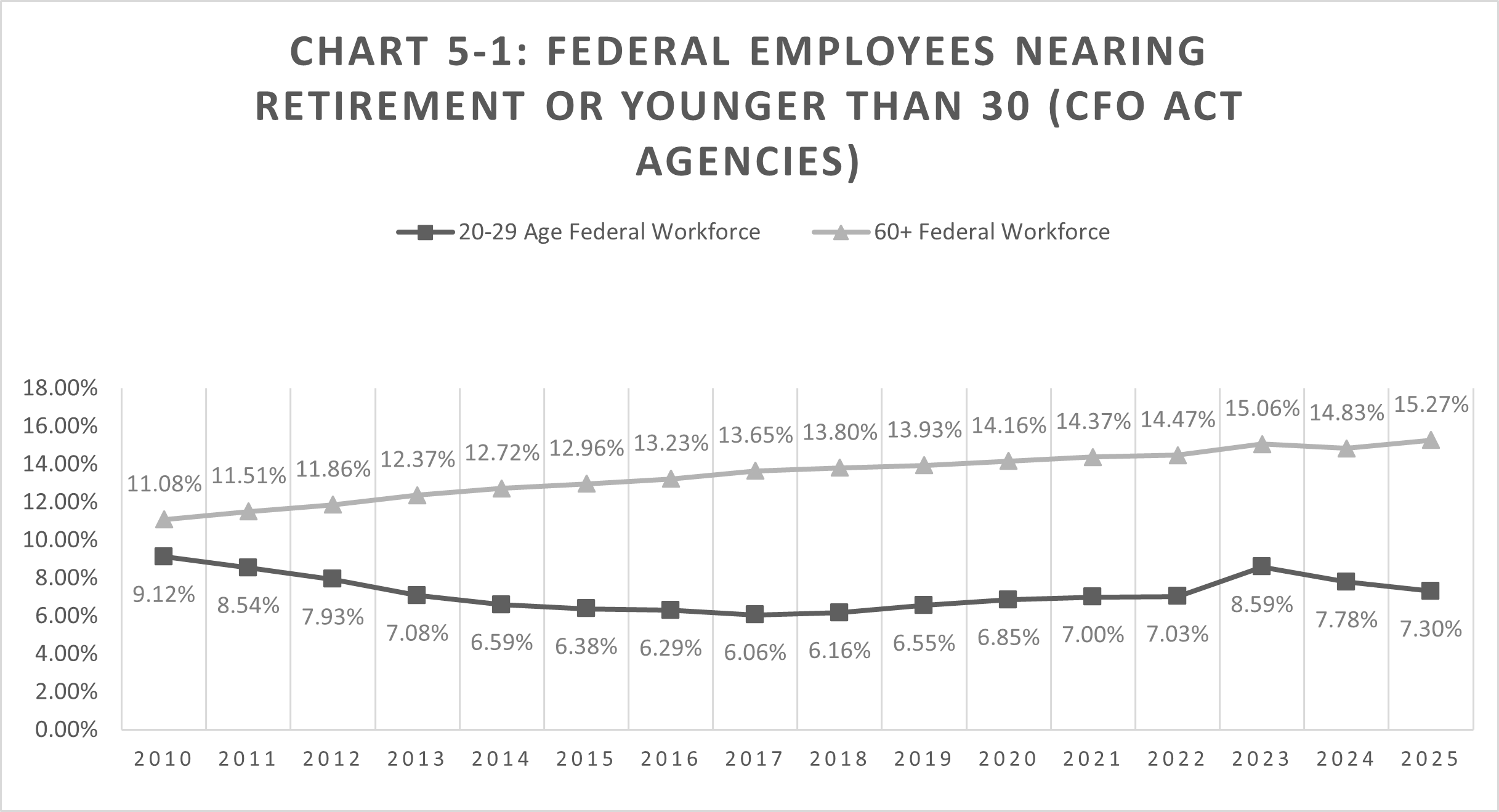 Source: Office of Management and Budget.
Trump administration officials have expressed interest in boosting early-career employment across government. Office of Personnel Management Director Scott Kupor called the under-30 age demographic a priority for the federal workforce. Some of OPM’s current hiring initiatives, such as the U.S. Tech Force, aim to encourage younger employees to join public service, at least temporarily.
]]>
The president’s budget arrives as the House and Senate remain tangled over current-year spending and stalemated over Department of Homeland Security funding. Trump announced Thursday he would sign an executive order to pay all DHS employees who have gone without paychecks during the record-long partial government shutdown that began Feb. 14.
Updated Friday afternoon with additional details. The Associated Press contributed reporting.
Copyright
© 2026 Federal News Network. All rights reserved. This website is not intended for users located within the European Economic Area.