
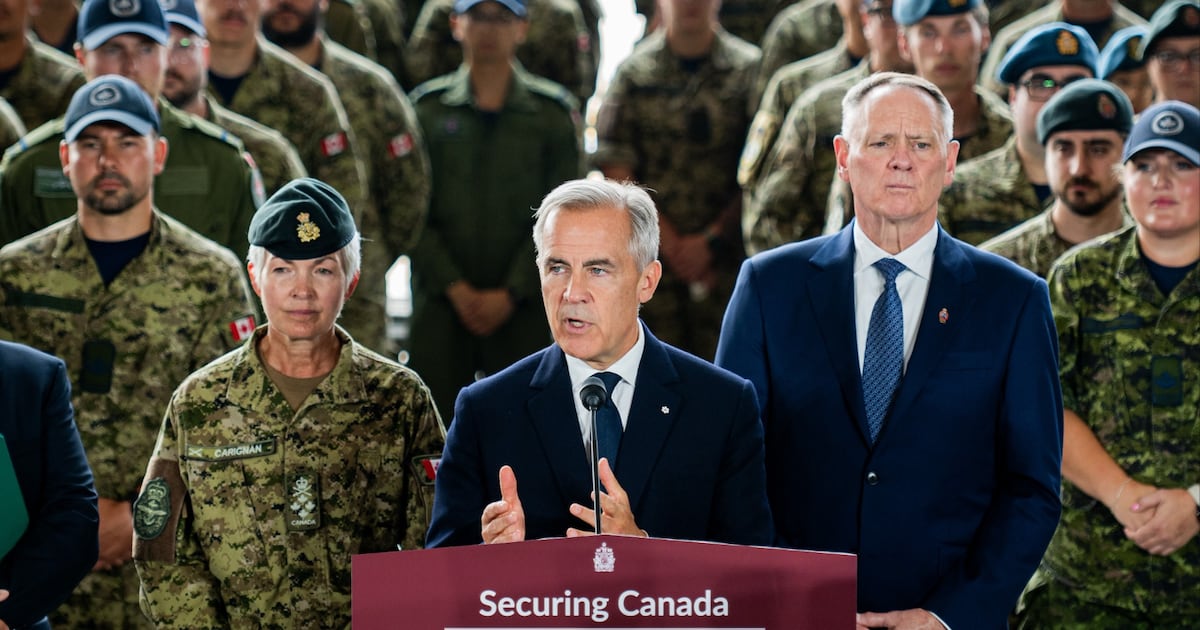
The federal government should consider a one-to-two-point increase in the GST and slower growth in non-defence spending to finance a massive jump Canada’s military budget, according to a new report from the C.D. Howe Institute.
“Some combination of tax increases, spending cuts, or taking on more debt is required,” wrote authors Colin Busby and Nicholas Dahir.
The analysis warns that meeting Canada’s commitment to raise defence spending to five per cent of GDP by 2035 will require “hard fiscal choices,” including potential GST hikes and tighter limits on non-defence programs.
In the report released Thursday, the institute projects annual defence spending will triple, from just over $60 billion in 2025–26 to almost $150 billion by 2034–35. At that rate, defence expenditures would be on par with the major transfers Ottawa sends to provinces each year.
The analysis suggests a two per cent increase in the GST would bring in $25 billion in 2025-26 to the federal government.
The authors say that without policy changes, the surge in military spending would push federal deficits higher.
 Canadian military A Canadian soldier takes part in an announcement in Petawawa, Ont., on Thursday, Oct. 19, 2023. THE CANADIAN PRESS/Sean Kilpatrick
Last week, NATO announced Canada hit the defence spending target of two per cent of GDP. In 2024 under former prime minister Justin Trudeau, Canada was spending 1.5 per cent of GDP on defence, making it one of 11 countries that failed to meet the NATO target.
The report points to weak productivity, sluggish growth, an aging population and high federal debt — all leaving the government with little flexibility to increase defence spending without raising taxes, slowing spending growth or borrowing more.
The authors argue the most realistic approach combines what they describe as moderate tax hikes, potentially including an increase to the GST, with discipline on non-defence spending. They say that approach could help Ottawa hit its NATO commitment while limiting the debt burden left to future generations.
“A mixed approach that combines a modest GST increase with slower growth in non-defence spending offers a practical path to meeting NATO commitments while maintaining fiscal sustainability,” the authors wrote.
While there is broad political agreement that Canada must strengthen its military in an increasingly unstable world, the institute warns that achieving the target will require difficult choices other governments have deferred for decades.