
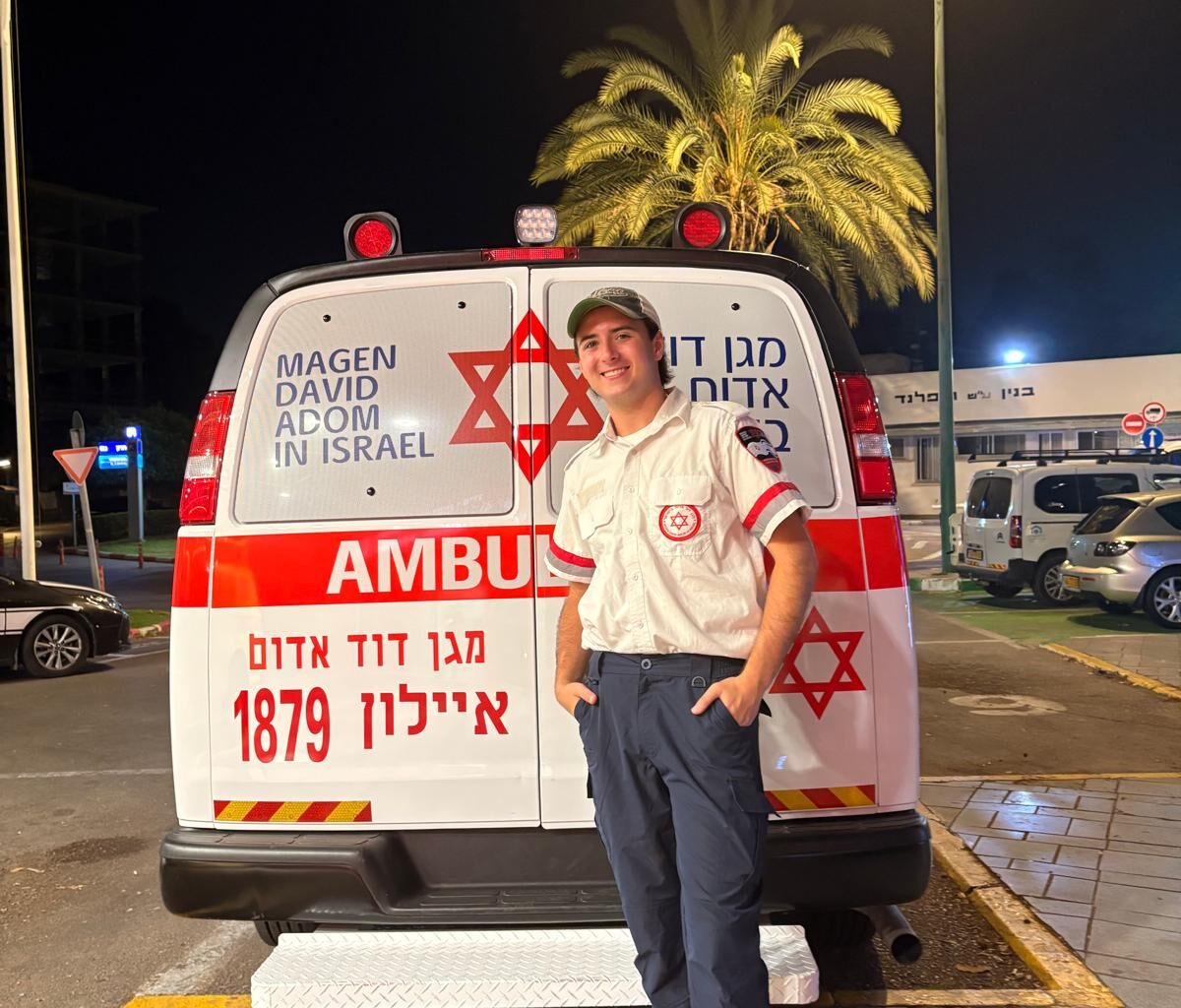
The last two weeks of the U.S. and Israel’s operation against the Iranian regime have brought up many emotions for me. Israel is my second home. I have spent the last four summers there, officially more time than I have spent in my hometown, New York City, since graduating high school. And yes, that means I was living in Israel last June during the 12-day war.
After my sophomore spring at Wake Forest, I flew to Israel, planning to volunteer as a first responder on an ambulance, play ice hockey and spend free time with friends on the beaches of Tel Aviv. I landed at Ben Gurion Airport on June 2 with a suitcase and my hockey gear, excited for the summer ahead.
I was set to play in the Israel Elite Hockey League for the third year in a row and train with Magen David Adom, Israel’s national emergency service, as an assistant Emergency Medical Technician. The first week was exactly what I had imagined. I was with my summer family once again. We spent our days by the sea, evenings at the rink and nights out with friends who represent the diversity of Israeli society.
Then, in an instant, everything changed.
Story continues below advertisement
One night, while we were out at a party, every phone in the club (hundreds of them) went off at once with the same alert.
“Due to the significant threat, follow Home Front Command instructions,” the alert read. “Get close to a sheltered area.”
People ran, calmly but quickly. I did not panic. It was not my first siren. My friends and I made it back to our apartment, which had a “mamad,” a reinforced safe room. We stayed up all night waiting for updates.
Israel had launched a preemptive strike against the Iranian regime. We did not sleep until morning.
The next day was quiet but tense. Everyone was waiting. We stocked up on food and supplies, unsure how long we might be confined to the shelter. That night, though, during Shabbat dinner, another alert came through telling us to stay close to a protected space until further notice. It was on.
Minutes later, the sirens began. We ran to a nearby “miklat,” an underground bomb shelter, joining over 100 people packed into a tight space two floors below ground. Then came the first wave of missiles. The sound is hard to describe. It was like fireworks, but heavier and closer.
And yet, even there, something remarkable happened. It was Shabbat, the Jewish day of rest, and people refused to let it be taken from them. In the shelter, surrounded by strangers, we sang and finished prayers together.
For hours, we moved in and out of shelters, trying to safely return to our apartment. Above us, explosions echoed as interceptions lit up the sky. Around us, people held each other close, waiting for the next boom.
What no one tells you about war is that there is no sleep. Day and night, you run back and forth to shelter. By the time you lie down, another alert sends you running again. The exhaustion builds quickly, both physical and mental.
Everyone copes differently. Some people tried to sleep on the floor of the safe room. Others stayed on their phones, tracking missile alerts. Some called home. I knew my family would be seeing the alerts, so I texted them to say I was OK. Then I tried to conserve my energy.
Rinse and repeat. Every day. Every night.
By the fourth day, I was too tired to feel much until one moment changed that. During our third siren of the night, we were back in the shelter waiting. After a few familiar interceptions, there was a deafening crash. The building shook violently. Every vibration ran through us. Everyone thought we were hit.
We waited for what felt like hours before getting the “all clear.” When we stepped outside, our apartment was still standing, with only paint chips scattered across the floor. But around the corner, a missile had struck and decimated a building. And then something unexpected happened.
Instead of chaos, there was action. Once emergency services accounted for everyone, the neighborhood came together. People filled the streets, clearing rubble and helping one another. It was all hands on deck–a moment of unity in the middle of destruction.
A few days later, I experienced something shocking. I was on a bus heading south when the sirens sounded again. The driver pulled over immediately. Everyone got out and lay face down on the side of the road with their arms over their heads. There was no shelter.
From the ground, we could see interceptions lighting up the sky and hear explosions in the distance. We were completely exposed, lying on the asphalt under the unrelenting desert sun.
For 12 days and nights, this was life. Missiles were launched into civilian areas, targeting people indiscriminately–Jews, Arabs, Druze, Bedouins, Muslims and Christians alike. Everyone was a target.
For many people at Wake Forest, war exists in lectures, books and debates. For me, it was the sound of explosions overhead, the scramble to shelters at all hours and the quiet relief when a notification finally said it was safe to leave. It was fear, exhaustion and uncertainty, but also resilience.
Living through war changes you. I can no longer hear fireworks the same way. Not long after I returned home, an unexpected fireworks display sent me instinctively to the ground with my hands over my head. Maybe that feeling will fade. Maybe it will not.
But war teaches you something else, too. It shows you how fragile normal life really is and how extraordinary people can be when everything around them is uncertain. What I remember most is not the sirens or the explosions, but the resilience, the spirit and the heart of the people who kept singing in shelters and rebuilding in the dark. That is the Israel I keep going back to.