
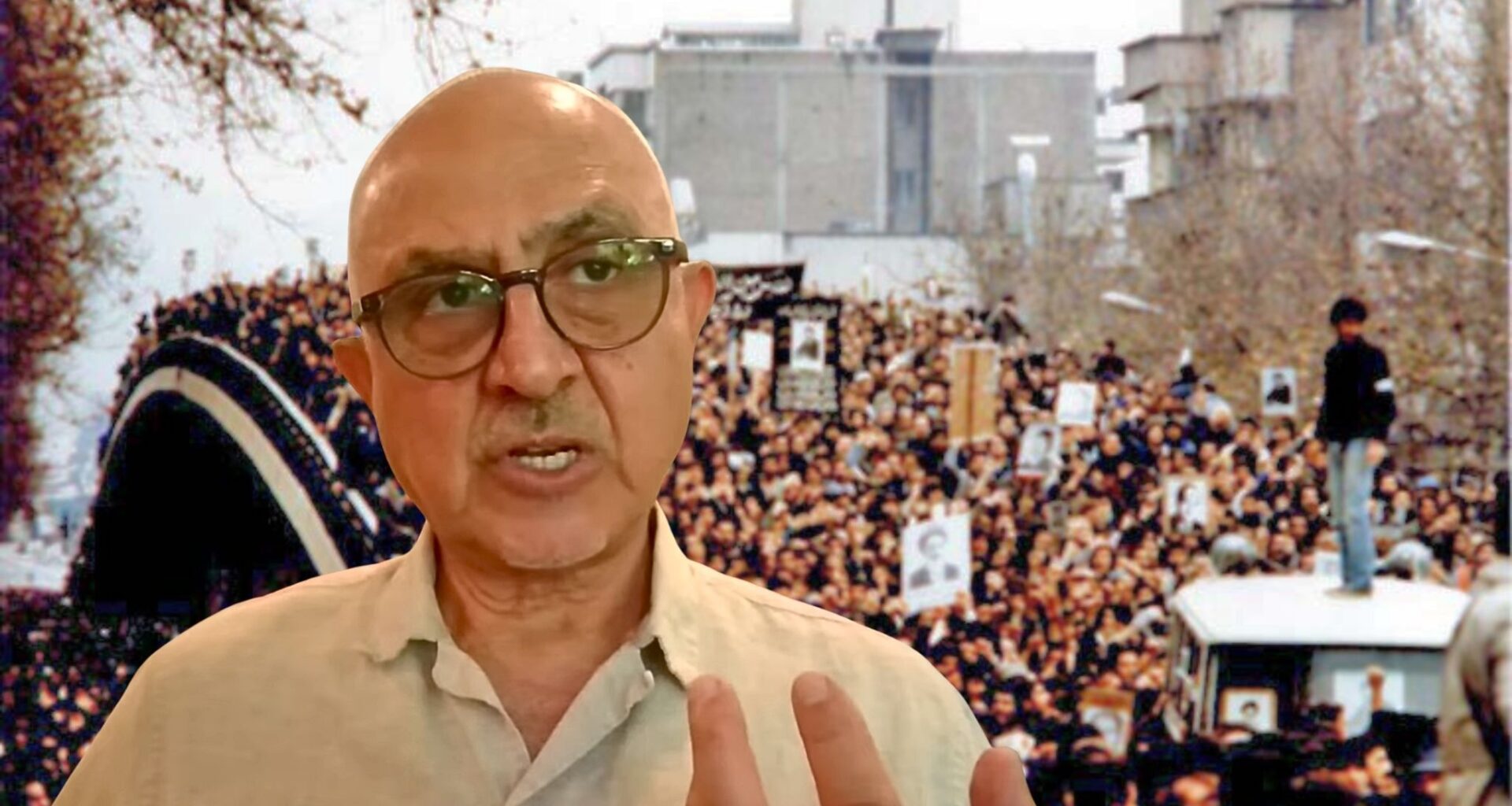
Afshin Matin-Asgari has spent decades studying the long, fraught history between Iran and the United States—and as a former participant in the 1979 revolution, who opposed both the Shah and the Islamic Republic that replaced him, his perspective is shaped by direct experience as much as scholarship.
The historian and author of Axis of Empire: A History of Iran–US Relations joined Current Affairs to discuss what history can tell us about the present crisis: from the lasting effects of the 1953 Iranian coup d’état to the myths surrounding Iranian politics and nuclear ambitions.
As calls for regime change grow louder in Washington D.C. and Tel Aviv, Matin-Asgari insists that the future of Iran must be determined not by bombs or sanctions, but by the Iranian people themselves.
Nathan J. Robinson
I wanted to start by asking you to give people a little bit of context as to your background. You are Iranian yourself, and you, in fact, participated in the early stages of the 1978-79 revolution against the Shah. As I understand it, you are a leftist, anti-imperialist Iranian who is also an opponent of the Islamic regime there. And I assume that gives you a number of complex and difficult opinions and reactions to things.
We saw in the early phases of this war a number of people who were opponents of the regime pleased at blows being struck against it. And then quickly, I think, some of that celebration turned to anger as people realized that the United States doesn’t care very much whether it hits civilian targets. Let me just ask you, personally, given your background, how are you feeling at the moment?
Afshin Matin-Asgari
Well, a lot of mixed and conflicted emotions. These high officials of the regime, from the Supreme Leader to more and more officials, have been assassinated mainly by the Israelis. But these were not popular figures. They’re not my favorite people in this world.
However, I think they should have been answerable, ideally, to the people of Iran, not to have criminal outsiders coming into the country and taking them out. So I don’t feel joy or happiness because the context and the actions of attacking these officials are highly problematic. I would say criminal. It’s against international law. It’s violating the sovereignty of a country, and even if these people were hated, maybe by a lot of people in Iran, including myself, this is not the way to deal with them.
Robinson
And I wonder if I could get your opinion concerning what the current US-Israeli actions mean for the future of Iranian dissidents. Obviously the United States and Israel have said, “We want to see uprisings. We want to see the government overthrown.” That seems to be based on a faulty theory that when you bomb a country, you empower dissidents, when generally you empower the state.
Reading your history here, it certainly wouldn’t be the first time that aggression against Iran, supported by the United States, had shored up the Islamic government. I’m referring there, of course, to the attack on Iran by Iraq in the 1980s, supported by the United States, which, you point out in this book, helped consolidate state power, as I understand it. So maybe you could talk about what these attacks actually mean for the future of those who want to see a different government in Iran.
Matin-Asgari
The future is extremely difficult to—I’m not in the game of predicting—even to think about because the big question is, would the regime even survive or not? If it survives, then it’s anybody’s guess, but the most likely scenario is, as you say, and looking at the history of the Islamic Republic, that the regime is likely to become more repressive.
It has always justified domestic repression on the grounds that domestic opponents are at the service of foreign enemies. And this time around, in part, there is a very strong sentiment, mostly outside of Iran in the Iranian diaspora but also inside of Iran, that these attacks on Iran by Israel and the US are a good thing. They either weaken or they bring down the regime, and once and for all, we will be rid of an unpopular regime. But as you said, and all the evidence we have shows, bombing a country massively does not, first of all, necessarily bring the regime down. And second, if the outcome is not positive, the outcome is usually a more repressive regime if it survives.
Robinson
Perhaps we could go back into some of the history here. You have published this extremely timely book, Axis of Empire: History of Iran-US Relations. There are a number of points that we could start at, but because of your personal experience, I was wondering if you could tell us a little bit about 1978, about that moment that I’m sure you and many others on the left felt a great deal of promise as the US-backed dictatorship toppled and then eventually fell, and then you saw that promise sort of extinguished. But perhaps you could tell me in your own words what you see as the significance of that moment.
Matin-Asgari
Yes, as I briefly mentioned in the book’s introduction, I was politicized in the 1970s environment milieu of the American New Left. I was part of the largest student opposition movement outside a country, the Iranian student opposition to the Shah. I was a part of it a few years before the revolution.
Then, in 1978, a few years before the Shah fell, I left my classes and everything and went back to Iran to be part of the revolution. And I was there running around in the streets, joining the crowds, but I was part of a very small minority, also within the left. But it was not just the leftists who, from the beginning, were not supporters of an Islamic Republic, which came in as a totally undefined concept. And increasingly, in the first few months of the revolution, it became clear that this would be a very repressive regime, a constitutional dictatorship, because the powers of the Supreme Leader in the new constitution were far and above any power that the Shah or the king had. And so people don’t really know the story of that first year.
The Iranian left was divided between a faction that supported the Islamic Republic and another faction, to which I belong, that was opposed to it from the very beginning. But it was difficult because Ayatollah Khomeini, the leader of the revolution, had tremendous popular support. So in effect, if you were part of the left where I was, you had to stand against the overwhelming majority of the population, who were also supportive of the new regime. So it was not an easy place to be.
Robinson
Do you feel like the leftists who were on the other side of that question eventually came to be disillusioned or came to see the wisdom of the position that had been held by your faction as the state consolidated power?
Matin-Asgari
Well, people usually don’t like to admit those kinds of mistakes, but whether they came around to see it or not, the entire left was wiped out, including the supporters of the regime. The last kind of major leftist organization that continued supporting the regime was the pro-Soviet Tudeh Party. But they were also wiped out utterly and brutally within the first two or three years of the revolution.
Robinson
Let’s talk about the United States. Your book is a history of US-Iranian relations. You spent a lot of time on what happened in 1953, that is to say, the US-backed coup that brought in the dictatorship.
What lessons or what significance do you think what happened in 1953 has for our understanding of Iran over the next half century and today?
Matin-Asgari
The year 1953 was enormously important. It was the first joint CIA and British MI6 clandestine operation of its kind. It was not entirely the doing of these foreign agents. They helped tip the balance using, of course, the armed forces to force out the government of Prime Minister Mohammad Mosaddegh, who was in charge of nationalizing oil and standing up to the British government over issues of compensation and the uncompromising stand of the British government and his overthrow. He had hopes that the US might be on his side, and he was disabused of that notion in August 1953.
That moment made a deep mark not only on the Iranian left forces, the Communist Party that was very strong—it was the strongest Communist Party in the Middle East at the time—but also on Iranian nationalists. And it was also a defining moment for the kind of operations that the CIA would do. This was a very successful event. With minimum effort and resources and assets, they overthrew a government and put in place, in a very significant oil-producing country, a regime friendly to the US. And the next year, the US tried something similar—not exactly the same, but more or less the same—scenario in Guatemala in Latin America.
And the number of coups and regime changes of that sort continued. It was 1963 in Vietnam, 1965 in Indonesia, all the way to 1973 with Allende in Chile. So that event was important in Iranian history and also internationally. But as I explained in the book, I don’t think there’s a straight line from 1953 to 1979, when the Shah’s regime was overthrown. I don’t agree that everything was set in motion in 1953 for the Shah to collapse. I think both the Shah and successive US administrations, as I explained in this book, had many, many opportunities to change course, but they never did. The US gave its ironclad support to the Shah. There were a few times when there was hesitation, but basically, as the Shah became more megalomaniacal and as oil prices rose, he had delusions of power.
It coincided with a moment when Nixon and Kissinger basically fanned the flames of his megalomania, and they were making a good deal. The Shah was intervening in the Gulf. He put down a revolutionary movement in Oman. He intervened in Iraq. He would recycle back billions of dollars of Iran’s oil income to the US to buy the most advanced weapons. And so from that perspective, it was a good deal. But then, in the second half of the 1970s, it became clear that maybe this was not really the most sensible policy for the US to pursue. This was when Nixon fell and when the US came out of Vietnam. There was a moment of kind of reflection on whether support for these kinds of regimes is a wise foreign policy course. Carter became president, but he also supported the Shah 100%. Contrary to some hesitation he had expressed only three to four months before the Shah fell, there was confusion and disarray in the Carter administration. They realized there’s something wrong. But even then, by that time, it was too late to change the course of events.
Robinson
You point out that the United States government tended not to realize that the Shah was incompetent and unpopular or deluded itself and sort of clung to him until the very last minute. Some of the very striking accounts in your book are of the Carter administration, which had pronounced itself committed to human rights as what Carter called the “soul of our foreign policy.”
There were divisions within the Carter administration that you go into, but it ended up essentially trying to scheme ways to keep this regime from collapsing, even as it became pretty evident that it didn’t have any popular support.
Matin-Asgari
Yes, that moment in late 1978 is very important, and it has given rise to really conspiratorial readings of what happened between the Carter administration and Iran. Iranian monarchists followed a narrative that the Shah himself put out there in his last book that he published before he died, which argued that the Carter administration brought the Shah down because, supposedly, the Shah was too independent; he wanted to be like the hawk of OPEC and raise oil prices. A number of arguments that didn’t make any sense.
But the gist of it was, the Americans brought the Shah down. And they said that ultimately, when the Shah was to leave Iran, yes, it was the US Ambassador who went to the palace and said, “Your Majesty, it is now time to leave.” But part of this confusion is the confusion that existed in the Carter administration, as you mentioned. There was a faction led by Zbigniew Brzezinski, national security advisor, that wanted the US to support the Shah, using the Iranian armed forces and killing as many people as necessary to possibly keep him on the throne.
There was another faction, mostly led by the State Department under Cyrus Vance, and they thought that the Shah was finished, and if they tried force, it would only backfire. It would only radicalize the revolution with which they hoped to come to some kind of accommodation. And they did. The Carter administration eventually came to some kind of understanding with the Khomeini camp for a transition. It didn’t go exactly as they had planned, because part of the transition was for the armed forces that were still tied to the US to move as a package, intact, to the new regime. But what happened, in fact, was the military collapse in some kind of a popular uprising, so the transition didn’t go as smoothly as they had planned.
But this idea that somehow the Americans could have prevented the Shah’s fall, and they didn’t, therefore they’re responsible for his fall, is a myth that is being repeated these days. The Iranian monarchists who now clamor for the US to go and bomb Iran to freedom, in the back of their minds, think that the scenario of the revolution can be repeated, but this time reversing itself, and the Americans bringing the monarchy back.
Robinson
What do you see as the legacy or the consequences of the fact that the United States infamously supported this coup in 1953 and clung to the Pahlavi dictatorship until the very last minute? What effects did that have long-term in terms of US-Iranian relations? Does the shadow of that hang over the subsequent decades in some way?
Matin-Asgari
Yes, definitely. The shadow of that still lingers in some ways that I mentioned, but it was definitely very strongly present. As I was growing up in Iran during the first 18 years of my life, I was aware of it as a semi-politically aware young student.
And then when I was in the US, everyone was thinking that the Shah, in the parlance of those days, was a US puppet. He wasn’t a puppet in the sense that the US would call him every morning and tell him what to do, but he was highly dependent on the US. It was understood that there was a very tight relationship between the Shah’s regime and the US, and its origins go back to 1953.
Robinson
The way that many American politicians on the right are talking currently about the Islamic Republic, the phrase that is used is, “It has been at war with the United States for 47 years.” In fact, they’ve tried to suggest, “We didn’t even start a war; we’re just continuing a war that has been ongoing. They have been implacably hostile to us. They have terrorized us in various instances.” That is the narrative. Essentially, since the revolution, we have faced a hostile power that we’re finally dealing with.
Can you explain in what respects that narrative misses the reality here?
Matin-Asgari
That narrative does miss reality. However, the beginning part of it has a grain of truth in it.
Right after the Shah fell, the US had relatively cordial but cold relations with the new Islamic Republic. The ambassador was recalled, but the US Embassy was in Tehran and functioning, and there were meetings between US diplomats at the embassy and the provisional government that served under Ayatollah Khomeini—secret meetings, including meetings with the CIA, and exchanges of information. The basis of that was anti-communism. The Ayatollah’s regime was anti-communist, and the US was very sensitive. Iran was just on the border of the Soviet Union, a very kind of geostrategically important country awash with oil, and the Soviet Union was about to intervene in Afghanistan directly militarily. So there was a thinking that there may be the foundation of some kind of a mutual relationship between the two.
But all of that changed when, in November 1979, Khomeini’s followers took the US Embassy hostage and kept personnel for 444 days, and this amounts to a war. Yes, if you take the country’s entire embassy staff hostage, it’s sort of a declaration of war, and the US retaliated by again imposing draconian sanctions on Iran, which is also effectively an act of war. So in a sense, the war began. The side that started it, ironically, was the Iranian side, but in the succeeding 46 or 47 years, because of the imbalance of power between the two sides—if you look at these two countries, the imbalance of power is enormously obvious.
In these years, I would argue, and I think most experts would agree, that it was the American side, and then joined by Israel, that was more responsible for this war in not finding a resolution. It did come to, if not a resolution, a working relationship under the Obama administration during his second term, where Obama managed to strike a deal with the Iranian government, where Iran’s nuclear enrichment was placed under strict international monitoring. That was the big issue between Iran and the US by that time, by the early 21st century: that Iran had a nuclear energy program, and it might be diverting it towards at least the ability to build nuclear bombs. So that was put under control, and the Iranian side was very happy with this. The Israel lobby fought very strongly. Netanyahu came and personally went before the US Congress to oppose this deal. But that was a major defeat.
I can think of this as the only time that the Israel lobby was defeated on a major issue. And the deal held. It was just a deal that the president put in place. Congress could overturn it. The next president could overturn it. This is exactly what happened. Trump came in his first term and threw it out the window and said, “I’m going to force a better deal on Iran,” and the better deal is what we see. So Trump’s promise was a better deal, and this war that we’re seeing now is the better deal that he got.
Robinson
Although from some news reports that have come out in the last week, it seems as if—I think there was a British negotiator who said that Iran seemed to be putting an actual better deal on the table for the Trump administration. That it almost seemed like what he had said wasn’t crazy in terms of their being genuinely willing to make it some kind of deal, and then it was entirely blown up by starting the war. What’s your understanding of what happened there?
Matin-Asgari
Yes, these new revelations came out in the Guardian in the UK; they seem to make perfect sense because there is a history of negotiations between the Trump administration and the Iranian government. It happened last summer as well.
They were negotiating, and in the middle of it, Israel invaded Iran, and then the US joined in, but to the extent of a massive bombing campaign. And this round of negotiations, in a sense, was a continuation of that. Now we have to remember that some kind of a deal with the US is something that—obviously, the people of Iran have suffered under these onerous sanctions for almost half a century. So to the ordinary Iranians, an end to these sanctions would be something they would desire.
The Islamic government also has all kinds of problems. This economy is out of control with inflation; there are all kinds of issues of shortages, electricity, water, and the environment, and a very restive public that periodically comes out in protest. So to wrap things up with the US was in everybody’s interest. And for a moment it seemed that it might have been possible. According to the report you mentioned, the Iranian side has said, “Okay, we’re going to stop enrichment,” which they effectively had stopped. From the last previous bombing, enrichment seems to have been effectively stopped. They had about 400 or 450 kilograms of highly enriched uranium, and it seems they had to let that go for any deal to be possible. And they had said they would dilute that under UN supervision inside of Iran, and that would have ensured that there’s no nuclear threat.
But we have to remember that there’s a third party to this, and that is Israel. To Israel, that would not have been acceptable. And I think that Trump finally gave in and accepted the Israeli agenda. Every commentary you see, from the ordinary person on the street to officials in Trump’s own administration, is “This is Israel’s war, and Trump joined in.”
Robinson
And so the United States then could have come to an accommodation with the Iranian government. And one of the things that’s striking about that is there’s often a portrayal on the right of the Iranian government as fanatical. They’re a theocratic government, but the idea is they’re sort of bent on the destruction of the United States and Israel.
But one of the things that certainly comes across in your history and in these kinds of reports is that the Islamic government is more flexible and pragmatic than these kinds of cartoonish depictions would suggest.
Matin-Asgari
Of course. They may be brutal, and they are brutal and repressive towards domestic dissent and the people of Iran, but they’re not crazy. This idea that their ultimate goal is to build a bomb and, as soon as they have it, throw it at Israel is crazy, because that would mean they’re suicidal. Israel has an arsenal of nuclear weapons, and if Iran attacks them, they would totally obliterate Iran. So no, they’re not crazy. And if you look at how they have conducted themselves during this war, with the highest echelons of their military and political leadership being essentially wiped out, you can see that there is some kind of method to their apparent madness. They’re not mad people. They’re quite effectively defending themselves. So no, they’re not crazy.
It’s just that the idea that the Islamic Republic must be removed was a project that especially Prime Minister Netanyahu, from his first term in the 1990s, constantly harped on this notion that Iran is building a nuclear bomb and is very close to it. He’s been saying for 30 years that Iran is one year away from building a bomb. That was 30 years ago. And it’s clear that what Israel seeks is a condition where the Iranian regime, which is the main contender to Israel in the region, has to be removed as a nuisance.
And I think all the rest of the talk, such as bringing the son of the Shah back, all of that is window dressing. I don’t think that even the Israelis take that option seriously. Because look at the war they’re waging. It’s not just Iran. Israel is fighting on two fronts and has already invaded Lebanon. So what they want is a free rein where the IDF can fly all over the region, bomb any place it wants, and kill anyone it wants, and Trump has acceded to that. Biden, for all his faults and for his assent to the genocide in Gaza, did not agree to give Netanyahu free rein and did not agree to go to war alongside Netanyahu. Trump did.
Robinson
What is your general assessment of the trajectory of the Iranian government’s relationship with nuclear weapons? We had the Iranian American historian, John Ghazvinian, on a couple of years ago. He had, I think, just written an op-ed in the New York Times, and his assessment was something like the government wanted to be a nuclear threshold state but was not pursuing nuclear weapons. He thought that might change. And I wonder what your take is when you hear that argument that they’ve been a year away from a bomb for 30 years.
Matin-Asgari
Yes, I think Ghazvinian’s assessment is correct. Because they have enriched uranium close to—not exactly, but approaching—that threshold. When the Obama deal was thrown out for a while, the Islamic Republic still stayed within that agreement. They did not enrich uranium beyond a certain minimum level, but after a while, they just said, apparently, “What the heck? We’re going to go back to enrichment to approach”—that term is exactly correct—”the threshold of nuclear capability, so that if we wanted to, we could go ahead and build a bomb quickly.”
I, personally, think that was a foolish strategy, because you’re kind of giving credence to your opponents. Because that’s the Israeli argument: look, they want to build a bomb. So a standard policy would have been, if you don’t want to build a nuclear bomb, then don’t enrich towards that threshold. But they did. They went ahead and did that. There’s an argument that the Islamic Republic was doing that to get leverage, to have something to bargain over. But as we see, that strategy failed because it didn’t work. It did not work as a deterrent.
So yes, obviously they wanted to have that capacity. And now there is speculation that, what if Iran emerges from this war? The Islamic Republic is badly bruised and hurt. What would they do with their nuclear energy program now? Would this prove to them that what you need to do is indeed to go and build a bomb? Because that’s the ultimate defense. Again, these are not arguments I agree with. I think these are highly dangerous and, in fact, foolhardy. But that’s another option. The argument out there is, well, look at North Korea. They built their nuclear bomb, and nobody can touch them. I don’t agree with that. I think there are other reasons. Iran is not North Korea. But the whole nuclear issue has been pushed to the forefront of that.
We also have to remember that even for producing energy, that program has been a failure, because Iran has spent billions of dollars—nobody knows exactly how much—and it’s a country that faces shortages of electricity. So the nuclear program, after 30 years, has not even been able to be sufficient for Iran’s energy needs. And it has led to and is at the core of this confrontation. There are arguments that these are all excuses, and no matter what the Islamic Republic had done, the outcome would have been the same. I don’t agree with that. I hold the Islamic Republic partly responsible for things leading to this moment. I think the US and Israel obviously have much more responsibility in this. I think the Islamic Republic is also responsible to a lesser degree, but its policies have been wrong.
Robinson
Although I wonder how you would assess the seeming efforts they made to avoid war with the United States. It did seem that for a while there, when there were retaliatory strikes against the United States and Israel, they were very carefully calculated to be proportional or to not take lives, and there were sort of advanced warnings. That seemed to suggest that the Iranian government was very reluctant to go to war with the United States. I don’t know if you think they miscalculated their policy towards the United States or what.
Matin-Asgari
No, you’re right. Up until this war, for example, during the last 12-day war of last summer, their response to the US and even to Israel was calibrated. They responded in a measure that would not escalate if the other side would not escalate. They did not escalate because they know escalation is not to their advantage. This time it is clear to them that the other side, the US and Israel, are here to finish the job and bring the regime down, which is what they’ve said they want to do.
So if it’s a question of survival, then they have no gain in restraint. The best thing they can do is to throw everything they have to make the cost of this war as high as possible to the other side. So perhaps at some point the US would relent and say, “Okay, we’ve done enough damage to them, and we will leave them alone.” In the process of this resistance, I think they have focused on something that must have been in their thinking, because they had mentioned closing the Strait of Hormuz.
But effectively, as things have evolved in the past couple of weeks, it seems that their strongest hand to play is to focus on the Strait and disrupt the flow of oil and also hit at their neighbors. They’re hitting at their neighbors, not indiscriminately. They’re hitting at places that they see as US military bases and also at kind of economic targets. They want to tell US allies in the Persian Gulf that if you let the US use your territory to attack us, then we’re going to make you suffer by attacking, for example, your energy infrastructure. They’re kind of trying to wage an economic war and raise the cost, and they’re very successful at that so far.
Robinson
But it seems that, from what you’re saying, the US and Israel have essentially put them in a position where they have no choice strategically but to do that.
Matin-Asgari
They have no choice; either they have to go down or sit back and accept defeat and say, “Come and dictate terms to us,” or they have to throw in everything they’ve got. Israel will not relent as long as the US is in. Israel would stay to the very end of this. I think this is important because Israel and the US seem to have two different kinds of endgames in mind. The end game for Israel seems to be, and Netanyahu and others have said this: they want Iran to be a failed state. They want the Islamic Republic to fall, and they don’t care what happens—chaos, disruption. Iran’s disintegration is even better for them, because their strongest adversary in the region would be removed. If Iran were to plunge into chaos and disintegration, all the better.
The difficulty is the strategy of the US Trump administration is not clear. Trump never could make it clear what his war aims were. Sometimes, it’s “the liberation of Iran, and we want to weaken the regime.” Other times it says, “We want to overthrow the regime.” So he went into this against the advice of his own intelligence people. We heard what Joe Kent said recently. I just saw that Tulsi Gabbard also testified before Congress—some kind of critical testimony. And so Trump seems to have gone into this without a clear understanding of what he was facing, and as the cost of this war is piling up in every sense. And clearly there is an anti-war sentiment that’s growing in the US, among the public, and also in Congress and in the media. And at some point, Trump has to think about, is this worth continuing, or should he somehow find an exit strategy and leave? So far, he still seems to be just mired in his confusions and bluster, but I think that his position is kind of weakening by the day.
Robinson
You mentioned Israel’s desires in this war; there was a remarkable Washington Post article this week saying that Israel wants to trigger an uprising in Iran, and Israeli intelligence also believes that an uprising would trigger a disastrous mass slaughter. But they hold those two beliefs at the same time. They want it, and also they think it would result in a bloodbath.
Matin-Asgari
Yes, I think Israeli strategy, and I’m not just saying this is like a nefarious thing—this is clearly what they have been pursuing—they don’t really care what the outcome is, because from the collapse of the regime to its weakening to people going into the streets, rising up, and being massacred, all of those serve their basic interests to weaken and perhaps overthrow the state, even though Iranian society in that process is going to suffer tremendously, but they don’t care. I don’t even think that they take the monarchist opposition seriously. They know that the Shah’s son, the crown prince, really doesn’t have any institutional, organized support inside the country. Yes, there is some kind of a diffuse monarchy sentiment, and not necessarily a majority opinion, but that sentiment exists in Iran.
Outside of Iran, it’s difficult to gauge, but let’s say even half of the politicized Iranian diaspora supports the monarchy. But that doesn’t mean they can come to power. The only way they might come to power in Iran is if the US occupies the country and puts this guy on a throne, and that would never happen. So Israelis are far too smart to bank on this figure, but he’s useful as a wedge. He is useful as a tool, and they’re using him. So whatever happens, whatever damage they can bring about, it doesn’t matter.
Robinson
Well, that brings me to my final question for you here, Professor. For those on the left who, like yourself, are critics of the Islamic Republic government but who also are critics of US and Israeli imperialism, what do you think is the correct stance and attitude in this moment? Is it just an immediate demand for an end to the US-Israeli war? How are you thinking about where the left should stand, given the fact that your loyalties are with the Iranian people and not really any of the three states involved in this conflict?
Matin-Asgari
From both a basic humanitarian perspective and a political perspective, I think the proper demand is for this war to immediately stop. I, like many Iranians outside of Iran, have relatives who are under bombardment. They might die tomorrow. And so the immediate demand, I think, should be, and you see it in numerous petitions and statements, that the war must stop now, immediately.
And as to the future, I think it’s the business of the people of Iran. Nobody should interfere. They don’t need liberation. For two generations, the people in Iran, and in all kinds of ways, Iranian women, Iranian artists, Iranian intellectuals, lawyers, and labor organizations have all tried to push back against the regime, and at times, they have been successful. Women, for example, got rid of mandatory dress codes, and so the pressure of Iranian civil society has not been futile. So from a political perspective, and I don’t think this is just a leftist perspective, we should leave the people of Iran to themselves to figure out how to deal with this regime. Foreign interference—political or military on any side—would further complicate this and would get in the way of the Iranian people being sovereign and having agency in deciding for themselves what they want and how they want to build their future.
Transcript edited by Patrick Farnsworth.