
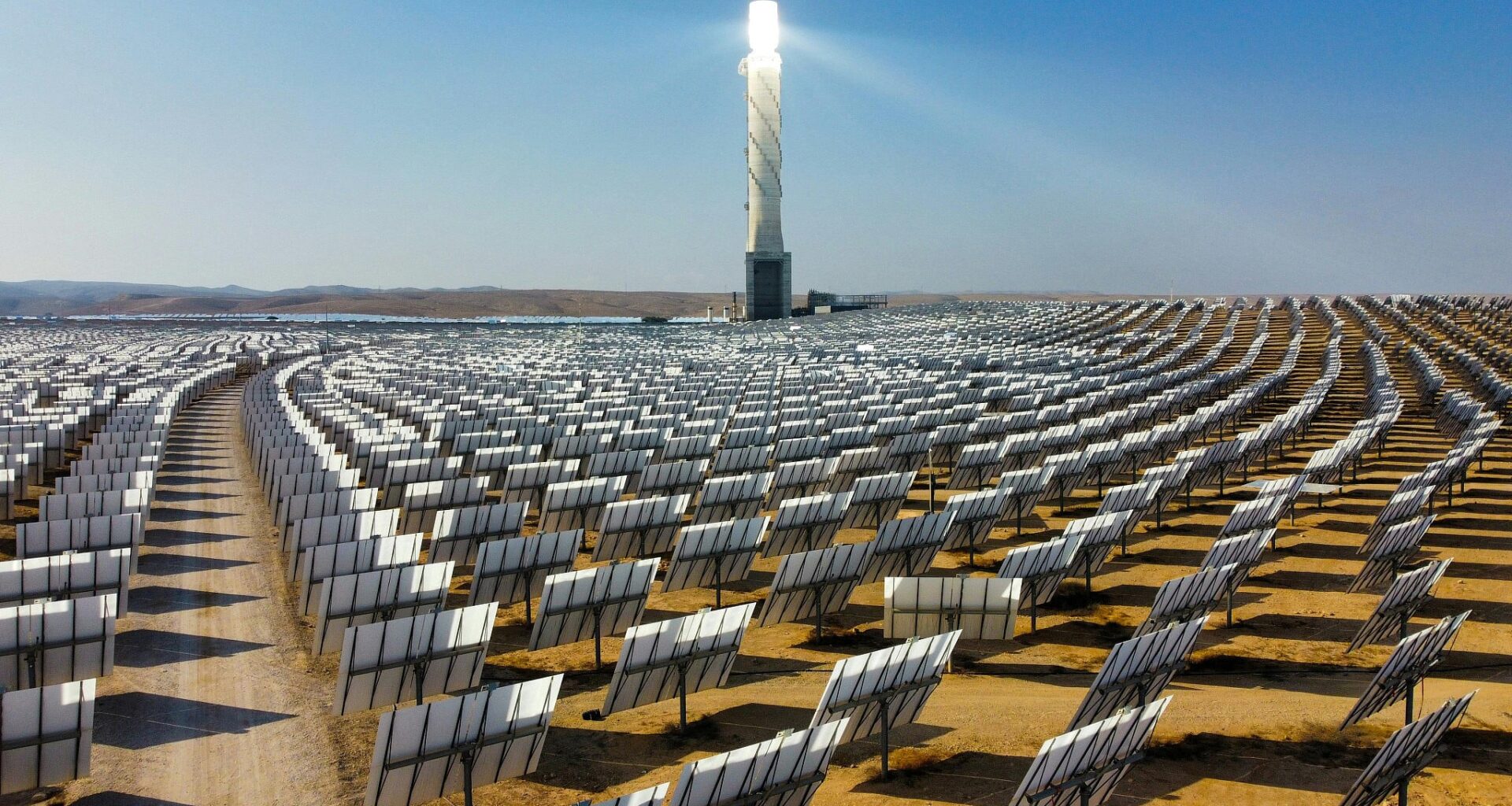
Picture an agrovoltaic solar developer in the Negev desert who has proven technology to harvest sunlight twice—growing crops and generating electricity from the same piece of land at the same time. She’s got the permits, the technology that will accelerate both energy productivity and food security by capturing the sunlight — roughly 300 days a year of it. What she doesn’t have is any way to guarantee what her electricity will be worth next year, or the year after that. Banks notice. Investors hesitate. The project that everyone agrees should get built… doesn’t.
Now picture a family in Texas, February 2021. A winter storm has knocked the grid sideways. Wholesale electricity prices have spiked to 300 times their normal level — not for minutes, but for days. Their energy provider, which never bought financial protection against this kind of event, will be bankrupt by spring. The family’s bill arrives. It’s staggering.
These two stories — one about a project that can’t get started, the other about a crisis that didn’t have to be catastrophic — are connected by the same missing piece. It’s not a solar panel or a battery. It’s a financial contract called a derivative.
The Farmer’s Old Trick, Applied to Electricity
Here’s something most people don’t realize: the global clean energy revolution runs on the same basic financial idea that both Midwestern and Mesopotamian wheat farmers figured out centuries ago.
A farmer planting in April doesn’t know what wheat will sell for in October. So he sells a futures contract — locking in a price now, eliminating the guessing game, and sleeping a lot better. The buyer on the other side — maybe a cereal company — also sleeps better, because they’ve locked in their costs. Everyone gives up the chance of a windfall in exchange for something more valuable: certainty.
Electricity derivatives work the same way. A solar farm operator can lock in the price of next year’s power. An industrial manufacturer can cap energy costs so a heat wave doesn’t blow up the budget. A carbon credit puts a tangible dollar value on reducing emissions. These tools — futures, forwards, options, swaps — are what turn clean and cheaper energy from a risky bet into an investable asset class.
In the energy world, they serve as shock absorbers. And as it turns out, shock absorbers matter most precisely when the road gets bumpy.
What Happens When You Have Them — and When You Don’t
Back to Texas. When Winter Storm Uri hit in February 2021, the electricity retailers who had bought futures contracts weathered the crisis. Their losses were capped by the instruments they’d purchased in advance. The retailers who hadn’t hedged? Billions in losses, overnight. Bankruptcies cascaded through the system. The difference between survival and collapse was not who had the best power plants. It was who had the right financial contracts to mitigate risk.
Contrast that with Denmark, where Orsted — the world’s largest offshore wind developer — commits billions of euros to new projects precisely because Nordic derivatives markets let them hedge years of future revenue. Physical assets managed through financial markets. That’s the formula that works.
Good derivatives, as financial innovator and frontier “carbon hunter” Richard Sandor taught us, don’t amplify speculation, but reduce risk to solve real economic and environmental problems—to capture, reduce and remove carbon emissions—and transition to more economic energy portfolios. Banks don’t fail anymore because of interest-rate risk—Sandor first pioneered those derivatives (measuring the rate of change of one thing relative to another) that standardized how banks could hedge risks against fluctuations in borrowing costs (interest rates). But you don’t need to understand partial differential equations or calculus developed by Newton and Leibniz to understand this principle in the financial world as it helped humanity understand the physical world. A derivative is just an agreement between two parties about the future price of that underlying asset. The idea is ancient. In energy, water, and biodiversity of the 21st century, market-based instruments like derivatives can cut pollution, eliminate electricity poverty, deliver cheaper and safer energy, and conserve groundwater at lower costs. Just as they have done by aligning monetary incentives with cleaner air and reduced acid rain since the 1980s.
And globally, the vast majority of utility-scale (and increasingly hybrid) solar and wind built over the past decade was financed using synthetic power purchase agreements — essentially, derivative contracts that guarantee a developer a stable price while the actual electricity trades at whatever the market dictates. Lenders love them. Without them, most of these projects would never have broken ground.
Three perspectives, one conclusion: derivatives aren’t Wall Street exotica. They’re the plumbing that makes clean energy investable to de-risk our energy portfolios through mid-century without frying the earth or a future of continuing to be held hostage by locking in fossil fuel monopolies and conflicts.
Israel: Lots of Sun, Not Enough Financial Infrastructure
Israel is a fascinating test case. Its electricity sector — about NIS 30 billion a year — is transforming fast. A decade ago, the government controlled 84% of generation. By 2030, private producers are expected to supply 77%. Renewables have grown from 2% to nearly 12%, with a 30% target on the horizon. Battery storage capacity is set to grow 13-fold. A carbon tax kicked in at the start of 2025.
All the ingredients for a clean energy (at lower costs) success story — except one. Israel currently has no standardized electricity derivatives market. Producers, suppliers, and large consumers have no liquid, transparent way to hedge price risk. For a country that needs to invest roughly NIS 2.2 billion per year to meet its 2030 targets, that’s a serious gap.
Making it trickier: Israel is still currently an energy island, with no physical grid connections to neighbors. It has to balance its increasingly solar-dependent system entirely through domestic storage, flexible demand, and gas generation. Price volatility isn’t a theoretical concern — it’s a daily operational reality.
Part of the answer lies in a new generation of distributed energy models. Virtual power plants — platforms that coordinate thousands of rooftop solar systems, batteries, and flexible loads into a single grid-responsive network — are proving they can deliver reliability without massive centralized infrastructure. In New York, David Arfin’s Nine Dot Energy is deploying hundreds of megawatts of community-scale battery storage across urban neighborhoods and pioneering vehicle-to-grid technology, turning parking lots into power plants. Israel’s own “100,000 Solar Roofs” initiative and fast-growing virtual supplier market are headed in the same direction. Farmers in the Western Negev and Northern Israel planning their post-war recovery are hoping to develop similar projects to insure electricity security. But even these distributed systems need derivatives to become bankable. Without predictable revenue streams, institutional investors stay on the sidelines.
A new Financial Innovations Lab report from the Milken Innovation Center lays out a practical roadmap: start with a hybrid trading platform for standardized bilateral contracts, then build toward centrally cleared futures on the Tel Aviv Stock Exchange. On carbon, it recommends pairing the new tax with a tradable credit system — because taxing pollution is a start, but rewarding reductions creates a market.
Bigger Than One Country
Here’s where it gets really interesting. The Eastern Mediterranean and the better part of the Middle East is becoming a region where energy, climate, and diplomacy will converge. Gas pipelines connecting Israel, Egypt, and Jordan already exist. Shared renewable energy zones and marine protection areas aligned with natural gas are on the drawing board. The Abraham Accords have opened doors that were locked for decades. The long arc of history (and economics) ultimately favor regional cooperation over conflict.
But cross-border energy cooperation doesn’t work on handshakes. It needs financial contracts that let partners share risk, guarantee revenue, and attract international capital. Environmental derivatives — electricity swaps/options, carbon credits, renewable energy certificates — could become the common financial language of regional climate and trade cooperation. Israeli wind and water, Jordanian and Palestinian solar, shared storage and minigrids, all connected not just by wires but by the financial architecture that makes the whole thing bankable.
The Punchline
We spend a lot of time arguing about energy technology — which panels, which batteries, which fuel. We spend far too little time on the financial infrastructure and plumbing that determines whether any of it actually gets financed, built, and sustained.
Derivatives sound dull. That’s almost the point. The best financial infrastructure, like plumbing, is invisible — until it’s missing. Israel and its neighbors share the technology, the talent, and the sunlight. What it needs now are the financial instruments that the world’s most advanced energy markets already rely on.
The engineering is ready. It’s time to build the financial architecture to match — before the next storm, next war, the next price spike, or the next project that should have been built but wasn’t.
____________________________________________________
(This article is based up a recent Financial Innovations Lab Report: Financial Instrument’s for Israel’s Energy Transition: Electricity and Environmental Derivatives for the Israeli Economy from the Milken Innovation Center-Van-Leer Jerusalem Institute conducted in cooperation and with the support of the Ministry of Energy and Infrastructure (available in english (here) and hebrew (here). Based upon further applied research by our Fellows and staff (here.)