
Grieve said it was an important moment for investigative journalism and recognition of the courageous patients who spoke out against their doctor.
“This judgment is a complete vindication of the brave patients who had the courage to speak out and an indictment on the doctor who went to war with the people he has a duty to protect,” she said.
“I’m immensely thankful to the patients, family members, whistleblowers and doctors who gave evidence to enable the truth to be told.
“This is an important moment for investigative journalism and I’m proud of everyone who has worked so hard to defend this important public interest investigation.”
Nine, through Collins, had argued Al Muderis had been incapable of admitting his errors and left patients “devastated”.
“Our submission is that a surgeon who would treat people so callously, so appallingly … is not a surgeon who deserves a glittering reputation,” Collins said.
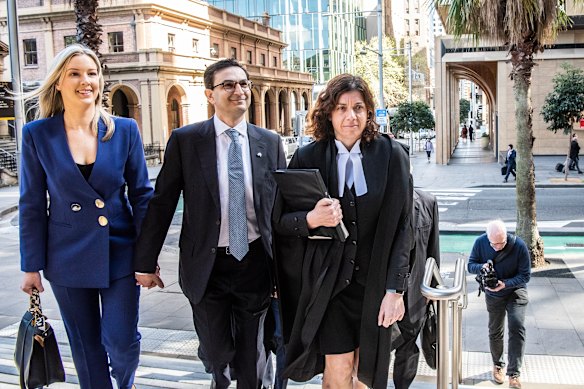
Al Muderis arriving at court with his barrister, Sue Chrysanthou, SC (right) in 2023.Credit: Steven Siewert
“[Al Muderis] is a surgeon whose malpractices and unethical conduct have left patients devastated and worse off than before they saw him; is a surgeon who has operated negligently; is a surgeon who has delivered substandard care, leaving patients to fend for themselves; is a surgeon who has not properly cared for his patients; is a surgeon who has made promises that he’s not delivered on; is a surgeon whose conduct at times has been appalling and beneath contempt.”
Al Muderis’ own lawyer, Sue Chrysanthou, SC, had argued that Nine unreasonably painted the surgeon as a “Dr Frankenstein”.
The case was one of the first major tests of the public interest defence for reporting, which allows media companies to argue they reasonably believed their journalism was published in the public interest.
Justice Abraham concluded Nine had “established that the beliefs they held were objectively reasonable” in reaching her conclusion.
Loading
The surgeon previously called for the identities of confidential sources relied upon by Grieve to be unmasked, but failed after a judge concluded revealing the sources did not outweigh the public interest in protecting their identities.
Justice Abraham said she considered the evidence of 22 patients, who were presented to the court as case studies for osseointegration performed by Al Muderis between 2013 and the publication of the stories.
The evidence of four more orthopaedic patients factored into Justice Abraham’s reasoning.
“Although [Nine] accepted Dr Al Muderis is, to many, an Australian hero who has devoted much of his life’s work to helping amputees walk again, they contended their investigation revealed there is a significant cohort of patients who are unhappy and negatively impacted by Dr Al Muderis’ services,” Abraham said.
Nine CEO Matt Stanton said the decision was “vindication of our reporting and reinforces Nine’s longstanding commitment to investigative journalism”.
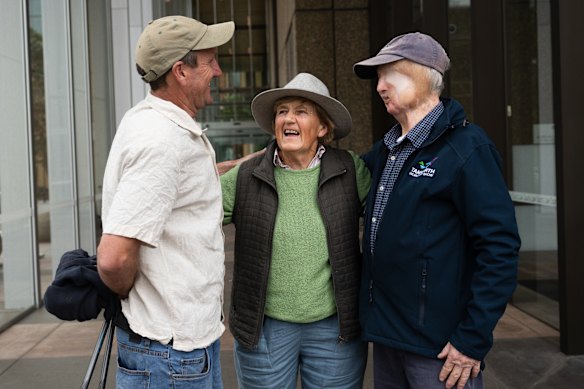
Leah Mooney, with her husband Tim Mooney (right) and son Paul Mooney, was jubilant with the decision. Nine ran stories about her botched treatment.Credit: Janie Barrett
“Nine welcomes today’s judgment by the Federal Court to dismiss Munjed Al Muderis’s claims of defamation. The court has confirmed the stories published by The Age, The Sydney Morning Herald, and aired on 60 Minutes, have been successfully defended. The decision is vindication of our reporting and reinforces Nine’s longstanding commitment to investigative journalism. Nine’s victory today on the basis of public interest is a significant moment in Australian defamation case law,” Stanton said.
Grieve said the decision was a vindication of the patients who had the courage to go public.
“This judgment is a complete vindication of the brave patients who had the courage to speak out and an indictment on the doctor who went to war with the people he has a duty to protect. I’m immensely thankful to the patients, family members, whistleblowers and doctors who gave evidence to enable the truth to be told. This is an important moment for investigative journalism and I’m proud of everyone who has worked so hard to defend this important public interest investigation.”
Loading
University of Sydney media law Professor David Rolph said the “comprehensive victory” for the newspapers showed the new public interest defence can succeed, where notoriously flimsy other defences fail in defamation.
“The old statutory qualified privilege defence was notorious in NSW, for many decades, for being unsuccessful and very difficult for media companies to rely on,” Rolph said.
“One of the most important things in the [2021 defamation reforms] was parliament signalling support for public interest journalism distinctly.”
The first case to test the public interest defence, in which former special forces soldier Heston Russell sued the ABC, ended with the public broadcaster paying out $400,000.
Justice Michael Lee rejected the ABC’s claim but said the case was not a good vehicle for the defence.
“But a case like [Al Muderis] involved very substantial evidence from a number of witnesses, who gave evidence about their treatment,” Rolph said.
NSW has been known as a playground for defamation lawyers, but high-profile losses, including that of war criminal Ben Roberts-Smith at the hands of Nine, have triggered a decline in filings.
Rolph said each case turns on its own evidence, but such failures cause a “chilling effect on prospective plaintiffs”, the professor said.