
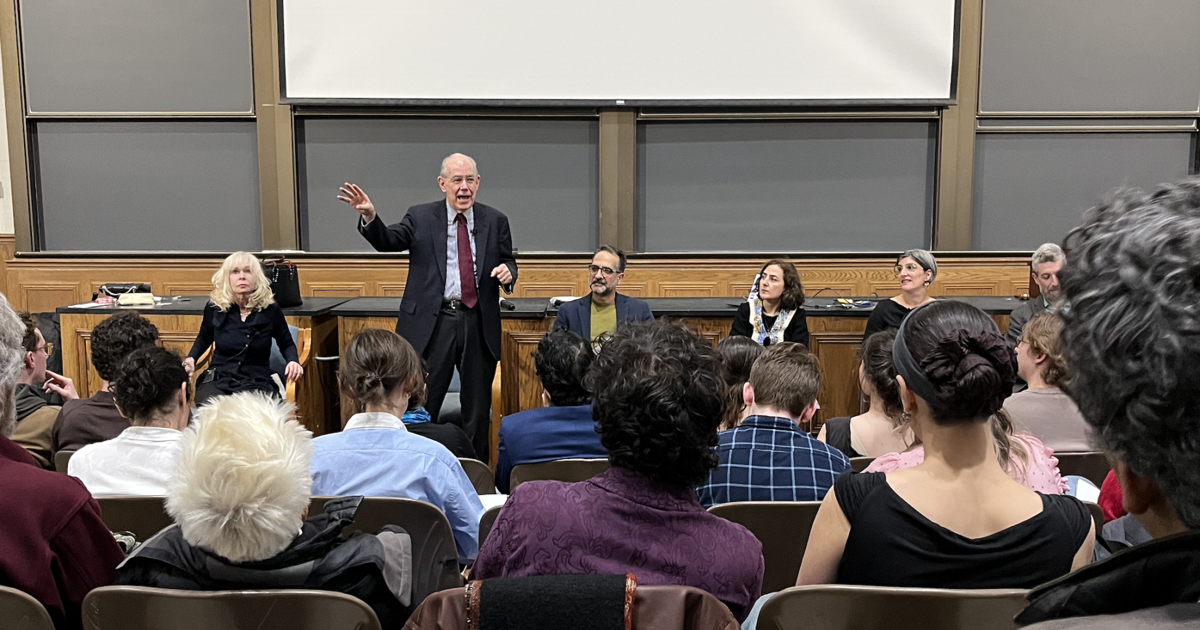
Less than 24 hours after President Donald Trump said the U.S.-Israeli war on Iran was winding down, University of Chicago scholars offered a starkly different assessment, arguing the United States is likely trapped in a conflict with no clear path out.
Speakers warned the war has strengthened Iran’s bargaining position, destabilized global markets and increased the likelihood of nuclear proliferation.
The event, held Thursday at Kent Chemical Laboratory, 1020 E. 58th St., was presented by U. of C.’s Center for Middle Eastern Studies and supported by the Chicago Center for Contemporary Theory. Speakers included international relations scholar John J. Mearsheimer, religious studies scholar Alireza Doostdar, literary scholar Ghenwa Hayek, historian Aaron Jakes and landscape archaeologist Mehrnoush Soroush, with political scientist Lisa Wedeen moderating.
Trump’s April 1 address was intended to reassure Americans that the war’s economic costs would be short-lived and that hostilities would wrap up within the next month. But markets sank after his speech, due in part to Trump’s lack of a concrete plan to reopen the Strait of Hormuz, through which roughly 20% of the world’s oil flows. Oil prices surged 8% in the hours after his 19-minute speech. In Illinois, gas prices now stand at $4.29 on average, more than $1 higher than what they were before the war began.
The war began Feb. 28, when the United States and Israel launched joint airstrikes that killed Ayatollah Ali Khamenei, Iran’s supreme leader, along with several top security and political officials. Trump said the strikes were necessary because Iran’s nuclear and ballistic missile programs posed imminent threats to the United States and Israel.
The conflict followed last year’s 12-day bombing campaign and anti-government protests in Iran in January. U.S. intelligence agencies, however, had assessed that Iran was not close to obtaining a nuclear weapon.
More than 1,900 people in Iran and 13 U.S. service members have been killed so far, along with hundreds more across the Middle East.
Mearsheimer opened the panel with a blunt assessment of how the war began and why it has gone wrong. He said that Israel’s Mossad chief David Barnea convinced Israeli Prime Minister Netanyahu and Trump that a swift shock-and-awe campaign targeting Iran’s leadership would trigger a popular uprising and overthrow the government. But that rested on a deeply flawed assumption.
“The historical record is unequivocally clear that toppling regimes with air power alone does not work,” Mearsheimer said.
When that quick victory failed to materialize, the U.S. found itself in a war of attrition in which time is on Iran’s side.
“President Trump committed a colossal blunder,” Mearsheimer summed up.
Mearsheimer ticked through Trump’s original war aims — eliminating Iran’s capacity to enrich uranium, neutralizing its ballistic missile program and ending its support for Hezbollah in Lebanon, the Houthis in Yemen and Hamas in Gaza — saying that none of them have been achieved because they all rested on the paramount and so far unattainable goal of regime change.
“Last night, he gave a speech about destroying the Iranian air force, destroying the Iranian navy,” Mearsheimer said, smirking. “Those were not our goals.”
On the nuclear question specifically, Mearsheimer thinks the war has almost certainly backfired.
“We’ve given them a greater incentive than ever to acquire nuclear weapons, and the people now in charge in Iran are more hawkish on that issue than the Iranian leaders were in February,” he said.
And far from weakening the government, Mearsheimer speculated that the war has strengthened it.
“When you go to war against a country like Iran, any nation-state in the contemporary world, you invariably cause a rally around the flag,” he said.
Meanwhile, with the Strait of Hormuz largely shut down, Iran now effectively controls a chokepoint for a third of the world’s fertilizer supply in addition to one-fifth of its oil. Iran also retains the capability to strike the Gulf states’ desalination plants and energy infrastructure, and Iranian cluster munitions are increasingly getting through Israeli air defenses.
Mearsheimer said that at this point Iran has every incentive to drag the conflict out.
“The more damage they do to the international economy, the more leverage they have,” he said, pointing out that the U.S. has already allowed Iran to sell its oil on the open market after years of crippling sanctions.
Doostdar, a professor of Islamic Studies who grew up in Iran, focused on the specific miscalculations the U.S. and Israel made about Iran’s military and political resilience.
On the military side, Doostdar said Iran’s own past behavior likely helped create a false impression among U.S. and Israeli policymakers that the country would not escalate militarily in response to attacks on its soil. After repeated opportunities to retaliate against U.S. or Israeli strikes going back to at least 2020, Iran consistently chose measured, pre-telegraphed responses that defense systems could easily intercept, he said.
“The message communicated to the Americans and Israelis was that this is a weak military,” he said. But what they failed to account for was Iran’s ability to sustain a prolonged asymmetric conflict using a decentralized “mosaic” defense system, in which lower-level commanders are authorized to act autonomously in retaliating against the United States, Israel and its Gulf State allies if the central leadership in Tehran was killed.
“There’s multiple layers of command that are ready to step in,” he said. “All of this has remained pretty solid.”
Doostdar said the Americans and Israelis also greatly underestimated the strength of popular support for the Islamic Republic in calculating that an uprising would take place. Despite four massive anti-government protest movements over the past decade, in the two most recent Iranian presidential elections, the pro-regime, hardline candidates won roughly 25 to 30% of eligible voters, indicating a sizable well of supporters even at the government’s lowest popular approval. Although many in the Iranian diaspora have long opposed the government and clamored for its downfall, Doostdar said the rally-around-the-flag effect has likely increased popular approval internally since the war began.
“National feeling has gone in support for the state in a way that they would not have done prior to this,” he said.
Doostdar also pointed to the institutional durability of the Iranian state, which has been in place for more than 40 years and maintains “a fairly vast and robust structure of institutions,” even in wartime. Government bureaucracies, which employ an estimated 8 million Iranians, are still operating, he said. The Islamic Revolutionary Guard Corps, which acts as a “deep state,” according to Doostdar, holding powerful military and economic functions, also remains intact despite strikes on their headquarters. And crucially, Doostdar noted, no senior Iranian leader has fled the country, unlike in Syria, where former President Bashar Al-Assad and many of his top officials escaped to Russia.
“Everybody that we’ve seen has preferred to die in Iran rather than leave,” he said. “That reinforces the idea that the leadership itself buys into the system” and sustains popular legitimacy.
In the years ahead, Doostdar predicted that Iran will emerge from the conflict more militarized, less willing to compromise internationally and almost certainly nuclear-armed.
“Everything that the U.S. was hoping to get out of this war is really going to be the opposite,” he said.
The panel also addressed the war’s broader dimensions. Soroush spoke about the severe ecological toll of the wars on the Middle East’s air and water quality. Hayek placed Israel’s recent invasion and bombing campaign of Lebanon, which has killed more than 1,400 and displaced over 1.2 million people, in historical context, describing it as the latest in a series of conflicts dating back to the late 1970s. And Jakes examined recent mediacomparisons between the current energy and food supply crisis and two earlier shocks, the 1956 Suez Crisis and the 1973 oil embargo, arguing that the U.S. may have unintentionally sparked a transition from a dollarized world economy to the Chinese yuan.
The bottom line, according to Mearsheimer, is that with Iran holding substantial leverage over the global economy by controlling the strait and continuing to penetrate Gulf states’ and Israeli air defenses, the U.S. has no clear exit strategy.
“Trump is completely screwed,” Mearsheimer said. “The other side has all the cards.”