
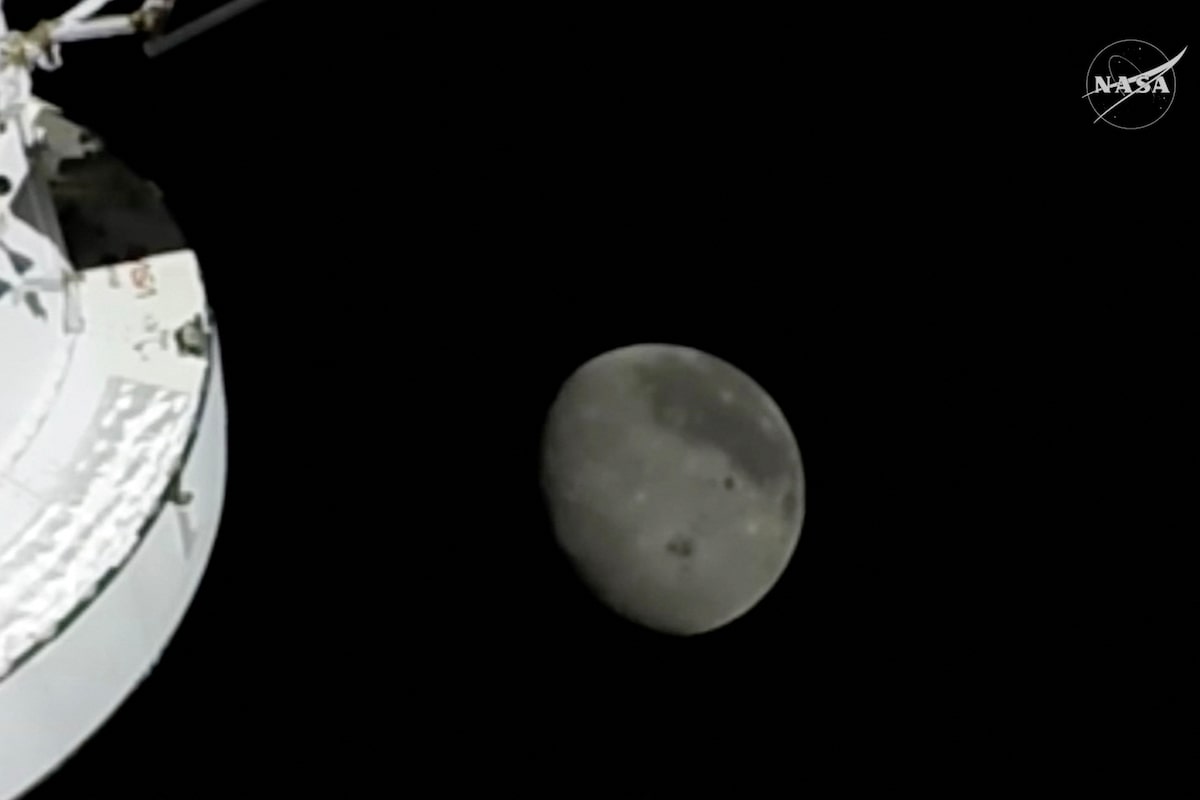
In this image from video provided by NASA, the moon is seen from a camera outside the Orion Spacecraft after the Artemis II astronauts surpassed the farthest distance ever traveled by humans from Earth.AFP/Getty Images
04/06/26 18:18Integrity will soon slip behind the moon and out of contact
– Ivan Semeniuk
The crew is now into the fourth block of their observing plan and fast approaching the moment when Integrity slips behind the moon from our point of view at about 6:45 pm ET. They will then be out of contact with Earth for about 40 minutes.
To see what this will look like from their point of view have a look at our narrated video simulation of the flyby.
04/06/26 18:07A better look at Mare Orientale
– Ivan Semeniuk
Victor Glover was back on the intercom and could be heard describing aspects of the large impact basin Mare Orientale which is now close to disappearing over the edge of the moon.
Over the past few hours, the crew has had the opportunity to view Mare Orientale across a wide sweep of angles. Capt. Glover has just emphasized that this has given them a sense of the three-dimensional shape of the feature, due to the parallax effect.
04/06/26 17:36Lunch on the flyby
– Ivan Semeniuk
Today’s lunar observations are divided into five blocks and right now the crew is in block three. While they swap places at the windows in pairs, crew members are also scheduled to have a meal now, which they can do between stints of taking photos.
The moon now looks half illuminated with very little of the near side now visible. The moon is larger now in the capsule’s external camera and the terminator is quite prominent. Integrity is about 7,500 kilometres from the moon, or just over twice the moon’s diameter away.
04/06/26 17:25Chebyshev and the many Russian-named craters on the far side of the moon
– Ivan Semeniuk
A little while ago we heard the science team help the crew identify a crater they were seeing in the lunar southern hemisphere called Chebyshev. Meanwhile, Reid Wiseman and Jeremy Hansen are now studying a crater called Glushko.
It’s a reminder that many craters on the far side of the moon have Russian names. It was the Soviet Union that captured the first image of the lunar far side with a spacecraft called Luna III in 1959.
04/06/26 16:52The Ohm crater is viewed by the crew
– Ivan Semeniuk
In this photo provided by NASA, Artemis II pilot and NASA astronaut Victor Glover peers out one of the Orion spacecraft’s windows looking back at Earth ahead of the crew’s lunar flyby on April 6, 2026.Uncredited/The Associated Press
Currently Christina Koch and Victor Glover are taking pictures with the Nikon cameras and telephoto lenses the crew have on board. One of the features they’ve been looking at is a small crater called Ohm, which is not visible from Earth. It has a prominent system of rays made up of ejected debris that sprayed outward from the asteroid impact that created the crater.
The crew has also had to cover up one of the capsules windows with a T-shirt because, from their current angle, the Earth is coming into view and is bright enough to mess with their dark-adapted eyes.
04/06/26 16:26Disappearing behind the moon in two-and-a-half hours
– Ivan Semeniuk
Integrity is now just over two and a half hours from the moment it disappears behind the moon from Earth’s point of view, during which there will be no possibility of communicating with the spacecraft for about 40 minutes.
This article has been updated to correct the time at which the spacecraft will go behind the moon.
04/06/26 16:18‘Make sure this record is not long-lived’
– Globe staff
A video showing the Artemis II crew as they broke the record for the furthest humans have been from Earth. Canadian Jeremy Hansen said they “choose this moment to challenge this generation and the next to make sure this record is not long-lived.”
04/06/26 16:09A real-time description of the terminator
– Ivan Semeniuk
Victor Glover’s description of the terminator, the line that separates night from day, has a sense of wonder.
“I wish I had some more time to just sit here and describe what I’m seeing. But the terminator right now is just fantastic. It is the most rugged that I’ve seen it, from a lighting perspective. There are little islands — there are islands of terrain out there that are completely surrounded by darkness, which indicates some real variation in terrain.”
04/06/26 16:06Views approaching the far side of the moon
– Ivan Semeniuk
The near side (the hemisphere we see from Earth) visible at the top half of the disk, identifiable by the dark splotches. At the lower center is Orientale basin, a massive crater that straddles the Moon’s near and far sides. Everything below the crater is the far side.Uncredited/The Associated Press
The moon is certainly no longer looking full anymore as Integrity pulls around to the backside. A little bit of the dark “maria” (Latin for seas) on the near side can still be seen.
These are floodplains where lava once spilled out onto the surface. But more prominent now is the far side and the line that separates night from day, called the terminator. This is where shadows are longest and where vertical relief is easier to distinguish.
04/06/26 15:30Rare real-time observations turn space exploration into live theatre
– Ivan Semeniuk
If you are following along with the crew speaking in detail about what they are seeing, it’s worth thinking about how unusual this is. It’s been decades since we last heard astronauts speaking about what they are seeing in real time.
In planetary missions, including to Mars or more distant worlds in our solar system, the signal delay time is too great for near real time communications. Instead, the data arrives after the fact and sometimes, if journalists are present, we can listen to scientists interpreting what they see. But it’s an arm’s-length experience.
This is space exploration as live theatre and it’s quite something to watch.
04/06/26 15:25When does Artemis II return?
– Globe Staff
The NASA mission is expected to return to Earth on Friday, April 10 at 8:07 p.m. ET, splashing down in the Pacific Ocean off the coast of San Diego California.
However the exact time and location are both likely to shift as different milestones are met throughout the approximately 10-day mission.
04/06/26 15:13Astronauts reporting observations directly to scientists on Earth, a first for planetary science mission
– Ivan Semeniuk
Artemis II pilot Victor Glover peers out one of the Orion spacecraft’s windows looking back at Earth ahead of the crew’s lunar flyby.The Associated Press
Victor Glover is reporting to the science team in Houston about some of what the crew is seeing including variations in light and dark regions on the floor of the large crater Grimaldi. These are subtleties that are of high interest to geologists. This is the first time a planetary science mission has put astronauts in direct contact with scientists on the ground in real time while the data gathering is underway.
04/06/26 15:02Crew to compare features on near and far side of the moon
– Ivan Semeniuk
This handout image released by NASA shows a fully illuminated Moon, with the near side at top, dark lava plains, and the Orientale basin, with parts of the far side visible, on Monday.Supplied/AFP/Getty Images
As part of today’s exercise, the crew has been asked to compare features on the near and far side of the moon, portions of which are both in view right now.
They are speaking out loud about their impressions which are being recorded, to take advantage of the subtle variations that the human eye can detect.
Pilot Victor Glover has just confirmed that the lights are off in the crew cabin except for a few LEDs.
Outside, the prominent crater Tycho, which can be seen from Earth, is about to disappear over the horizon as their viewing angle shifts.
04/06/26 14:58Observations get underway on Orion capsule
– Ivan Semeniuk
As observations get underway, the crew is focusing on a list of 35 targets.
They have just started discussing the lunar impact basin called Hertzsprung. It is older and more degraded than Mare Orientale, the prominent circular feature that is now close to the centre of their view. Hertzsprung makes a good contrast to Orientale.
Christina Koch is also reporting that the crew can see both Earth and moon at the same time and that Earth looks brighter despite appearing smaller than the moon does to them right now.
This is not a total surprise because clouds in Earth’s atmosphere make it a shinier object in the sky than the cement-grey moon.
04/06/26 14:50A view of the moon from one of Orion’s cameras
– Ivan Semeniuk
In the view from a camera mounted on one of the capsule’s solar arrays, the moon has grown noticeably larger in the past two hours and now more of the far side is visible.
The view has also been flipped relative to how it was shown earlier. Now, lunar North is at the top.
Here’s a live view from the Orion capsule:
04/06/26 14:45Astronauts request altitude change of Orion capsule
– Ivan Semeniuk
The crew has requested an altitude change of their capsule to put the moon in a better position for their observations, which begin about 2:45 p.m. ET.
04/06/26 14:40How to track the Artemis II mission live
– Reet Arora
Artemis Real-time Orbit Website (AROW) is also allowing people to track Artemis II live as it progresses in unexplored airspace. Anyone with internet access can track where Orion and the crew are, including their distance from Earth, distance from the Moon, mission duration, and more.
Access to AROW is available on:
04/06/26 14:15Crew requests feature on lunar surface be named Carroll after Reid Wiseman’s late wife
– Ivan Semeniuk
Victor Glover, Reid Wiseman, Jeremy Hansen and Christina Koch embracing aboard the Orion spacecraft after naming a lunar crater ‘Carroll’ in honour of Wiseman’s late wife, Carroll Taylor Wiseman.Supplied/AFP/Getty Images
The crew has proposed names for two unnamed features on the lunar surface.
One is a crater that they suggested be called Integrity after their spacecraft. The other is a feature near the transition between the near and far side that they have suggested be called Carroll, after Carroll Taylor Wiseman, commander Reid Wiseman’s wife, who died of cancer in 2020. Jeremy Hansen’s voice could be heard breaking as he read out her name.
The crew is now set to dim their cabin to facilitate photography of the moon.
04/06/26 13:56Astronauts surpass Apollo 13 record for new distance record from Earth
– Ivan Semeniuk
Integrity has just broken the distance record, surpassing the mark set by Apollo 13 in April, 1970.
Every moment of the flyby now until about 7:07 p.m. ET tonight takes them further than humans have ever gone from Earth before. They are now beyond 400,171 kilometres from earth.
To mark the moment, Jeremy Hansen said: “We choose this moment to challenge this generation and the next to make sure this record is not long lived.”
04/06/26 13:45Canadian astronaut Jenni Gibbons acting as CAPCOM
– Ivan Semeniuk
Canadian Space Agency astronaut Jenni Gibbons (L) and NASA astronaut Andre Douglas, backup crew members for the Artemis II mission, at Kennedy Space Center in Florida on March 27.MIGUEL J RODRIGUEZ CARRILLO/AFP/Getty Images
In mission control in Houston, we can see Jenni Gibbons on “CAPCOM.” She is Jeremy Hansen’s backup and today her job is communicating directly with the crew members.
Lunar science lead Kelsey Young is also speaking with the crew about their plans for observations and photographs of the moon’s far side.
04/06/26 13:40Jeremy Hansen from inside the Orion spacecraft Open this photo in gallery:
This image released by NASA shows Artemis II mission specialist and Canadian Space Agency astronaut Jeremy Hansen shaving inside the Orion spacecraft during Flight Day 5 and ahead of the crew’s lunar flyby.Supplied/AFP/Getty Images
04/06/26 13:15Artemis II crew get ready for lunar observing campaign
– Ivan Semeniuk
The crew is getting ready for their lunar observing campaign.
At about 1:56 pm ET, they will officially break the record for the farthest from Earth that humans have ever gone. At about 7:07 pm ET tonight, they will set a new record.
04/06/26 13:10Astronauts using GoPro, iPhone cameras to document moon missionOpen this photo in gallery:
This picture by an Artemis II crew member provided by NASA shows a sliver of Earth illuminated against the blackness of space through the window of the Orion spacecraft on April 4.Supplied/AFP/Getty Images
The four astronauts of NASA’s Artemis II mission have a few different devices on board to take photos of space from inside their Orion capsule throughout the flight.
They include a small GoPro action camera, iPhones and professional Nikon cameras, a more familiar brand for NASA astronauts who have used them on the International Space Station (ISS) for years.
The decision to equip the crew with iPhones was made under NASA Administrator Jared Isaacman, a billionaire astronaut who flew on two private SpaceX Dragon missions and used the devices during his own flights, NASA officials have said.
– Reuters
04/06/26 12:55Flyby to illuminate lunar history with new images of the moon
– Ivan Semeniuk
We may see some images of the moon taken by astronauts today, but the real prize will come when Integrity returns to earth and scientists can unload thousands of high-resolution images from the onboard cameras.
It’s been noted that these views will be complementary to those taken by the Lunar Reconnaissance Orbiter, an orbiting spacecraft that flies only about 50 kilometres above the moon’s surface.
Today’s flyby brings a more global and regional view from much farther away with the opportunity to illuminate lunar history across various geological provinces.
04/06/26 12:50The Artemis II astronauts
– Reet Arora
This screengrab taken from a NASA livestream shows Artemis II mission astronauts (L-R) NASA’s pilot Victor Glover, NASA commander Reid Wiseman, Canadian Space Agency’s mission specialist Jeremy Hansen and NASA’s mission specialist Christina Koch from inside the Orion spacecraft on April 4.Supplied/AFP/Getty Images
The Artemis II crew consists of three Americans and one Canadian: commander Reid Wiseman, pilot Victor Glover, mission specialist Christina Koch and Canadian Space Agency astronaut and mission specialist Jeremy Hansen. The mission’s crew was selected in 2023.
Commander Reid WisemanBaltimore, Maryland
Previously flew as a flight engineer aboard the International Space Station for Expedition 41 from May through November 2014, logging more than 165 days in space. He has a Bachelor of Science degree from Rensselaer Polytechnic Institute and a Master of Science in systems engineering from the Johns Hopkins University.
Pilot Victor GloverPomona, California
This is Glover’s second flight to space having previously served as pilot on NASA’s SpaceX Crew-1, which flew to the International Space Station. He has contributed to scientific investigations, technology demonstrations and participated in four spacewalks.
Mission Specialist Christina KochJacksonville, North Carolina
Koch has served as flight engineer aboard the International Space Station for Expedition 59, 60 and 61. She has set a record for the longest single spaceflight by a woman with a total of 328 days in space and participated in the first all-female spacewalks.
Mission Specialist Jeremy Hansen London, Ont.
Hansen is the first Canadian astronaut to venture to the moon. The former fighter pilot was selected as one of two recruits by the Canadian Space Agency for its astronaut recruitment program in 2009 and began working at the Mission Control Center in Houston in 2011.
He has previously participated in the European Space Agency’s CAVES program in Italy during which he lived underground for six days. He was a crew member of space mission simulation NEEMO 19 before becoming the first Canadian to lead a NASA astronaut class.
04/06/26 12:12A live view from the Orion capsule
– Ivan Semeniuk
Currently, the live view from the Orion capsule shows the moon in an orientation that is upside down in the sense that the moon’s North Pole is at the bottom.
The moon looks nearly full from this angle because the sun is almost directly behind the capsule.
Over the next several hours, as the capsule swings around the moon’s far side, the moon will narrow to a crescent and then disappear completely when it blocks the sun and causes an eclipse.
04/06/26 12:08Get ready for your close-up, moon
– Arisa Valyear
Chris Hadfield, retired Canadian astronaut and former commander of the International Space Station, said the Artemis II crew will witness quite the spectacle today during what is expected to be a landmark lunar flyby.
“The first since 1972, and the first-ever with digital cameras, to see better into the dark craters and textures. The crew will have perfect quiet when the Moon blocks out Earth – a time of peace, alone, together,” he wrote in a post on X.
04/06/26 11:55How the crew’s viewing angle differs from what we see on Earth
– Ivan Semeniuk
The view of the moon on flight day 5.The Associated Press
The crew’s view before going to sleep on day five shows a full moon with a difference.
Their viewing angle then was already significantly different from what we see on Earth.
While many of the same features are visible, they are shifted to the right.
Meanwhile, on the left, you can see the moon’s brighter, more cratered far side creeping into view.
Late last night Integrity reached the point where it is feeling the moon’s gravity more strongly than Earth, and that is now bending its trajectory to send it around the back of the moon.
04/06/26 11:50The mission’s flight path
– Ivan Semeniuk
NASA calls this encounter a “lunar flyby” because the spacecraft is not going into orbit around the moon. Instead, it’s tracing a figure-8 loop that starts on the east side of the moon (the left side as seen from the northern hemisphere) and swings around the back to the other side.
At that point the collective gravitational pull of the Earth and moon together will send the spacecraft back toward Earth for a splashdown in the Pacific Ocean on Friday.

Orion will travel more than
400,000 km from Earth and
could set a new record for
the farthest humans have
ever gone into space
Lift-off from Cape Canaveral
Two minutes after launch, boosters
separate followed by launch abort system
Eight minutes after launch ICPS and Orion
separate from Core stage. Orion’s solar
arrays unfurl
After 90-minute orbit, ICPS fires engines
to raise Orion to higher Earth orbit.
Crew begins multiple system checks
If everything is in order, Orion separates
from ICPS.Then, astronauts manually fly
Orion toward and away from ICPS, practising
proximity operations for future missions
Around 23 hours later, Orion Service Module
carries out Translunar Injection (TLI) burn –
sending Orion on a trajectory around
the moon
After lunar flyby on Day 6, gravity draws
Orion back toward Earth
Just before re-entry, Orion’s crew module
separates from service module
Capsule re-enters atmosphere at speed of
32,187 km/h and temperatures of up to
2,200°C
Series of parachutes slow craft before
splashdown in Pacific Ocean
THE GLOBE AND MAIL, Sources: GRAPHIC NEWS;
NASA; ESA; Lockheed Martin

Orion will travel more than
400,000 km from Earth and
could set a new record for
the farthest humans have
ever gone into space
Lift-off from Cape Canaveral
Two minutes after launch, boosters
separate followed by launch abort system
Eight minutes after launch ICPS and Orion
separate from Core stage. Orion’s solar
arrays unfurl
After 90-minute orbit, ICPS fires engines
to raise Orion to higher Earth orbit.
Crew begins multiple system checks
If everything is in order, Orion separates
from ICPS.Then, astronauts manually fly
Orion toward and away from ICPS, practising
proximity operations for future missions
Around 23 hours later, Orion Service Module
carries out Translunar Injection (TLI) burn –
sending Orion on a trajectory around
the moon
After lunar flyby on Day 6, gravity draws
Orion back toward Earth
Just before re-entry, Orion’s crew module
separates from service module
Capsule re-enters atmosphere at speed of
32,187 km/h and temperatures of up to
2,200°C
Series of parachutes slow craft before
splashdown in Pacific Ocean
THE GLOBE AND MAIL, Sources: GRAPHIC NEWS;
NASA; ESA; Lockheed Martin

After lunar flyby on Day 6,
gravity draws Orion back
toward Earth
Just before re-entry, Orion’s
crew module separates from
service module
Capsule re-enters atmosph-
ere at speed of 32,187 km/h
and temperatures of up to
2,200°C
Series of parachutes slow
craft before splashdown in
Pacific Ocean
Orion will travel more than
400,000 km from Earth and
could set a new record for
the farthest humans have
ever gone into space
Lift-off from
Cape Canaveral
Two minutes after launch,
boosters separate followed
by launch abort system
Eight minutes after launch,
ICPS and Orion separate from
Core stage. Orion’s solar arrays unfurl
After 90-minute orbit, ICPS fires engines
to raise Orion to higher Earth orbit.
Crew begins multiple system checks
If everything is in order, Orion separates
from ICPS.Then, astronauts manually fly
Orion toward and away from ICPS, practising
proximity operations for future missions
Around 23 hours later, Orion Service Module
carries out Translunar Injection (TLI) burn –
sending Orion on a trajectory around the moon
THE GLOBE AND MAIL, Sources: GRAPHIC NEWS; NASA; ESA; Lockheed Martin
04/06/26 11:42A look at the Artemis II mission so far
– Ivan Semeniuk
In this photo provided by NASA, a view of the Earth from NASA’s Orion spacecraft as it orbits above the planet during the Artemis II test flight, on April 2.The Associated Press
The crew of Artemis II has now been in space for more than four days since launching at the Kennedy Space Center in Florida at 6:35 pm ET on Wednesday April 1.
About 25 hours later, after a period of high Earth orbit, they conducted a “trans-lunar injection burn” during which their spacecraft fired its main engine to put them on course for the moon. It’s approximately four days from that point to their closest approach to the moon later this evening.
04/06/26 11:40Artemis II mission will reach its apex today
– Ivan Semeniuk
NASA astronaut and Artemis II mission specialist Christina Koch peers out of one of the Orion spacecraft’s main cabin windows, looking back at Earth, as the crew travels towards the moon on April 4.NASA/Getty Images
NASA Artemis II mission is reaching its apex today as the space capsule called Integrity makes its closest approach to the moon. The four astronauts on board, including Reid Wiseman, Victor Glover, Christina Koch and Canada’s Jeremy Hansen have a busy series of observations planned, primarily focused on the moon’s far side which is not visible from Earth. The astronauts will be the first people in history to lay eyes on some of these features, because the Apollo astronauts who circled the moon were much closer and were also doing so when different regions of the moon were illuminated by sunlight.
Follow along as we cover the lunar encounter live. The busiest part of the flyby will begin at 2:45 pm ET. Toward the end of the flyby the crew will also experience a solar eclipse starting at 8:35 pm ET.
04/06/26 11:35A special message from astronaut Jim Lovell
– Abigale Subdhan
The Artemis II crew woke up this morning to a special message from astronaut Jim Lovell, the pilot of Apollo 8.
“Welcome to my old neighbourhood,” the renowned NASA astronaut said in an audio message that was recorded back in 2025 before his death. “It’s a historic day and I know how busy you’ll be, but don’t forget to enjoy the view.”
Apollo 8 launched on Dec. 21, 1968 with crew members Frank Borman, William A. Anders and James (Jim) A. Lovell Jr., and it was the first human space flight to the moon and back. It was an important prelude to the moon landing in 1969.
Lovell, who died in August, 2025, was a veteran of the Gemini VII, Gemini XII and Apollo 8 missions before becoming the mission commander for the nearly-disastrous Apollo 13 mission to the moon.
04/06/26 11:00The schedule for today’s main eventOpen this photo in gallery:
NASA Artemis II crew members Jeremy Hansen, Reid Wiseman, Christina Koch, and Victor Glover answer questions from reporters during the first downlink event of their mission on April 2.NASA TV/Reuters
The four astronauts of NASA’s Artemis II mission entered the moon’s gravitational sphere of influence early Monday morning as they cruised along a path that will soon take them over the shadowed, lunar far side to become the farthest-flying humans in history.
The Artemis II crew woke up around 10:50 a.m. ET Monday for their sixth flight day. By 7:05 p.m., they will reach the mission’s maximum distance from Earth of about 406,778 kilometres, approximately 6,601 kilometres beyond the record held by the Apollo 13 crew for 56 years.
As NASA astronauts Reid Wiseman, Victor Glover and Christina Koch and Canadian astronaut Jeremy Hansen approach the distance record, they will be sailing around the moon’s far side, witnessing it from roughly 4,000 miles above its darkened surface as it eclipses a basketball-sized Earth in the distant background.
The milestone is a climactic point in the nearly 10-day Artemis II mission, the first crewed test flight of NASA’s Artemis program.
Officially starting at 2:34 p.m. ET, the lunar flyby will plunge the crew into darkness and brief communications blackouts as the moon blocks them from NASA’s Deep Space Network, a global array of massive radio communications antennas the agency has been using to talk to the crew.
The flyby will last about six hours, during which the astronauts will use professional cameras to take detailed photos through Orion’s window of the silhouetted moon, showing a rare and scientifically valuable vantage point of sunlight filtering around its edges in what will effectively be a lunar eclipse.
They will also have the chance to photograph a rare moment in which their home planet, dwarfed by their record-breaking distance in space, will rise from the lunar horizon as their capsule emerges from the other side, a celestial remix of a moonrise seen from Earth.
A team of dozens of lunar scientists positioned in the Science Evaluation Room at NASA’s Johnson Space Center in Houston will be taking notes as the astronauts, who studied an array of lunar phenomena as part of mission training, describe their view in real time.
– Reuters
04/06/26 11:00A view of Earth, courtesy of the Orion spacecraftOpen this photo in gallery:
This image shows a view of Earth taken by NASA astronaut and Artemis II Commander Reid Wiseman from of the Orion spacecraft’s window.Uncredited/The Associated Press
In a briefing at Houston’s Johnson Space Center on Friday, NASA shared some of the crew’s first images of the entire Earth – something that can only be seen from a distance of thousands of kilometres. The International Space Station is far too close for such a view, so by nature, these pictures imply a very different kind of space voyage.
04/06/26 11:00Artemis II is about to break a record that should never have been
– Ivan Semeniuk
The moon during its waxing gibbous phase after the launch of NASA’s Artemis II lunar flyby mission on April 2, 2026.Jon Nazca/Reuters
Throughout its journey around the moon, the Artemis II mission has frequently drawn comparisons to an early predecessor – Apollo 8.
That flight, in December, 1968, marked the first time humans circled the moon, which would serve as a prelude to a lunar landing the following year. It is the mission that produced the iconic “Earthrise” photo, which showed our planet suspended above the moon’s horizon and sparked a paradigm shift in how we view our place as a species.
Like the crew of Apollo 8, the four Artemis II astronauts – Reid Wiseman, Victor Glover, Christina Koch and Canada’s Jeremy Hansen – have ventured into lunar space to test the viability of their spacecraft, dubbed Integrity, and set the stage for moon landings yet to come. They lifted off from NASA’s Kennedy Space Center in Florida on Wednesday.
But Monday evening, as the crew rounds the far side of the moon and begins heading toward home, a different Apollo-era mission will be on everyone’s mind.
Apollo 13 was the ill-fated flight that turned into a daring rescue and a narrowly averted disaster in April, 1970. Along the way, NASA astronauts Jim Lovell, Fred Haise and Jack Swigert travelled farther from Earth than humans have ever gone – an unplanned record that has persisted for 56 years, until now.
Based on the latest figures from NASA, at 7:07 p.m. ET, the equations of celestial mechanics predict that Integrity will be about 406,778 kilometres from Earth. That exceeds the Apollo 13 record by about 6,606 km, which means Col. Hansen and his crewmates will have truly gone where no one has gone before.
NASA said on Sunday that the Artemis II crewed mission will reach record distances from Earth, surpassing a mark set during Apollo 13 more than five decades ago.
Reuters