
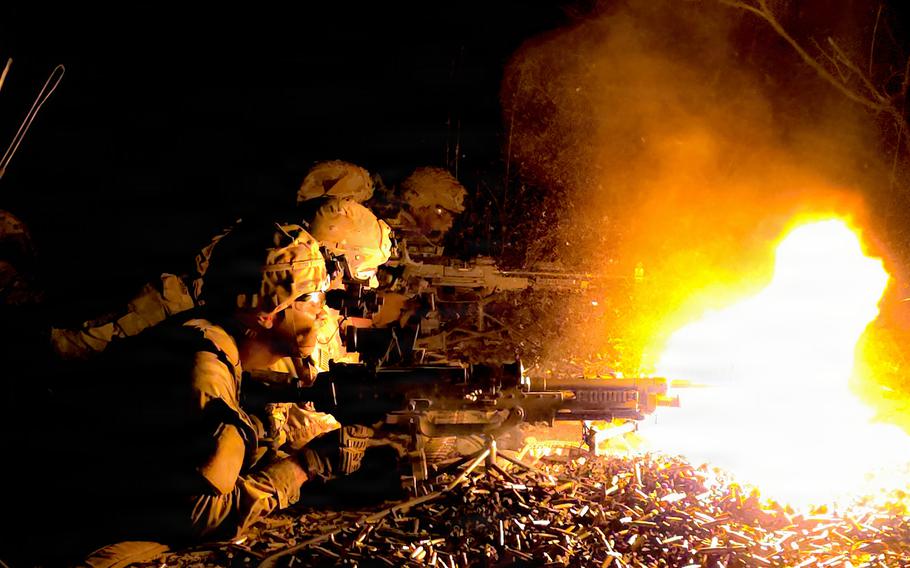
Soldiers assigned to the 11th Airborne Division fire M240 machine guns during an exercise at Rodriguez Live Fire Complex in South Korea, March 24, 2026. (Alexander Knight/U.S. Army)
President Donald Trump this week criticized three key U.S. allies in the Pacific for not assisting in the war he launched against Iran in February, despite longstanding American security commitments to the region.
“Japan didn’t help us,” he told reporters Monday at a White House news conference. “Australia didn’t help us. South Korea didn’t help us.”
Trump’s remarks widened a complaint he has made for years — that allies benefitting from U.S. military protection do not do enough in return — and came as his administration faces growing scrutiny over the costs of the conflict.
He pointed out how American troops stationed in Japan and South Korea are “in harm’s way” of North Korean nuclear weapons.
Trump’s criticism followed similar complaints at the news conference over NATO member states also declining to join the war, describing that alliance as a “paper tiger.”
Trump, along with Israel, launched Operation Epic Fury against Iran on Feb. 28 without seeking formal approval by Congress or apprising European allies of his plan.
A massive bombing campaign has killed many of Iran’s top leaders, but the half-century old regime remains in place.
In response, Iran has blocked the Strait of Hormuz and caused a global energy crisis.
Trump said last week that reopening the strait was the responsibility of countries that rely on it for shipping. That list of nations did not include the United States, he said.
But he threatened in social media posts over the weekend to demolish Iran’s critical civilian infrastructure, such as power plants and bridges, if the strait remains blocked.
Trump said at Monday’s news conference that the U.S. has 50,000 service members stationed in Japan to protect that nation from North Korean aggression.
The U.S. has approximately 28,500 troops in South Korea, where the Army has maintained a presence since the Korean War in the early 1950s, according to a Congressional Research Service report in January.
During Monday’s press conference, Trump referred to 45,000 U.S. soldiers being stationed in South Korea, an inflated number he began using in recent months.
North Korea’s leader, Kim Jong Un, has routinely antagonized Japan by conducting ballistic missile tests over the Sea of Japan, also known as the East Sea.
Japanese Prime Minister Sanae Takaichi said Monday that the Japanese government was arranging summit talks with Iran about reopening the strait.
Meanwhile, South Korean President Lee Jae Myung has largely avoided directly opining on the Iran war, instead cajoling citizens to conserve energy in light of surging fuel costs.
Trump has said during both his first and current administrations that Tokyo and Seoul should pay more toward the costs of maintaining U.S. troops in those countries.
The Biden administration signed a five-year agreement with South Korea in 2024 under which Seoul was to raise its funding for the sustainment of U.S. troops by 8.3% to $1.47 billion in the first year. Later increases would be linked to the consumer price index.
During the 2024 election campaign, Trump said South Korea should pay as much as $10 billion per year.
Japan contributes roughly $2 billion a year to host American troops, an amount that falls far short of the $8 billion Trump has called for in the past.