
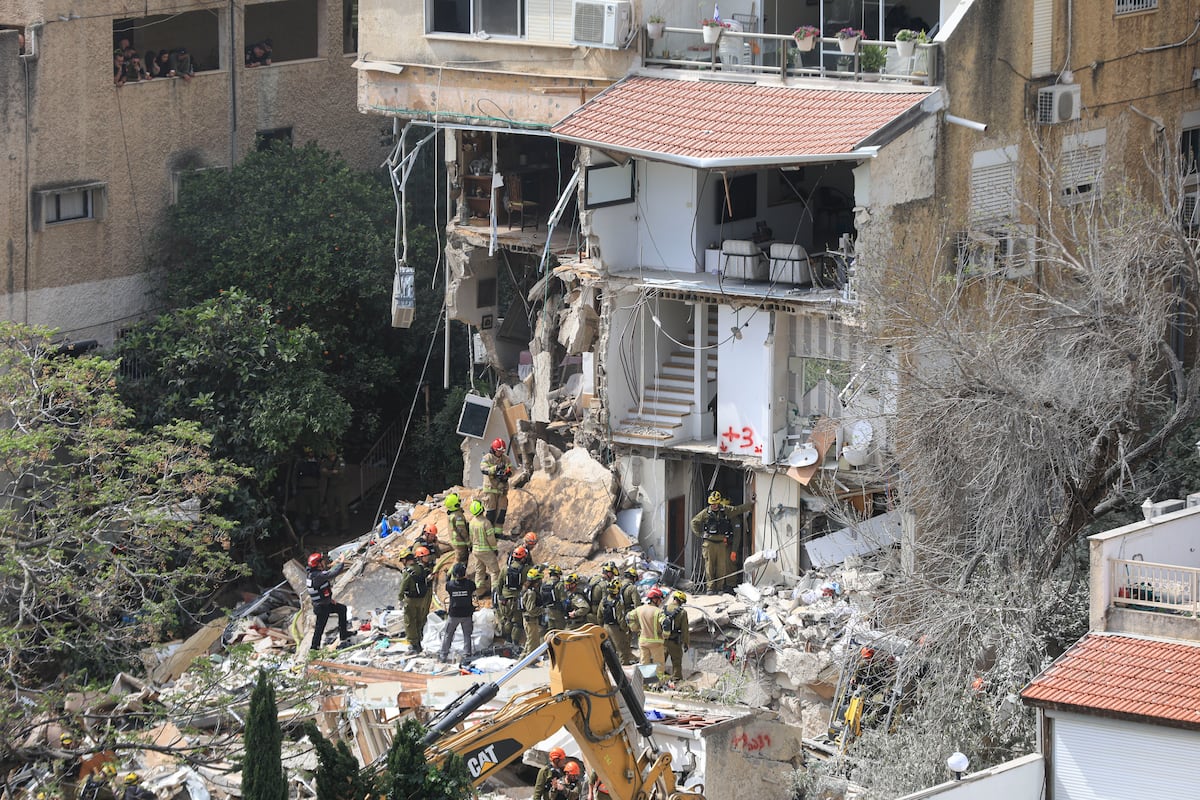
Tragedy shattered the small residential paradise nestled between the sky and the sea where a retired couple had settled. Among pine forests overlooking the historic Haifa Bay in northern Israel, the direct hit of an Iranian ballistic missile destroyed their ground-floor apartment as they dined at sunset on Sunday with one of their sons and his wife. Fired from some 1,200 miles northeast with a payload of hundreds of kilograms of explosives, the projectile struck their living room. It failed to detonate, but it pounded like a pile driver on the five-story building, terraced on a slope of Mount Carmel. Rescue teams were still working on Monday to assist the distraught residents after recovering the four bodies. Nearby, army bomb disposal experts struggled to deactivate the warhead of a rocket that highlights Israel’s vulnerability, despite its advanced defensive systems.
“They were two elderly people, one of their sons, and their daughter-in-law,” Colonel Dovev Viess of the Home Front (the equivalent of civil defense) reported from a terrace across from the house. Amid a large deployment of police, firefighters, rescue workers, and Jewish religious leaders meticulously collecting the smallest human remains scattered by the impact, the officer explained to the press that only this family had been hit by the missile, which could have caused a massacre had it exploded. “Only one man, around 80 years old, has been admitted to Ranban Hospital in Haifa in critical condition,” the officer specified. Another 10 residents, including the hospitalized man’s wife, around 75 years old, suffered only minor injuries.
The Israeli colonel declined to provide the victims’ identities as he pointed out to television cameras the living-dining room that had been struck by the ballistic missile. An air conditioning unit hung by a cable above the gaping facade. The local press identified them as Vladimir Gershovich, 73, and his wife, Lena Ostrovsky, 68; their son, Dima Gershovich, 42, and his wife, Lucille Jean, 25, a Filipino woman whom he had married two years earlier.
The first three had emigrated from the former Soviet Union more than three decades ago. Until her retirement, Lena Ostrovsky was a diction teacher at the Nissan Nativ Theater School in Jerusalem, according to a statement of condolence released by the Actors Association of Israel on state television.
“I didn’t know them, although many retirees live in this neighborhood in the upper part of Haifa,” explained 84-year-old retired engineer Tsivi Nisnas, who had come to inquire about one of the building’s residents. “Half the houses, the older ones like this one, barely have individual shelters or safe rooms, and there are only collective shelters in the basements,” he noted, accustomed to conflict after a long life. “When I was a child, I suffered through the War of Independence (1948-1949); I fought in the Six-Day War (1967) and the Yom Kippur War (1974), and now I have to live through this war at my age. What other choice do we have?” he reflected.
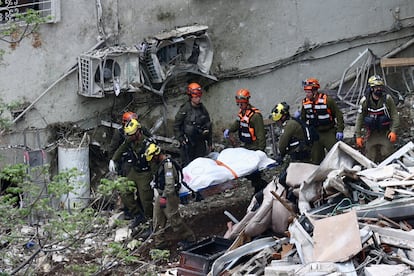 Israeli rescue teams carry a covered body while searching the site where a residential building was hit by an Iranian missile attack in Haifa on April 6, 2026.JAMAL AWAD (EFE)
Just meters from where the press was still taking pictures of rubble and household items, bomb disposal experts were trying to deactivate the warhead of the ballistic missile so it could be removed to a safe location, at the end of an 18-hour search for the remains of the four victims. They used tunnel boring machines and technological tools for detecting bodies.
This is the second-deadliest Iranian attack on Israel in more than five weeks of war, surpassed only by the nine deaths from another direct hit in Beit Shemesh (in Jerusalem province) in the early days of the conflict. On March 22, two missiles launched from Iran injured 200 people when they struck the towns of Arad and Dimona in southern Israel, where the Jewish state’s nuclear facilities are located. In total, Israel has recorded 23 deaths in attacks by Iran and the Lebanese militia Hezbollah.
In Lebanon, at least 1,460 people have died, including 125 children. In Iran, authorities have stopped counting bodies, although the U.S.-based humanitarian NGO HRANA puts the death toll at over 3,500, including 240 children, and medical sources cited by Reuters report more than 7,000 fatalities. But Israel is a country with cell phone alerts, air raid sirens, and a missile defense system, the Iron Dome, that the army says has over 90% interception effectiveness.
What could have happened in the retirement neighborhood on Mount Carmel in Haifa? The ballistic missile was detected en route, and residents received a high-level emergency alert on their cell phones. Then the sirens began wailing, warning of an imminent bombing. All the testimonies gathered on the ground agree that there was advance warning. But the projectile penetrated the various layers of the missile defense system.
The digital news outlet Times of Israel cites military sources indicating that the missile broke apart before impact, thus failing to explode. Military spokespeople say they are investigating whether there were failures in the interception system.
This is not the first time Israelis have questioned whether the army has sufficient resources to protect the more than 10 million Israelis concentrated in the central and coastal areas of this relatively small country. Recently, the failure to intercept two missiles in quick succession sparked public concern.
The army eventually admitted that they were not special state-of-the-art missiles, but rather that they tried to shoot them down with a modified version of a cheaper and more accessible system (the medium-range David’s Sling), instead of the Arrow 3 (long-range), originally designed for ballistic rockets launched from 1,200 miles away.
This Monday, Benjamin Netanyahu’s government announced it will increase production of Arrow missile systems to counter the Iranian threat. Each Arrow interceptor costs between $2 million and $3 million. The David’s Sling missile system costs around $1 million.
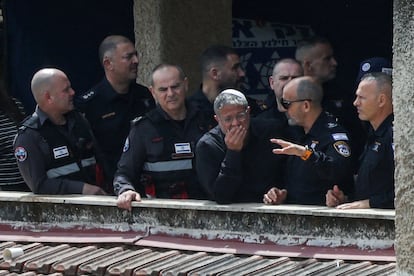 Israeli National Security Minister Itamar Ben-Gvir at the site of the missile impact in Haifa, Israel, on April 6, 2026. Shir Torem (REUTERS)
And why did the family buried in the rubble decide to continue with their Passover meal instead of going to the shelter? After nearly a month and a half of hostilities, Israelis seem to have grown accustomed to cell phone alerts, most of which are deactivated within a few minutes. Nor are there enough bomb shelters for everyone.
According to January 2025 data from the State Comptroller (Israel’s equivalent of the Ombudsman), approximately one-third (around 3.2 million) of the country’s population — primarily Arab — lacks adequate public or private shelters. In Haifa, 280,000 residents rely mainly on public shelters. The building that was hit had a communal shelter. And some residents told the EFE news agency that they had built a reinforced concrete safe room inside their apartment.
At the scene of the direct impact, the Mediterranean forest, the distant sea, and a stormy sky formed a funereal tableau on Monday afternoon for a war that is once again convulsing the Middle East.
Sign up for our weekly newsletter to get more English-language news coverage from EL PAÍS USA Edition