
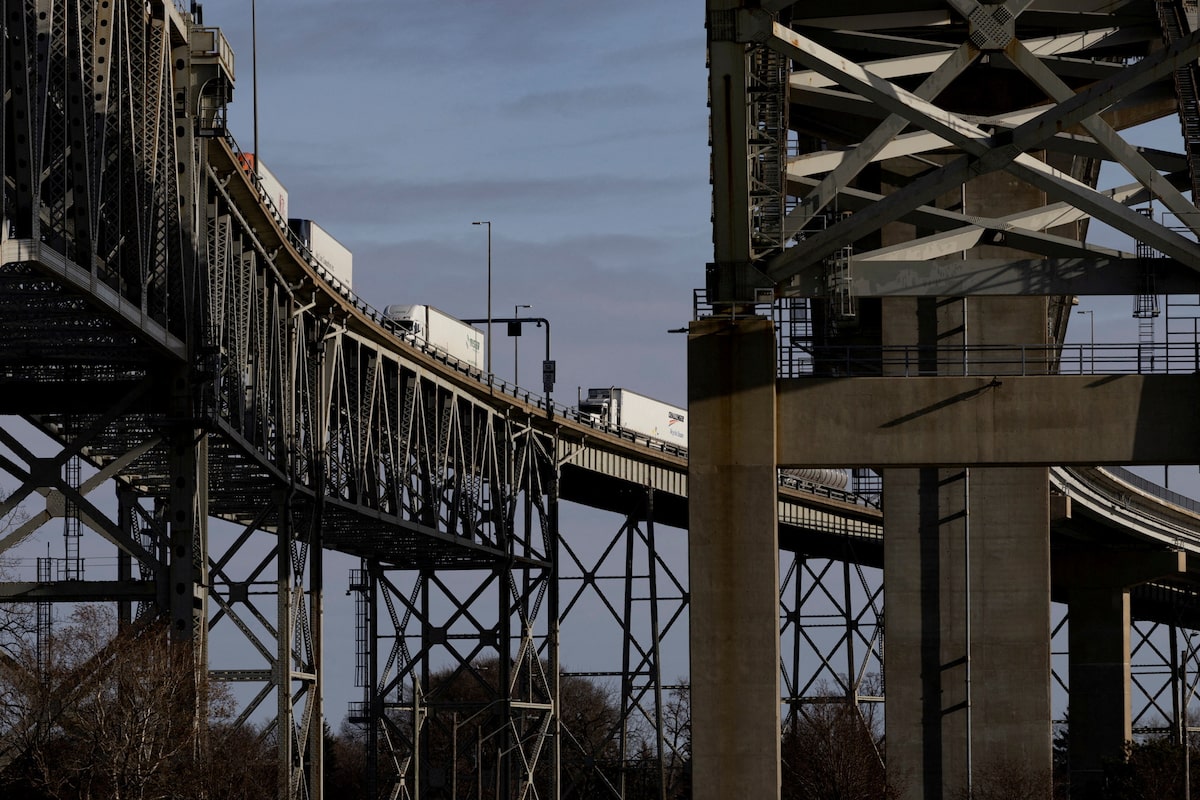
Trucks cross the Blue Water Bridge between Port Huron, Mich., and Sarnia, Ont., carrying goods between the U.S. and Canada last year.Emily Elconin/Reuters
The United States’ top trade official said he expects negotiations over the North American free trade pact to result in “two separate protocols” with Canada and Mexico layered on top of the existing agreement, and that negotiations will continue after July 1.
In an event on Tuesday in Washington, U.S. Trade Representative Jamieson Greer laid out his expectations for the review of the United States-Mexico-Canada Agreement (USMCA), which is scheduled to happen on July 1.
A key question heading into the review is whether the deal will survive as a trilateral pact, or be split into two separate bilateral agreements – an idea U.S. officials have floated several times in recent months.
“Our baseline is that things have to be changed,” Mr. Greer said about the USMCA, which came into force in 2020 and governs trade between the three countries. But he suggested the core of the agreement would remain in place, while bilateral issues would be dealt with separately with Canada and Mexico.
Analysis: Canada and Mexico on different paths heading into USMCA crunch time
There are “a bunch of load-bearing pillars” in the agreement that function well, Mr. Greer said. “If we get rid of them, I just have to go back and do it again.”
At the same time, he added, “our import-export profile is different with each country, the labour situation in each country is different, the reasons why we have deficits with these countries are different. So it necessitates two separate protocols that we can layer over those load-bearing pillars of USMCA.”
Mr. Greer said that he does not expect negotiations over these bilateral issues to be complete by the formal review date this summer.
“I think that we aren’t probably going to be able to resolve all issues by July 1, but I think we are on track to resolve many of them and to move as quickly as we can,” he said.
U.S. Trade Representative Jamieson Greer, pictured outside the White House on April 2, says USMCA talks will continue past July 1.Alex Wong/Getty Images
The U.S. began “technical discussions” with the Mexicans last month on a range of issues, including rules of origin, supply chain security and investment screening. Canadian trade officials re-engaged with their counterparts in Washington over the past month, but formal USMCA review talks between Ottawa and Washington have yet to start.
The agreement lays out three possible paths forward. On July 1, the partners can agree to renew the deal for 16 years. If they don’t, it starts a process of annual reviews that continue for 10 years, after which the agreement ends. Any of the three partners can also withdraw from the agreement with six months’ notice.
Mr. Greer suggested that the U.S. will pursue the second option.
“On July 1, what has to happen is the United States tells Canada and Mexico what we intend to do. Do we intend to just rubber stamp this thing and say, ‘All right, renewed, everything’s fine. Let’s hold hands and move on?’ Or do we say, ‘This is not sufficient, we have to have modifications to this agreement, we have to change it?’ And so we’ll enter into a period, we’ll be on the path to going out [of the agreement], which is actually a 10-year period. But we’ll be in negotiations during that time and try to resolve some things sooner rather than later.”
Opinion: As middle powers forge a future without the U.S., Canada walks a tricky path
Mr. Greer said that he had to report to Congress on June 1, a month ahead of the formal review date, to lay out the Trump administration’s plans.
Both Canadian and Mexican officials have said they want to retain the trilateral structure of the USMCA, while acknowledging that there are issues that will need to be addressed bilaterally with the United States.
“We’ve said all along that there will be a bilateral element to these discussions, and there will also be a trilateral element,” Dominic LeBlanc, minister responsible for Canada-U.S. trade, told reporters last week.
“The Treaty involves a trilateral review, that process will occur. But the American administration and our government and the Mexicans have also been clear that there are bilateral issues that properly will be worked on together by two countries, and it will necessarily form part of the discussion around the trilateral review,” Mr. LeBlanc said.
Mr. Greer has previously outlined trade grievances with Canada and Mexico, respectively, that the U.S. wants resolved as part of the USMCA review talks.
For Canada, this includes dairy quota allocation, digital-streaming rules and provincial bans on U.S. liquor. An updated list, published by Mr. Greer’s office last week, added several new complaints, including Canada’s move to establish sovereign cloud computing infrastructure, Buy Canadian policies and restrictions on provincial government procurement.
For Mexico, U.S. complaints include the use of “third-country content” in manufactured goods, the enforcement of labour laws and the country’s restrictions on investment in the energy sector.
Mr. Greer has also said he will push for more structural changes to the agreement that will apply to all three countries. These include tighter rules of origin (which lay out how much of a product must be made in North America to trade duty-free), as well as more alignment on external tariffs, screening of inbound investment and export controls.
Here, the U.S. goal is to pull more manufacturing to the United States, boost U.S. content in products made in all three countries, and limit Chinese products entering the United States through Mexican and Canadian supply chains.
“President Trump has been clear that he is dissatisfied with a lot of the outcomes of the USMCA. So while we certainly focus on the provisions, the nature of the provisions, the rules of origin, all these different things, the President is constantly looking at outcomes,” Mr. Greer said Tuesday.
Over the past year, the Trump administration has placed sectoral tariffs on a range of industries, including steel, aluminum, automobiles and forest products – in contravention of side agreements that were reached during the original USMCA negotiations. It has also placed tariffs on products that don’t meet USMCA rules of origin. The future of both the sectoral tariffs and the broad-based tariffs will be a key issue in the USMCA review talks.