
Old Wounds, New War: What This War Is Asking of Israel’s Elderly
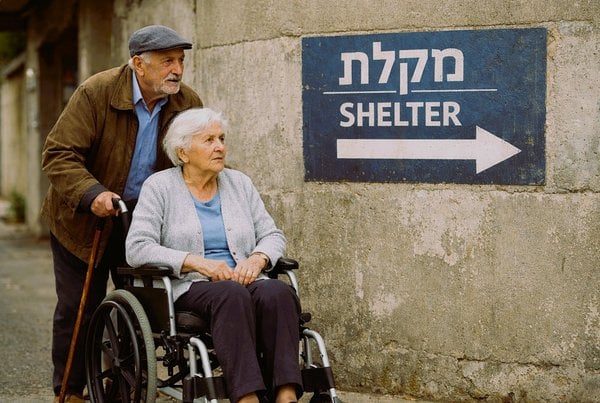
Picture a man in his late eighties somewhere in Israel. He knows his building’s shelter. He knows the route. He has probably timed it in his head, the way people do when a possibility becomes a recurring reality. He also knows that his knees are not what they were, and that ninety seconds is a different proposition at eighty-seven than it was at forty. He has navigated danger before — not in this country, not in this war, but in the particular experience of threat pressing against a body that cannot fully respond. More than once.
That last phrase is worth staying with. More than once.
Approximately 12.5 percent of Israel’s population is over 65, and that number is growing. Within that population, there were still nearly 147,000 Holocaust survivors as of last year. But the population I want to address is broader: anyone now in their seventies, eighties, or nineties who came to Israel from places where traumatic events were not abstractions — from Hungary, from Yemen, from Iran, from Ethiopia, from the former Soviet Union — people for whom displacement, violence, and persecution were formative experiences rather than history lessons. For this population, what happened on October 7 is not the first trauma. In most cases, it is not even the second.
Old Wounds, New War
There is a clinical phenomenon that most people have never heard of, and that I suspect most elderly Israelis have never had named for them. Researchers call it trauma reactivation. The basic finding: people who have previously experienced severe trauma are specifically vulnerable to having that older trauma reawakened — not merely triggered in a surface way, but genuinely reignited — by new events that carry even partial resemblance to the original. The nervous system has its own memory, encoded at a level deeper than narrative.
Research after October 7 confirmed this dynamic in an Israeli context: Holocaust descendants showed measurably higher rates of probable PTSD in the weeks following the attack than peers without that family history. What this means, practically, is that the elderly person struggling most in this war may not be the one who appears most distressed. They may be the one who has been quiet — who spent decades managing an old wound carefully, who found equilibrium through discipline or routine, and who is now finding that equilibrium disrupted in ways they cannot entirely explain, even to themselves.
A Word Directly to You
If you are reading this and recognize yourself in it — if something that felt long-settled has been less settled since October 7, if old feelings have returned in ways you didn’t expect and can’t fully explain — I want to say something directly to you.
What you are experiencing has a name. It is not a sign that you never truly healed, and it is not weakness. It is a known, documented response of a nervous system that has been here before and recognizes the terrain. The fact that it is happening again, after everything you have already survived, is not a verdict on your resilience. It is evidence of how much has been asked of you over a lifetime.
You are not obligated to speak about it. But you are also not obligated to carry it alone.
The Body in the Shelter
Ninety seconds. That is the warning time in central Israel. For a healthy, mobile adult, it is urgent but manageable. For someone managing a hip replacement, severe arthritis, Parkinson’s disease, or significant cardiac limitation, those ninety seconds present not just a practical problem but a daily confrontation with the body’s limits under the worst possible conditions. Some cannot make it to the shelter reliably. Some have had falls trying. And some have made the calculation — consciously or not — that the psychological cost of the rush outweighs the safety benefit, and stay where they are.
These decisions are made quietly, often alone, and almost never spoken aloud. What is being challenged is not only safety, but dignity. Making it to the shelter every time may not be possible. But preparing as well as one can, reducing risk where possible, and accepting the body’s limits without self-blame are not lesser responses. They are realistic ones. And realism, in these conditions, is a form of strength.
What Has Actually Helped People Survive
Primo Levi spent nearly a year in Auschwitz. He lost colleagues, witnessed death as a daily fact, and had nothing — no freedom of movement, no certainty of survival, no control over any external circumstance. What he observed, and later wrote about with extraordinary precision, was this: the prisoners who maintained some connection to an inner life — who held onto curiosity, small acts of dignity, or some sense of purpose beyond the immediate moment — fared differently than those who lost that orientation entirely. Not always physically. But psychologically, in a way that mattered for as long as they lived.
Levi was not arguing that attitude determines survival. He was arguing something more precise: that even under extreme constraint, something interior remains available — a way of relating to what cannot be changed. That insight has particular resonance now, because the circumstances elderly Israelis face contain so much that cannot be changed. The war cannot be willed away. The body cannot be ordered back to what it was at sixty. The history cannot be unlived.
But within all of that constraint, something remains. Research on resilience in older adults consistently identifies small, daily acts of self-determination as clinically meaningful. The phone call initiated rather than waited for. The meal chosen with care. The grandchild read to for twenty minutes. The story written down, the prayer said, the garden watered. These are not trivial consolations. They are documented regulators of the nervous system, because the nervous system responds to the experience of agency even when that agency is small in scope.
The research on social connection is equally clear. A study of older Israeli adults following the 2014 Gaza conflict found that social connectedness measurably buffered the relationship between warfare exposure and deteriorating mental and physical health. For families reading this: visiting, calling, sitting with an elderly parent or grandparent during this period is not sentiment. It is medicine. The evidence says so.
What Remains
The elderly person who has survived what this generation has survived — persecution, displacement, earlier wars, the losses that accumulate over a long life — carries something no one younger yet possesses. A knowledge of endurance. A demonstrated capacity for continuing when continuing seemed impossible. That is not diminished by the fact that it has been tested more times than it should have been.
What this war is asking of Israel’s elderly is genuinely too much. Naming that plainly is not pessimism. It is respect.
And within that too-much, something remains: small choices, connection, and meaning. Not recovery as restoration, but recovery as the recovery of whatever peace is still within reach.
Dr. Ivan Gulas is a Board-Certified Clinical Psychologist, former faculty member at Harvard Medical School, and author of ‘Changing the Odds: A New Understanding of PTSD and the Path to Recovery.’ He writes regularly for the Times of Israel on the psychological dimensions of the current conflict.
Dr. Ivan Gulas, Ph.D., ABPP is a Board-Certified Clinical Psychologist with decades of clinical experience, including more than two decades on the faculty of Harvard Medical School. A childhood survivor of the 1956 Hungarian Revolution, he brings both personal and professional depth to his work on trauma and recovery. He graduated with honors from Boston University and completed his doctoral studies at Dartmouth College and Ohio University, and his clinical internship at Beth Israel Hospital / Harvard Medical School. Drawing on a broad command of treatment modalities, he tailored his approach to each patient’s needs, encompassing psychodynamic, cognitive and behavioral therapies, and neuropsychological evaluations.
Following his clinical career in Boston, he relocated to Los Angeles and has remained active in writing, publishing, and nonprofit engagement. His books include Changing the Odds: A New Understanding of PTSD and the Path to Recovery, Asylum Without Walls, and the forthcoming Senior Sex, Intimacy and Isolation. He is also the recipient of the Humanitarian of the Year Award by the Emanuel Foundation for Hungarian Culture, a charity established by actor Tony Curtis in 1987 to restore Jewish heritage sites in Hungary.