
Over a month into the conflict between Israel, Iran, and the United States, Iran has shown no sign of losing its capacity to control the Strait of Hormuz. Although the United States has agreed to a two-week suspension of strikes against Iran, Tehran continues to exercise de facto control over the Strait of Hormuz. Iran’s Foreign Minister has declared that vessels seeking to transit the Strait must coordinate directly with Iranian armed forces, subject to unspecified “technical limitations”—a posture that amounts to a unilateral assertion of sovereign authority over one of the world’s most critical maritime chokepoints. Meanwhile, President Trump has pledged that the United States “will be helping with traffic buildup in the Strait,” but that commitment remains undefined, and it is far from certain whether U.S. naval forces will play any role. Since the conflict started, Iran has rerouted commercial shipping through Iranian territorial waters and imposed a $2 million transit fee—an illegal “Tehran toll booth.” The fragile ceasefire does not appear to dismantle that arrangement.
The United States must define the operational scope of its naval commitment in the Strait. And Iran’s self-declared “technical limitations” must be rejected outright by the international community and not be made permanent. Limiting transit passage through the Strait of Hormuz is inconsistent with the freedom of navigation guaranteed under international law.
At the outset of the conflict, I analyzed the key legal and operational issues in the Strait of Hormuz, assessing that the Strait’s closure would provide Iran with enormous strategic leverage. One month in, that assessment has grown considerably darker. Iran has proven it can deny transit at an acceptable cost to itself—and no plausible U.S. military option can reliably reverse that in the near term. Iran has been weakened militarily, but remains far from defeated. Indeed, Iran has demonstrated the capacity to launch strikes hundreds of miles from its territory while shooting down a U.S. F-15E Strike Eagle, one of the most sophisticated aircraft in the American arsenal.
The logical takeaway is uncomfortable: Iran has established the capacity to control the Strait of Hormuz, perhaps indefinitely. Overwhelming military force alone is unlikely to change that reality. What is needed is both a sustained multinational effort to keep the Strait open and a diplomatic solution to restore transit passage rights and freedom of navigation. Tragically, neither appears achievable at this moment, and the U.N. Security Council just rejected a Resolution aimed at compelling Iran to open the Strait. We are witnessing a fundamental miscalculation of Iran’s leverage and the limits of U.S. military power to achieve broader strategic objectives.
The Trump administration has remained focused almost exclusively on military force, threatening to bomb Iran “back into the Stone Age” and “wipe out a whole civilization” while demanding that other nations take responsibility for reopening the Strait. Call it the anti-Pottery Barn rule: we broke it, you fix it. But that rhetoric and those military means have proven an ill fit for the task. In the meantime, Iran has a new source of revenue and an upper hand in the Strait ¾an illegal one ¾ never seen in the region.
The Strait’s Closure Has Produced a Cascading Energy Crisis
The economic consequences have been severe. The Strait of Hormuz accounts for approximately 20 percent of the world’s oil supply, and many Asian nations are wholly dependent on Middle Eastern energy sources. Only six or fewer ships are now transiting daily, with Iran controlling access on a selective basis. Some European and Asian refiners are paying nearly $150 a barrel for certain crude grades. The head of the International Energy Agency has described the blockade as more consequential than the disruptions of 1973, 1979, and 2022 combined. The disruptions have cascaded well beyond energy markets: fertilizer shipments are blocked, food insecurity concerns are mounting, and aluminum and helium markets have been severely affected.
Iran’s Demand: Treat the Strait of Hormuz as the Turkish Straits or Suez Canal
Iran has drawn explicit lessons from this disruption and is now seeking to institutionalize its control. Rather than closing the Strait to all traffic indiscriminately, Tehran has weaponized access selectively. Iran’s Foreign Minister announced that ships from China, Russia, India, Iraq, and Pakistan would be permitted to transit freely, while Iranian lawmakers have moved to formally codify Iran’s sovereignty and control over the Strait — creating a toll-collection regime that the Gulf Cooperation Council has confirmed is already operational, in flagrant violation of the law of the sea. Of note, Russia and China vetoed the Security Council Resolution, not an unsurprising outcome considering that Iran is favoring Russian and Chinese vessels.
Iran appears to be seeking legal authorities analogous to those Turkey holds over the Turkish Straits under the Montreux Convention of 1936, or those Egypt exercises in charging tolls to transit the Suez Canal. The Montreux Convention empowers Turkey to regulate the passage of warships through the Straits during wartime — an authority Turkey invoked at the outset of the Russia-Ukraine War.
The Strait of Hormuz operates under an entirely different legal regime. It is an international strait governed by Article 37 of UNCLOS, which establishes a non-negotiable right of transit passage. Tehran has gone further: among its stated conditions for ending the conflict is explicit recognition of Iranian sovereignty over the Strait, with pending legislation to “formally codify Iran’s sovereignty, control and oversight over the Strait of Hormuz” and create a permanent revenue stream through the collection of fees — an arrangement Iran has characterized as “entirely natural.” Iran is using the crisis to attempt a wholesale rewrite of the foundational rules governing transit passage. The rewrite goes far beyond anything the U.S. could legally accede to or reasonably agree to. In the interim, every effort must be made to resist that attempt; military force alone will not reopen the Strait.
Iran’s Actions Violate the Law of the Sea
Iran and the United States have longstanding disagreements about the applicability of UNCLOS to the Strait of Hormuz, a dispute that my colleague James Kraska described as a “Legal Vortex.” Still, the better reading is that transit passage is a foundational right under customary international law and UNCLOS. It is not a privilege that Tehran may selectively grant or monetize. Although neither Iran nor the United States is a party to UNCLOS, the transit passage regime for international straits is widely regarded as reflecting customary international law binding on all states regardless of ratification status. Iran’s closure violates those obligations in at least three respects.
First, the Strait of Hormuz is a “strait used for international navigation” within the meaning of Article 37 of UNCLOS, connecting one part of the exclusive economic zone to another. International straits under the law of the sea make clear that all ships and aircraft enjoy the right of transit passage, “which shall not be impeded.” That right is not suspended by armed conflict — UNCLOS does not provide for its automatic termination in wartime.
Second, Iran’s $2 million transit fee violates the prohibition on charges levied upon foreign ships by reason of passage alone. Under Article 26 of UNCLOS, charges may be levied only as payment for specific services rendered to the transiting vessel, applied without discrimination. Tehran’s fee is neither linked to any service nor applied without discrimination — it is a selective toll imposed for purely coercive purposes.
Third, Iran’s attempt to claim Montreux-style authority over the Strait has no legal foundation. The Montreux Convention predates UNCLOS by decades, and Article 35 of UNCLOS explicitly preserves “long-standing international conventions in force.” This carve-out reflects the specific historical bargain Turkey struck in 1936, not a template available to other straits states by analogy. There is no “Strait of Hormuz Convention,” and Iran cannot conjure one through unilateral assertion.
Iran may argue that the war itself—which 100 international law scholars and analysts, including Tess Bridgeman, Mike Schmitt, and Ryan Goodman, have assessed as resting on an exceptionally weak legal foundation—justifies extraordinary measures. But a questionable jus ad bellum basis for the conflict does not trigger suspension of transit passage rights that affect belligerents and non-belligerents alike. The world’s shipping does not lose its rights because the United States launched a legally contested war.
Of course, legal correctness and strategic leverage are not the same thing. Iran has correctly diagnosed the Strait’s strategic importance and converted geography into coercive power in a way that neither airstrikes nor elite ground forces have yet been able to answer.
Overwhelming Military Power Will Not, by Itself, Open the Strait
The Trump administration has responded to the strategic stalemate by deploying its most visible military assets. The Pentagon has ordered roughly 2,000 soldiers from the 82nd Airborne’s Immediate Response Force to the region, supplementing several thousand Marines. The 31st Marine Expeditionary Unit arrived on March 27 with amphibious assault assets and strike aircraft. The visible mission under discussion is the seizure of Kharg Island — a five-mile landmass in the northern Persian Gulf handling roughly 90 percent of Iran’s oil exports — on the theory that controlling Tehran’s primary revenue source would compel it to reopen the Strait. Reports indicate the U.S. is already striking targets on Kharg Island, potentially as a precursor to a broader amphibious operation.
The theory is superficially compelling. The operational reality is far more treacherous.
Retired Admiral James Stavridis, the former Supreme Allied Commander of NATO, has warned that the first challenge for any force targeting Kharg is simply reaching it. That means transiting a Strait where massive drone swarms, explosive-laden small boats, and anti-ship missiles will be directed at any amphibious ready group. Even assuming the force gets through, the island itself presents the next problem. Iran has emplaced new air defenses and possibly naval mines around Kharg and reinforced its garrison specifically in anticipation of a U.S. assault. Stavridis has stated flatly that Iran has “already set numerous traps” on the island and has done everything to prepare for the destruction of American forces there.
Even assuming tactical success, the operation collapses at the strategic level. A Marine garrison on Kharg becomes the most predictable target in the theater. Iran does not need to defeat all U.S. forces to neutralize the operation — it needs only to strike the oil terminal’s storage infrastructure once. Tehran has explicitly threatened to reduce U.S.-linked oil facilities to “a pile of ashes” if targeted.
There is a much deeper structural problem. Even if the United States seizes Kharg, Iran has demonstrated the ability to sustain operations without the roughly one million barrels per day the island represents in export revenue. More critically, Iran’s arsenal of low-cost Shaheed drones—each costing thousands of dollars—can disrupt maritime shipping worth billions, damage energy infrastructure throughout the Gulf, and impose a de facto blockade through the threat of attack alone. One month into the conflict, Iran struck U.S. forces hundreds of miles away at Prince Sultan Air Base in Saudi Arabia. The risk of attack, even without sustained execution, is sufficient to keep insurance rates prohibitive and shipping minimal.
Oil analysts and executives warn that the Strait must reopen by mid-April or supply disruptions will grow significantly worse. This mid-April timing reflects the normal journey time for tankers transiting from the Persian Gulf to Australia and Asian markets. Yet the window for a military solution is narrowing at exactly the moment the military option looks least promising. While President Donald Trump has already twice extended his deadline for Iran to reopen the Strait, Trump’s latest, expletive-ridden threats have a far more menacing and unhinged quality.
Where Do We Go from Here?
The United States retains overwhelming military superiority in conventional terms. But this crisis has not been a test of conventional dominance. It has been a test of whether that dominance can translate into control over a contested maritime chokepoint in the face of asymmetric, persistent denial. So far, it has not.
Iran has shown that it does not need to defeat U.S. forces to achieve its objectives. It needs only to make transit through the Strait sufficiently dangerous, unpredictable, and expensive that global shipping grinds to a halt or submits to its terms. That is a considerably lower bar—and one Iran appears capable of sustaining.
This is the central strategic reality: when Iran clamps down, the Strait of Hormuz cannot be reliably reopened by force alone. Not quickly, not cheaply, and not without unacceptable risk of escalation and broader regional disruption. Even successful tactical operations—whether strikes on Kharg Island or limited maritime engagements—do not resolve the underlying problem of persistent, low-cost maritime denial across a vast and heavily contested coastline.
If the Strait is to truly reopen, it will require more than demonstrations of military power. It will require a coordinated multinational effort to restore confidence in maritime transit, likely including naval escorts, insurance backstops, and sustained diplomatic engagement with regional actors. Ideally, the United States would lead this effort, but the Trump administration has isolated NATO and other core Allies with threats to attack Greenland, imposing massive tariffs, and insulting nations with ad hominem attacks. Never has the United States been so isolated. In a promising sign, last week Britain organized 40 foreign ministers to discuss ways to reopen the Strait of Hormuz, an important first step that should be built upon. All options should be on the table, including reflagging tankers and conducting convoy operations that were used with some success in the 1988 Tanker Wars. Tragically, none of that appears to be on the horizon. Just incendiary Truth Social posts without sustained diplomatic engagement and U.S. leadership as we lurch from one crisis to another. And it is simply too dangerous to transit the Strait with Iranian military opposition and the threat of a missile or drone strike on a tanker. Most importantly, opening the Strait requires a negotiated outcome that preserves the legal regime of transit passage without conceding to Iran’s attempt to rewrite it.
In sum, the U.S. appears to be solving the wrong problem. The United States has been applying force to defeat Iranian capabilities, when the actual problem is Iran’s ability to impose risk at scale. Until a real resolution is reached, the uncomfortable truth remains: geography, not firepower, is dictating outcomes in the Strait of Hormuz—and Iran is exploiting that reality with increasing effectiveness.
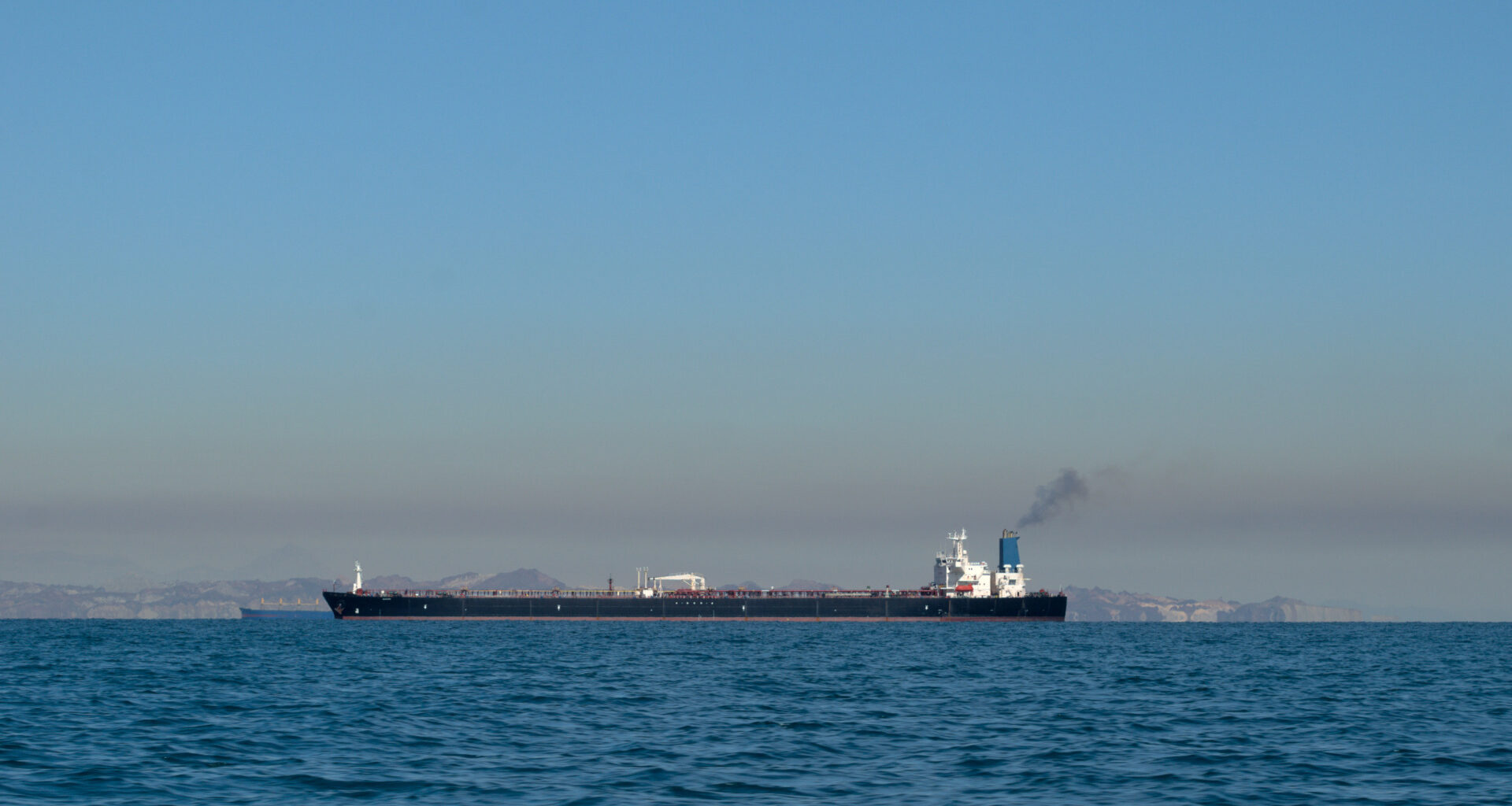
FEATURED IMAGE: A large oil tanker emits smoke while sailing through the Strait of Hormuz, Persian Gulf, Iran, June 2020. (Germán Vogel/Getty Images)