

For most Americans, the war involving Iran is unfolding as breaking international news, a conflict half a world away.
For Kenneth Kraus of Roswell, it is something else entirely — it’s personal.
Kraus knows what it means to be at the mercy of the Iranian regime.
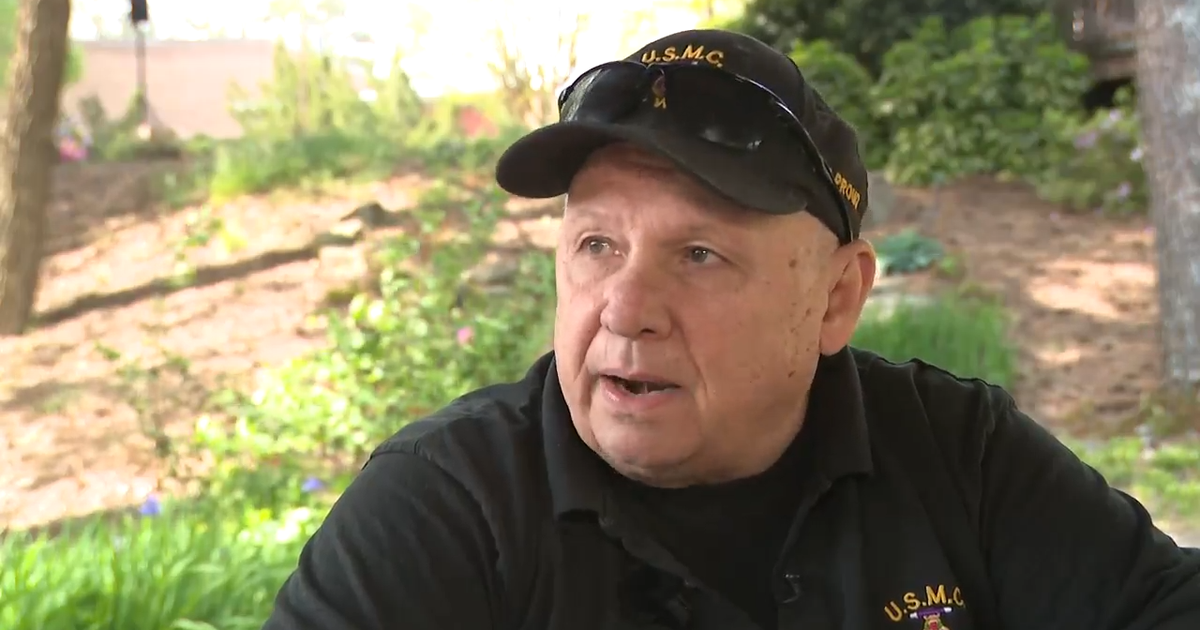
For Kenneth Kraus of Roswell, the conflict in the Middle East isn’t just news—it’s personal.
CBS News Atlanta
“This regime murders its own people,” he said. “They’re maniacal. They’re demonic. That’s the best way I can describe them.”
Long before the current war in Iran, the 444-day Iran hostage crisis transfixed the nation. Kraus was just 22-years-old, working as a U.S. Marine embassy guard stationed in Tehran. He was the first American taken hostage by Iranian militants during the 1979 assault on the U.S. Embassy.
He says he was shot, beaten, starved, and tortured, then hauled before an Islamic Revolutionary Court where he was sentenced to death, and shown an execution order bearing the signature of the cleric who would later become Iran’s Supreme Leader, Ayatollah Ali Khamenei.

A pedestrian passes a poster of Ayatollah Ali Khamenei in Tehran on March 5, 2026.
Majid Saeedi / Getty Images
After eight days in captivity, Kraus was released.
He returned home a decorated Marine, awarded the Purple Heart, and reunited with a mother he feared he would never see again.
Now, nearly half a century later, Kraus watches renewed fighting in the region with emotions still raw. Memories of that ordeal remain meticulously preserved: newspaper clippings, photographs, military honors, and the visual record of a chapter in American history he did not merely witness but survive. He even wrote a book about his experience.

CBS News Atlanta
When news broke that the cleric tied to his death sentence had been killed in a U.S.-Israeli airstrike, Kraus says the moment overwhelmed him.
“When I heard that, I dropped to my knees and thanked God that he let me live long enough to see him dead,” Kraus said.
For Kraus, the frustration runs deeper than personal trauma.

TEHRAN, IRAN – MARCH 13: Smoke rises after airstrikes in Tehran, Iran on March 13, 2026. Successive explosions were heard across the Iranian capital Tehran on Friday, amid continuing regional tensions following US and Israeli strikes on Iran
Fatemeh Bahrami/Anadolu via Getty Images
He says it is difficult to watch the United States and Iran remain locked in hostility nearly 50 years after his captivity.
“The people in Iran, the average everyday person, wants freedom,” Kraus said. “And right now you’re never going to have a better shot of getting rid of that regime than you do now.”
The retired Marine and former Roswell police officer says a lifetime of public service helped give meaning to the suffering he endured.

At 22, U.S. Marine Kenneth Kraus stood guard in Tehran—months before becoming the first American taken hostage in the 1979 embassy assault.
CBS News Atlanta
“You have to have faith in something you believe in,” he said. “If it’s just a job, you’re not going to have the desire to confront adversity.”
Today, Kraus shares his story with schools and civic groups across Georgia as living proof that consequences of armed conflict can endure for generations, and echo close to home, long after the headlines fade.
More from CBS News