
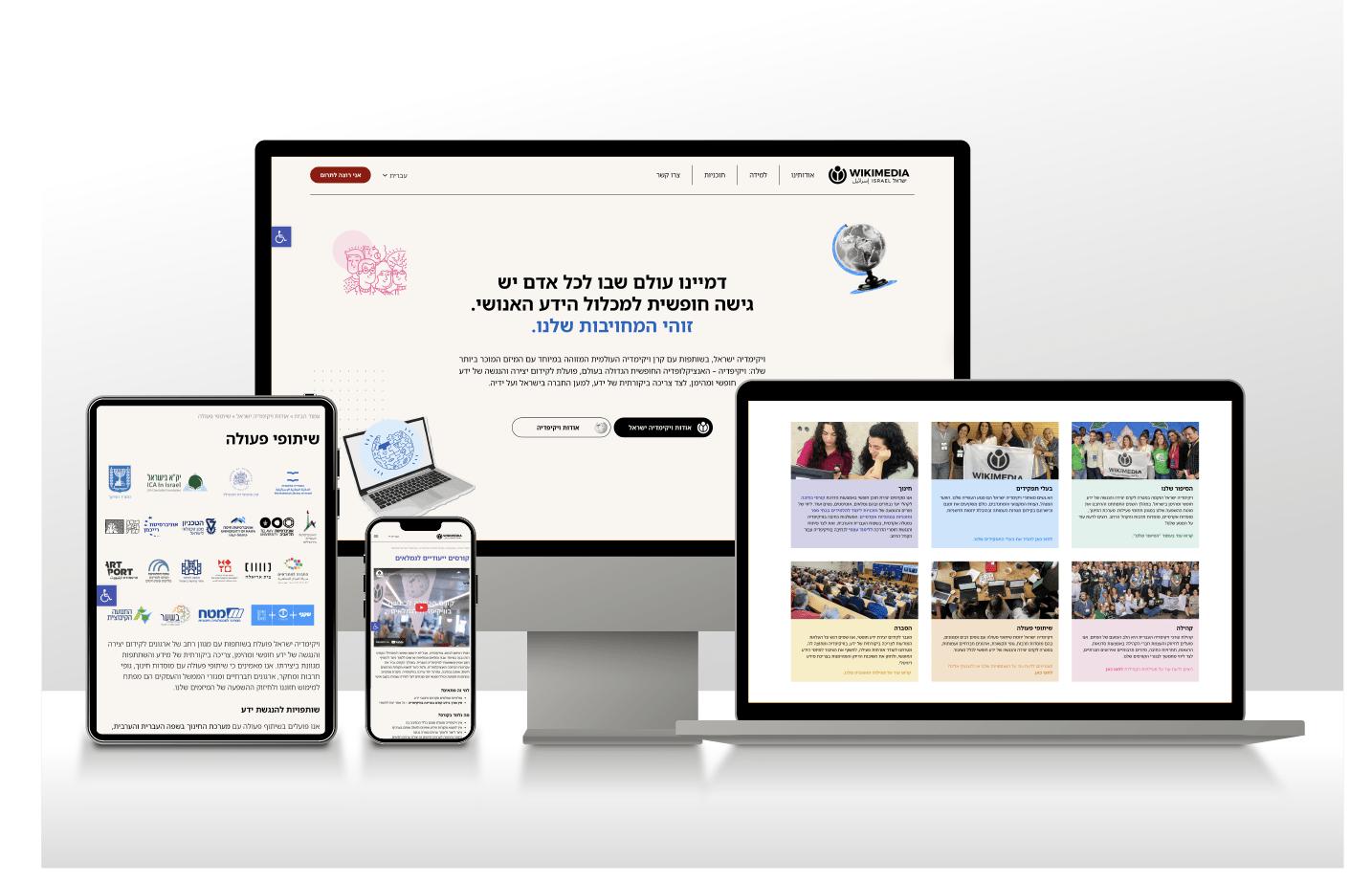
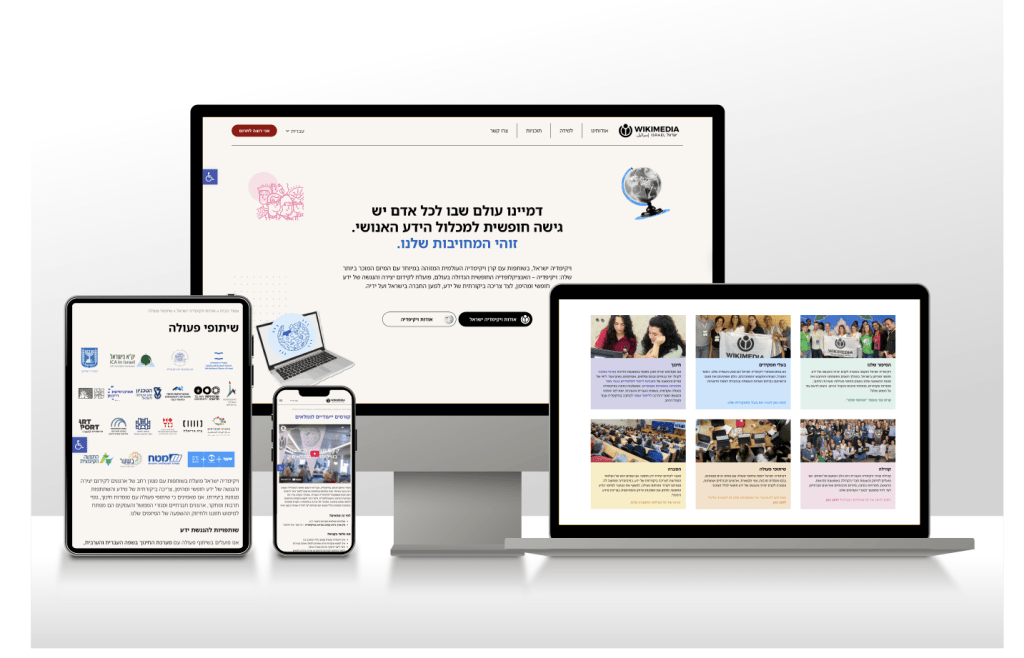
 CC BY-NC-SA 4.0 André Frank / Wikimedia Israel | https://commons.wikimedia.org/wiki/File:WMIL_Website_Mockup.png
From a 2012 website to a 2026 vision
When Wikimedia Israel first launched its website in 2012, it reflected the organization it was at the time. More than a decade later, both the organization and the broader knowledge ecosystem had changed dramatically, but the website had not.
Over the years, layers of content were added, but without a clear structure. Navigation became increasingly complex, the user experience deteriorated, and the site no longer reflected Wikimedia Israel’s strategic priorities, branding, or voice. It had become, in many ways, a legacy platform—informative, but not effective.
The turning point came when the team realized something striking: instead of directing people to the website, they were increasingly sending them to social media just to understand what Wikimedia Israel actually does.
That was the moment it became clear: the website needed not just an update, but a complete rethinking.
From information to participation
Wikimedia Israel operates in a space where Wikipedia is widely known, but the role of Wikimedia is often misunderstood. One of the key goals of the new site was therefore to improve clarity, helping audiences understand what Wikimedia Israel is, what it does, and how it relates to Wikipedia.
Alongside this need for clarity, the redesign also served as an opportunity to reflect Wikimedia Israel’s updated strategic direction. Following an internal strategic review, the organization defined four key goals:
Encouraging the public and cultural institutions to create and provide access to free and reliable knowledge.
Increasing public awareness of critical consumption of knowledge
Promoting the participation of marginalized groups in knowledge creation and expanding knowledge about them.
Strengthening Wikimedia Israel as a sustainable entity.
These goals became a foundation for the site’s structure, content, and calls to action.
Making choices: what to remove, what to elevate
One of the most significant parts of the process was not adding content, but removing and reorganizing it.
Over the years, the website had accumulated content designed primarily for the internal editing community. In the new version, this was intentionally streamlined. Internal-facing activities were consolidated into a single “Community” section, while the website itself was repositioned as a platform for external audiences.
At the same time, key programs that had previously been grouped together were given dedicated visibility. For example, instead of presenting all courses on a single page, each program—general audiences, retirees, women, neurodivergent participants, and institutional partnerships—now has its own space.
A new “About Wikipedia” section was also introduced, explaining how Wikipedia works, how it is funded, and how it connects to Wikimedia—helping bridge a critical gap in public understanding.
Simplicity as a design principle
The team made a deliberate decision to simplify the site’s structure.
The entire website was designed around just three levels:
Homepage
Archive pages
Content pages
This ensured that users would never get lost in deep navigation layers.
The main menu was organized into three core areas:
About (Wikimedia Israel and Wikipedia)
Learning (courses and self-learning resources)
Programs (education, academia, and GLAM)
Guided by principles of simplicity, accessibility, and storytelling, the design also aligned with Wikimedia Foundation branding, while drawing inspiration from other affiliates, especially Wikimedia UK.
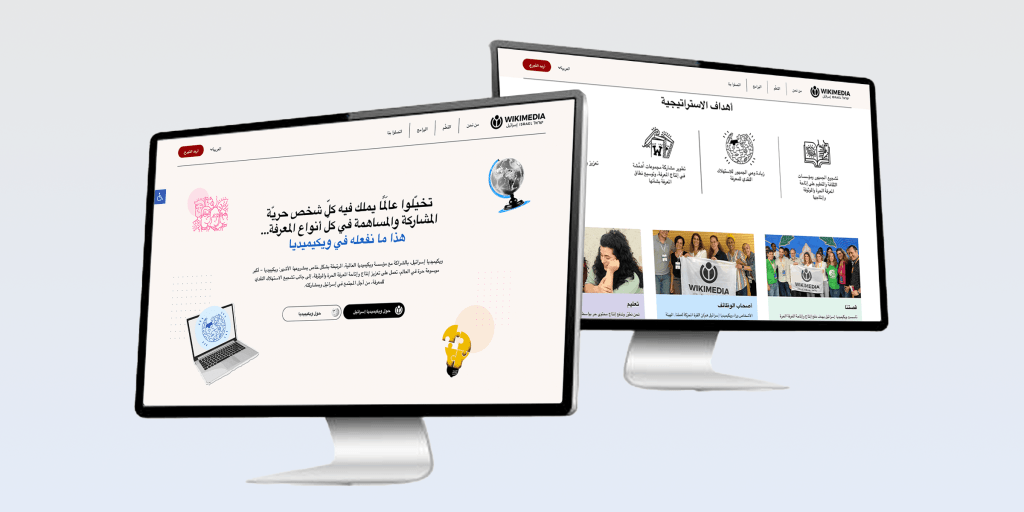 CC BY-NC-SA 4.0 André Frank / Wikimedia Israel | https://commons.wikimedia.org/wiki/File:WMIL_Arabic_Website_Mockup.png
A fully multilingual approach
Perhaps one of the most significant shifts was the decision to move from partial translation to full multilingual accessibility.
Previously, the site included limited content in English and Arabic. In the new version, the entire site is available in Hebrew, English, and Arabic.
This decision was rooted in principle: if Wikimedia Israel operates in both Hebrew and Arabic knowledge spaces, then access to its work should be equally available in both languages.
Rather than relying on machine translation, all content was translated by humans, ensuring clarity, cultural nuance, and readability.
A year-long process shaped from within
The redesign process took over a year and involved the entire organization.
While external vendors supported development and design, the team ultimately chose to write all content internally. After unsuccessful attempts to work with external copywriters, it became clear that capturing the voice and complexity of Wikimedia Israel required deep internal ownership.
This became one of the project’s defining insights: a website is not just a communication tool, it is an expression of institutional identity.
Early impact: from presence to conversion
The impact of the new site was immediate.
Traffic increased, but more importantly, the site began to fulfill its intended role:
Users started registering for programs directly through the site
Institutional partnerships became easier to establish
Wikimedia Israel strengthened its presence as a credible, visible organization
For the first time, the website was not just a reflection of activity, it became an active driver of it.
Lessons for the Wikimedia movement
For other Wikimedia affiliates, several key lessons emerged:
1. Explain Wikimedia clearly
The relationship between Wikimedia and Wikipedia cannot be assumed—it must be actively communicated.
2. Design for external audiences
Internal communities have many communication channels. The website should focus on those who are not yet part of the movement.
3. Invest in your digital presence
A well-designed website remains a critical asset for institutional credibility, partnerships, and growth.
4. Build from within
Authenticity matters. Involving the entire team in shaping content leads to a stronger and more accurate outcome.
More than a website
Beyond design and functionality, the process itself had a deeper impact. To build the new website, Wikimedia Israel had to ask fundamental questions: Who are we? What do we do? And why does it matter?
The result was not just a new website, but a clearer identity. And ultimately, that clarity is what allows others to join.
To tell the world who you are, you first need to deeply understand it yourself.
Visit us: https://wikimedia.org.il/en/
Can you help us translate this article?
In order for this article to reach as many people as possible we would like your help. Can you translate this article to get the message out?
Related