
The Middle East ceasefire appeared shaky less than two days after it was announced by U.S. President Donald Trump, as Israel bombed more targets in Lebanon on Thursday and Iran showed little sign of relinquishing its blockade of the Strait of Hormuz.
Iranian negotiators were expected to set off later on Thursday for Pakistan for the first peace talks of the war, where they are due to meet a delegation led by U.S. Vice -President JD Vance on Saturday.
Iran has flexed its control over the Strait of Hormuz, a crucial artery for oil, fertilizer and other resources, demanding tolls for safe passage. Tehran said there would be no ceasefire deal as long as Israel was striking Lebanon, as both it and mediator Pakistan believe was agreed to.
Iran’s Revolutionary Guards navy posted a map on Thursday showing alternative shipping routes in the strait to help ships avoid naval mines, the semi-official Iranian news agency ISNA said.
The futures contracts for delivery of oil in May or June, typically used as benchmarks for global oil prices, have eased since Trump announced the ceasefire. But the price of physical oil for delivery has shot up to record levels as refiners struggle to meet demand with one-fifth of the global supply knocked out for a month and a half.
Trump announced the ceasefire on Tuesday night just before a deadline he had set to destroy Iran’s “whole civilization” unless it unblocked the strait. Both he and Defence Secretary Pete Hegseth have since said the U.S. military is prepared to hit Iran harder than before if the ceasefire doesn’t hold.
WATCH | Blockade weakens food security: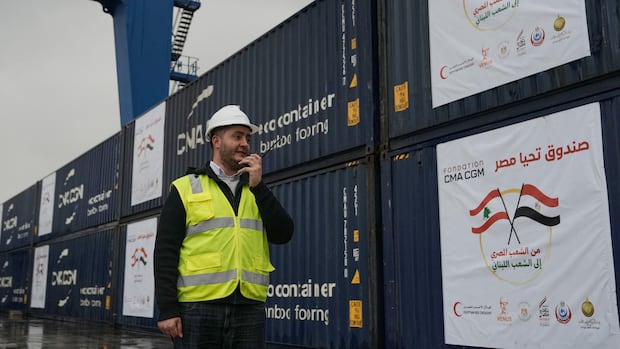
Hormuz crisis a ticking time bomb for food security, IRC representative says
The International Rescue Committee (IRC) says the near-total blockade of the Strait of Hormuz is worsening already strained food security in the region. Ciarán Donnelly, the IRC’s senior vice president of international programs, says the knock-on effects are also being felt globally in humanitarian aid.
Just a handful of ships were tracked crossing the strait on Wednesday, according to shipping news publisher Lloyd’s List. Hundreds more are within the Persian Gulf.
“If I were a shipowner or operator stuck in the Persian Gulf, I would wait a few days to see how the U.S., Israel, and Iran respond to this planned ceasefire,” said Roberto Giannetta, chairman of the Hong King Liner Shipping Association. “If it looks likely to be sticking, I may try moving my vessels out in the second week, or in a cluster or convoy together with other ships.”
Abu Dhabi state oil company ADNOC’s CEO Sultan Al Jaber said on Thursday in a post on LinkedIn that the Strait of Hormuz is not open, and it must be opened unconditionally. The strait is a natural waterway governed by international law, which guarantees transit rights, he said.
Canada was among a host of countries, mostly in Europe, which pledged in a statement on Wednesday to “contribute to ensuring freedom of navigation in the Strait of Hormuz” without offering specifics.
Prime Minister Giorgia Meloni of Italy, another signatory, told parliament in Rome on Thursday that the countries were trying to “build security conditions that allow for the full restoration of freedom of navigation and supply.” However, Deputy Prime Minister Matteo Salvini said on Wednesday that Italy would not send any ships to help patrol the strait without a UN mandate.
LISTEN | Economist geopolitics editor David Rennie on a state of confusion:
Front Burner30:30Did the Iran war change anything?
Pressure over Lebanon
Israel, which invaded Lebanon last month in parallel with the war on Iran to root out the armed group Hezbollah, Tehran’s ally, says its actions there are not covered by the ceasefire announced late on Tuesday by Trump. It was a position also held by the White House.
Lebanon’s Health Ministry said at least 203 people were killed and more than 1,000 wounded in widespread Israeli strikes in central Beirut and other areas of Lebanon on Wednesday. The death toll was the highest for a single day in Lebanon during more than five weeks of renewed war between Israel and Hezbollah.
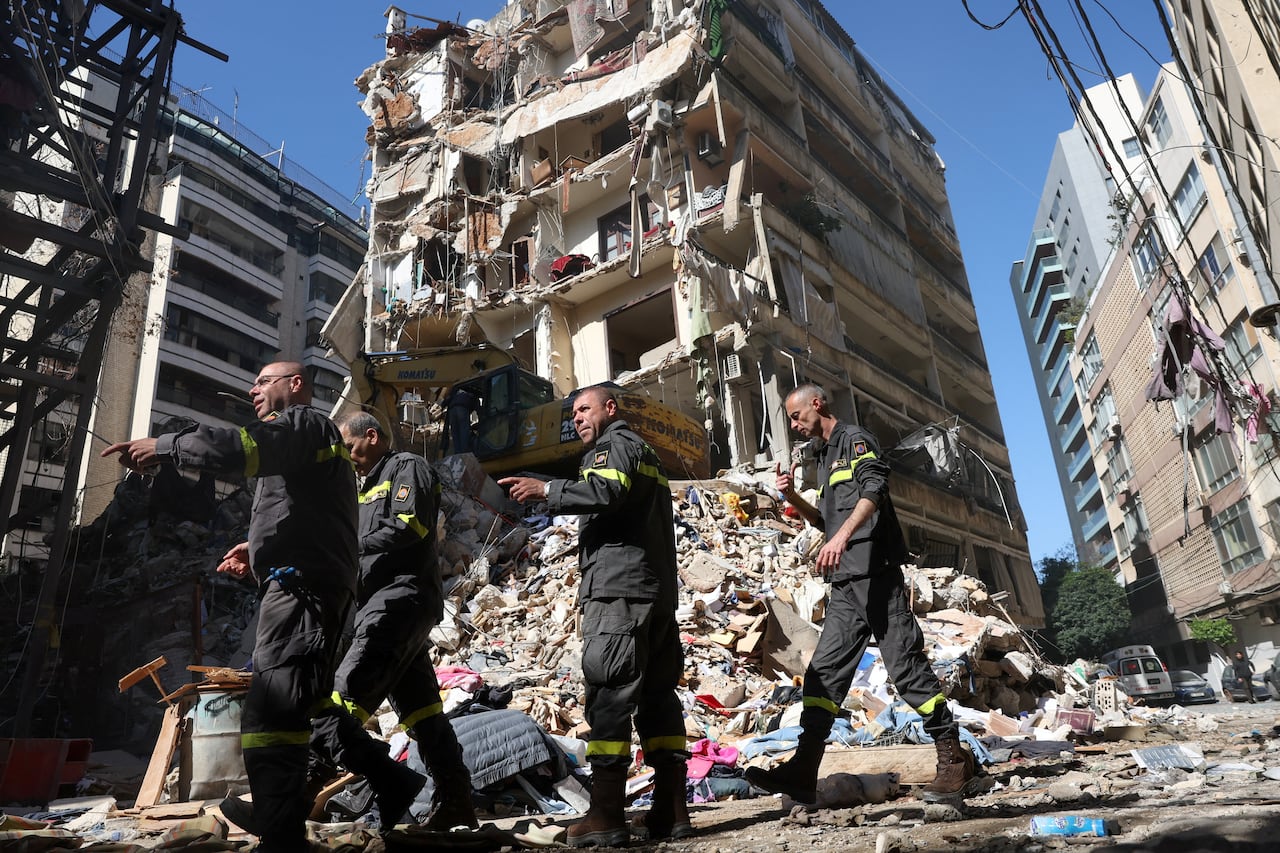 Rescuers work at the site of an Israeli strike carried out in Ain Al Mraiseh in Beirut, Lebanon on Thursday.
(Mohamed Azakir/Reuters)
Iranian deputy foreign minister Saeed Khatibzadeh told BBC Radio that Israel’s attacks on Lebanon were a “grave violation” of the ceasefire.
Pakistan’s Foreign Ministry condemned the Israeli operations on Thursday, which it said “undermine international efforts to establish peace and stability.”
A host of countries, including prominent U.S. allies Britain and France, said the cesaefire should extend to Lebanon and condemned Israel’s attacks on the country.
“Israeli strikes killed hundreds last night, making it hard to argue that such heavy-handed actions fall within self-defence,” said Kaja Kallas, the European Union’s top foreign affairs diplomat.
Kallas also called for the disarmament of Hezbollah, a process that the Lebanese government had been hopeful for prior to U.S. and Israel launching attacks on Iran on Feb. 28.
The Israeli military said on Thursday it had killed the nephew of Hezbollah’s Secretary General Naim Qassem, who had served as his personal secretary, and had struck river crossings used by the group overnight. Israel also struck Beirut suburbs and towns across the south on Thursday morning, Lebanese state media said.
For its part, Hezbollah, which had initially said it would pause attacks on Israel in line with the ceasefire, said it was resuming them on Thursday morning and had fired once across the border into Israel and twice at Israeli forces in southern Lebanon.
Khamenei mourned in Iran
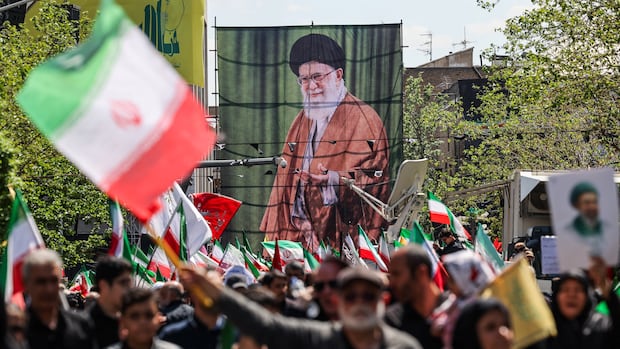
Inside Iran, where the halt to six weeks of U.S. and Iranian airstrikes has been portrayed as victory for the clerical rulers, huge crowds turned out for a commemoration to mark 40 days of mourning for Supreme Leader Ayatollah Ali Khamenei, killed on the war’s first day.
State TV showed crowds in Tehran, Kermanshah, Yazd and Zahedan, with mourners in black carrying Iranian flags and portraits of Khamenei and his son and successor Mojtaba, who has not been seen in public since his ascension.
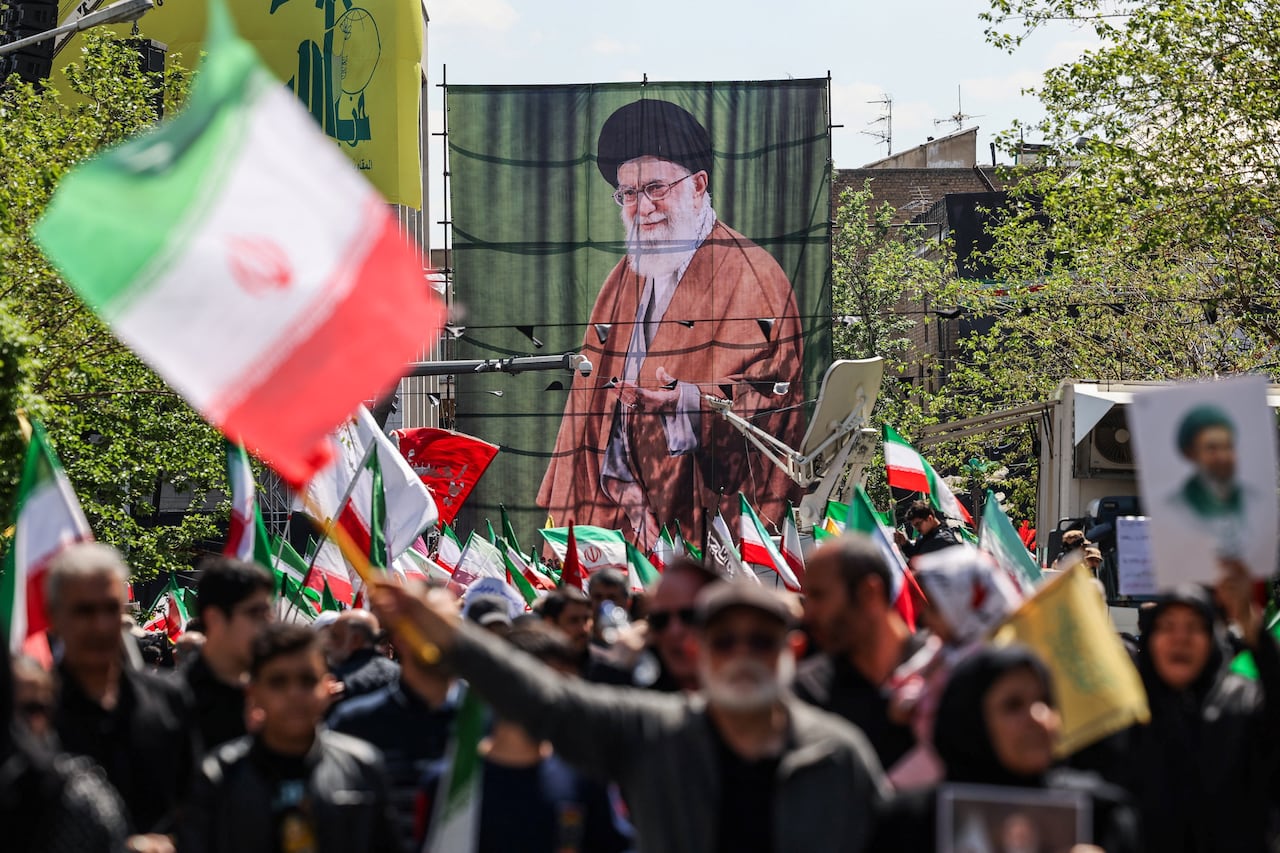 A banner with an image of late Supreme Leader Ayatollah Ali Khamenei is shown in Tehran on Thursday during a ceremony marking 40 days since he was killed. (Majid Asgaripour/West Asia News Agency/Reuters)
In Shiraz, a funeral procession was held for Iran Revolutionary Guards’ intelligence chief Majid Khademi, killed earlier this week in an Israeli strike in his home province of Fars.
Though Trump has declared victory, Washington did not achieve the aims he had announced to justify the war at its outset: to eliminate Iran’s ability to attack its neighbours, destroy its nuclear program and create conditions that would make it easier for Iranians to topple their government.
Iran still possesses missiles and drones capable of targeting its neighbors and a stockpile of more than 400 kg of highly enriched uranium.
The core disputes remain unresolved, as far as publicly known, with each side sticking to competing demands for a deal that could shape the Middle East for generations.