
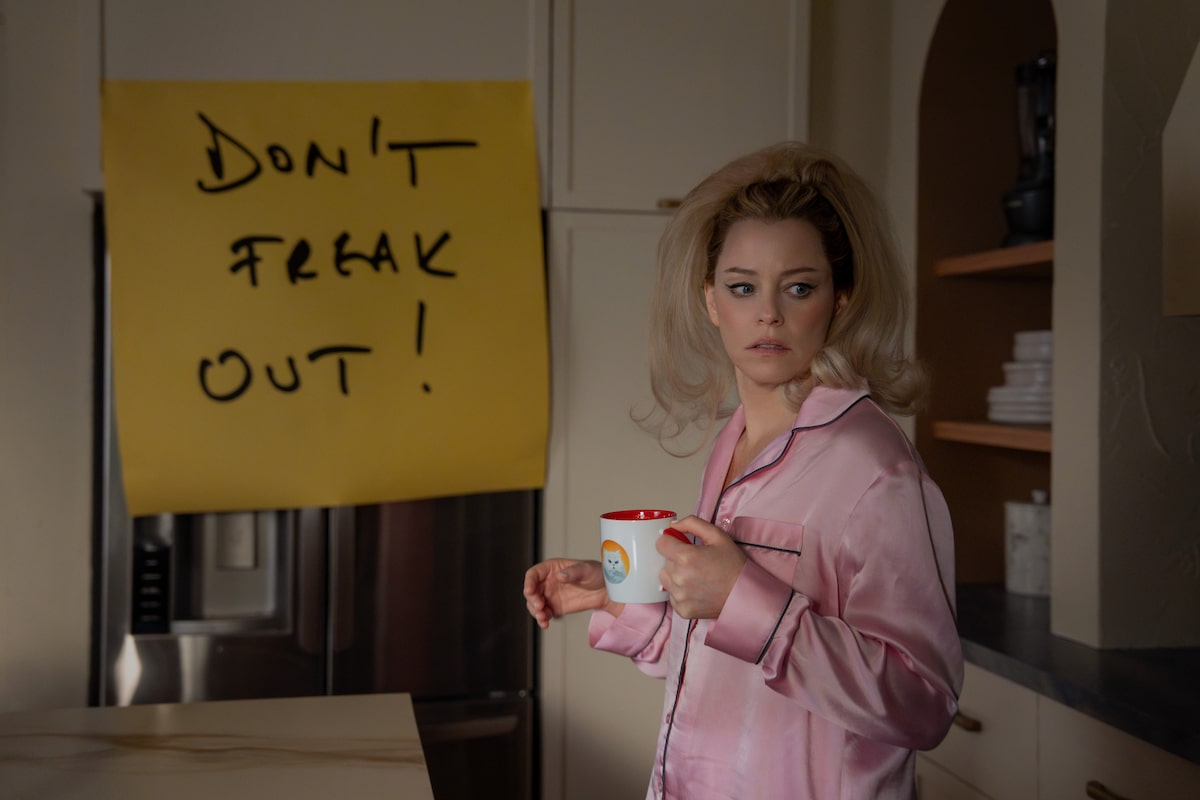
Elizabeth Banks, left, and Matthew Macfadyen in The Miniature Wife.Peacock/Supplied
The Miniature Wife is a new television dramedy that purports, at first, to be nothing more than a simple sci-fi story about a woman shrunk down to the size of a mouse by her spouse.
“My husband made me small,” says Lindy (Elizabeth Banks), the heroine, in the first flash-forward scene of this Peacock series, which streams on Crave in Canada, starting with four episodes on April 9.
“No, it’s not a metaphor: He made me six inches tall.”
This is in voice-over as we watch a tiny Lindy shown in peril, falling off a living-room table into the path of a robot vacuum that is about to mistake her for a speck of dust.
What a big mistake this show’s framing is. It diminishes what follows.
I can picture Crave subscribers, fans of Succession, lured in by Matthew Macfadyen’s co-starring role, reaching for the remote.
I can hear them asking, as I did: Why on earth would I invest 10 episodes of what little time I have on this Earth into watching what looks like Kids, I Shrunk My Honey – even if it does feature Macfadyen in the Rick Moranis mad-scientist role?
But don’t click too quickly.
The little lady doth protest too much.
There is metaphor at work here – as there has been with almost every story about truly little little people since Jonathan Swift’s Gulliver’s Travels.
The Miniature Wife uses the idea of size not to satirize 18th-century Europe but to put a modern marriage under the microscope.
Once it settles into its Flubber with F-bombs aesthetic, it’s surprisingly insightful about the different ways men and women take up space in a marriage – and how old ideas about husbands and wives still loom large in even the most ostensibly equal of heterosexual partnerships
As The Miniature Wife begins, Lindy, a novelist long suffering from writer’s block, and Les, a workaholic scientist who has figured out how to make objects smaller (but not how to restore them to original size), are headed for a renewal of vows after close to 20 years together.
The two have an 18-year-old daughter named Lulu (Sofia Rosinsky) off at college – and their empty-nest syndrome appears to have been solved through marriage counselling. (Conflict-resolution language is lovingly lampooned.)
Macfadyen in The Miniature Wife.Peacock/Supplied
But then Les’s stalled experiments in cellular reduction get a sudden new injection of funding that leads him to postpone their planned getaway.
Tired of being treated as a minor concern, Lindy decides to run away with Richard (O-T Fagbenle), a colleague of Les’s with whom she has been having an emotional affair.
Before she can get out of the dodgy marriage, however, Les brings his work home with him and, one argument and accidentally fired shrinking ray later, Lindy is 15 centimetres or so tall living in their daughter’s dollhouse.
There’s some appeal to the fun 1980s-styled action set pieces that follow.
Lindy fights a fly with hairpins and learns how to swipe the screen of a smartphone with a body the size of a finger as Les scrambles to figure out how to de-Ozempic his wife.
But what is actually engrossing is how the show, beneath its silly surface, slowly fills out the contours of the pair’s partnership.
Perhaps because there’s a female-male screenwriting duo, Jennifer Ames and Steve Turner, behind the series, sympathy is swapped back and forth between wife and husband in flashbacks.
Banks in The Miniature Wife.Supplied
Early on, we discover how Les put his own career on the back burner in order to support Lindy’s writing career during his more youthful, energetic years.
When she won the Pulitzer Prize for her first book, Les was left literally holding his wife’s handbag as she posed for photographs and, in return, was nearly left out of her acceptance speech.
But as the episodes unfold, we learn more about how Lindy and Les struck an agreement to take turns supporting each other’s careers.
That overly simplistic power-sharing scheme is complicated by the fact that, for Lindy, success came quickly, while, for Les, it has been slower and studded with failure.
Did Lindy really sign up to be an unhappy wine mom living in St. Louis (actually, a very recognizable Toronto) for the rest of her life or until her husband wins a Nobel Prize, whichever comes first?
How do you navigate the ups and downs of a marriage in which one person has more ups and the other more downs?
There’s more to The Miniature Wife than meets the eye, in short. And a few good laughs along the way, primarily thanks to Macfadyen – who has mastered the art of delivering progressive-sounding political pronouncements that self-destruct along the way.
“I’m not a misogynist; I’m not intentionally,” he says, during one early-episode squabble. “If anything, I’m an accidental misogynist – and I, too, blame the patriarchy for that.”
Okay, these shrunken scenes from a marriage are not quite Ingmar Bergman – but they’re not Ant-Man either. It’s as imperfect a union as any.