
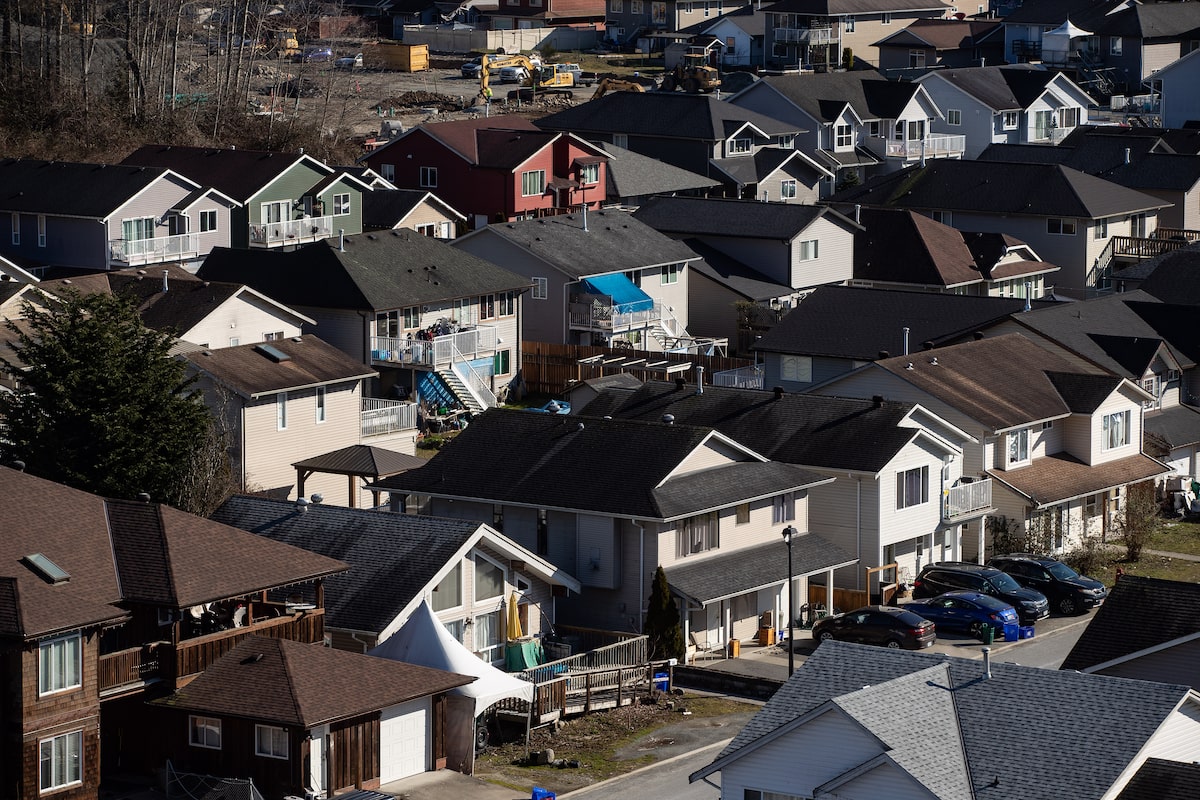
Houses in North Vancouver in 2022. New Ratehub data shows that people renewing a five-year fixed mortgage this year could see their payments increase by 24 per cent.DARRYL DYCK/The Canadian Press
Remember the financial meltdown that had been forecast when homeowners renewed their pandemic-era bargain mortgages to higher rates this year? Well, it just hasn’t materialized.
Defaults on mortgages are still relatively low, and banks are able to offer more flexibility upon renewal to help their clients than in the past, with options such as lengthening a client’s amortization.
But that doesn’t mean mortgage payments aren’t squeezing Canadian households.
New data from the rates comparison site Ratehub shows that people who are renewing a five-year fixed mortgage this year could see their payments increase by a massive 24 per cent. The figure assumes the homeowners had the lowest rate available one year ago at 1.68 per cent and are renewing into today’s lowest five-year fixed rate of 4.04 per cent.
For a $696,000 home that was purchased with a 10-per-cent down payment, that would be an increase of $622 a month in mortgage payments. (This example uses the average price of a home in 2021.)
It’s a significant increase, and it’s combined with persistent inflation in other necessary expenses like groceries.
Worried about rising inflation? These Goldman Sachs economists aren’t
Ratehub estimates one million homeowners will renew their mortgages this year into this challenging environment, and the Canada Mortgage and Housing Corporation has estimated that 1.5 million Canadians have already renewed pandemic-era mortgages.
What’s worse is that the war in the Middle East is creating concern around inflation in bond markets, and that has already sent five-year fixed mortgage rates roughly 40 basis points higher in the past couple weeks. That trend could continue if the war drags on.
“If I had a low fixed-rate mortgage coming up for renewal in six months, I would definitely be crossing my fingers, for more reasons than one, that things in the Middle East get rectified soon,” said Jason Heath, managing director and CFP at Objective Financial Partners in Markham, Ont.
Mr. Heath says it’ll take some time for the full impact of these payment increases to be felt by Canadians, but some of the first people that he expects to have to face tough financial decision are secondary property owners.
Landlords are seeing rents drop, even as interest and tax payments are increasing. And cottagers renewing into higher rates might struggle to justify owning a holiday home.
It could also take time before ordinary Canadians fully feel the squeeze of having to pay hundreds of dollars more on their mortgage payments and how it affects their saving goals.
I’m digging into how homeowners are dealing with these higher mortgage payments. Were you forced to increase your amortization period? Are you cutting back on expenses to account for higher payments? Considering downsizing or selling?
Reach me at sfarooqui@globeandmail.com to share your story about rising mortgage costs.
Subscribe to the On Money newsletter
Are you reading this newsletter on the web or did someone forward the e-mail version to you? If so, you can sign up for On Money here.
Sal’s personal finance reading list
How to beat the ‘single’s tax’ as a solo earner
Life is cheaper as a couple, even though the number of Canadians living alone is growing. This article has some tips to offset some of the ways that you end up paying more for things like vacation or food as a single person
Rents decreased even further across Canada in March
The latest report from Rentals.ca found that rents dropped nationally by 5.3 per cent on a year-over-year basis. That’s the largest drop since 2023. Rents dropped Toronto, Vancouver, Montreal, Calgary and Edmonton.
Chart of the day
The paycheque paradox: If wages are rising, why do Canadians feel left behind? Read the full analysis here.
New products that caught my eye
Are you stressed about an upcoming mortgage renewal? Try this straightforward mortgage calculator to see what your new payments could be.
ICYMI
In today’s savings and GIC accounts, locking your money away for longer is not much betterHow to fix your tax return, and when to fight back if things are amiss