
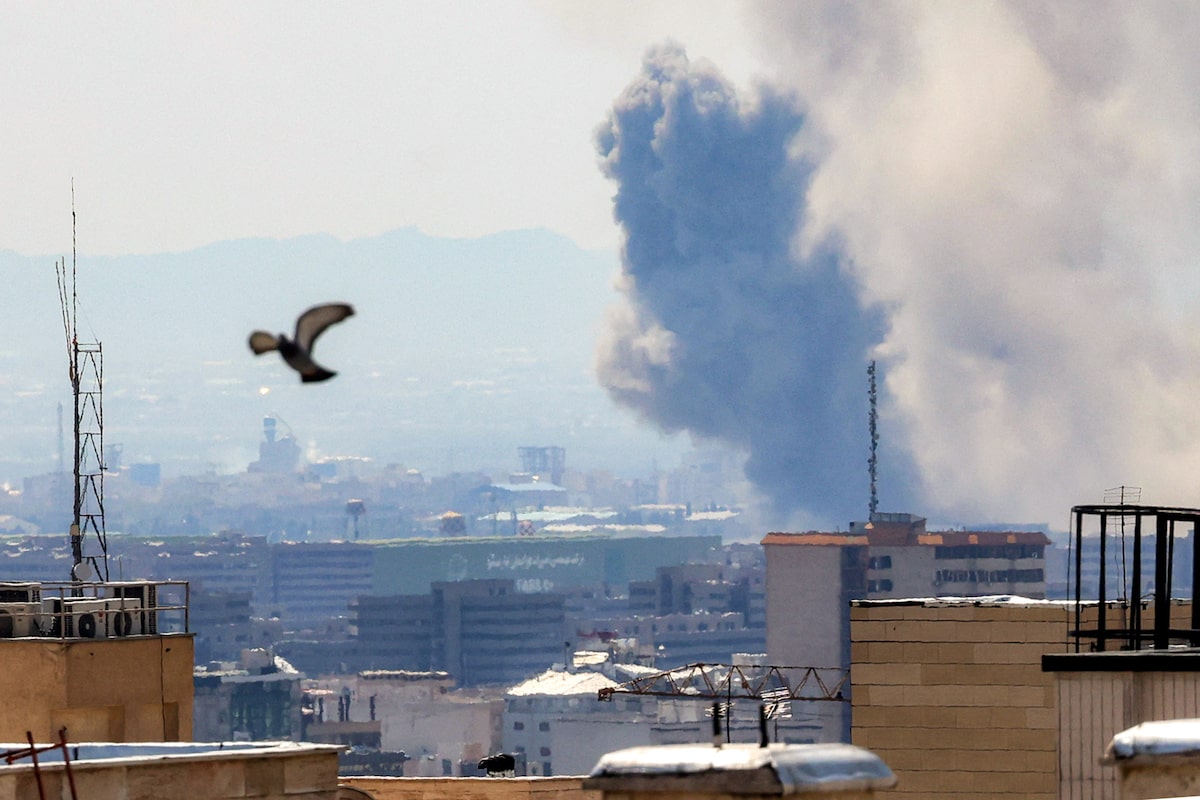
Smoke rises after strikes on Tehran on Tuesday.ATTA KENARE/AFP/Getty Images
Who are the winners and losers of U.S. President Donald Trump’s decision to launch, and abruptly end, what may one day be known as The First Iran War?
Loser – The Gulf states: These six countries, the largest of which is Saudi Arabia, enjoy a prosperity that rests on regional peace and freedom of navigation. That’s why they counselled Mr. Trump against starting the war.
However, once the U.S. and Israel attacked, and Iran responded by stopping traffic through the Strait of Hormuz, while at the same time launching waves of missile and drone attacks against the Gulf states, several governments urged the U.S. against ending the offensive with Iran still on the front foot.
Washington did not take any of that advice. The Gulf states have paid a heavy price, with more bills likely coming.
Opinion: The painful lessons of the Iran War
For many civilians in the Middle East, missile attacks come without shelter or warning
Loser – The U.S.: The American military has blown up a lot of stuff in Iran. But listing off targets hit and leaders killed echoes the Pentagon’s failed focus on “body count” during the Vietnam War.
This absence of strategy has led to a strategic defeat.
As of Thursday evening, the U.S. stopped its attacks against Iran and imposed the same behaviour on Israel; meanwhile, Iran continued its economic war by keeping the strait largely closed. Tehran also announced plans to levy tolls in what was, prior to Feb. 28, an open international waterway. And it demanded that the U.S. force Israel to stop attacking Hezbollah.
Mr. Trump went to war boasting about limitless U.S. power, demanding unconditional surrender and promising regime change. Quick and easy victory having eluded him, he has pivoted. He is now bidding to end the war on terms that would make Neville Chamberlain blush.
Loser – Israel: Iran was a friend of Israel prior to the 1979 Iranian Revolution. That’s why the overthrow or moderation of a Tehran regime obsessed with Israel’s annihilation is a long-standing Israeli goal.
But instead of regime change, the war has delivered an Iranian regime radicalized by its survival, and empowered by its success.
What’s more, Israel is increasingly portrayed in MAGA circles as having somehow tricked Mr. Trump into attacking Iran, even though Mr. Trump has wanted to do so for decades. Israel’s refusal to immediately cave in to Tehran’s demand that it stop attacking Hezbollah has also gotten in the way of Mr. Trump’s attempts to mollify Iran into allowing him to exit his war.
Loser – Lebanon: The country has been decimated by Israeli attacks on Hezbollah. But Hezbollah, a terrorist state-within-a-state that is not supported by most Lebanese, endures. Lebanon is suffering all the side-effects of chemotherapy with none of the benefits.
Like its sponsors in Tehran, Hezbollah may emerge from this conflict with renewed vigour. So may Iran’s role in Lebanon.
One positive sign: On Thursday, Israeli Prime Minister Benjamin Netanyahu reluctantly agreed to begin direct talks with the Lebanese government, aimed at finding long-term peace while disempowering Hezbollah.
The aftermath of several Israeli airstrikes in Beirut, Lebanon, on Wednesday.Hassan Ammar/The Associated Press
Winner – Islamic Republic of Iran: It demonstrated that, through geography and asymmetric weapons, it can make its neighbours and their superpower protector cry uncle.
Tehran has gone from deterred and cowed during last year’s one-sided Israeli-American bombing campaign to empowered and emboldened.
A dangerous offender previously under long-term supervision has discovered its get-out-of-jail card.
Loser – Iranians: The men running the Islamic Republic are emboldened; the people of Iran are in for greater repression.
Winner – China: American failure opens the door to Beijing. Unlike the U.S., China has good relations with the countries on both side of the Persian Gulf. Unlike the U.S., it is also a major customer for Iranian oil. That’s why China was the logical broker for a 2023 deal that renewed relations between Saudi Arabia and Iran.
China is the world’s second-largest consumer of oil, and does not want a closed Strait of Hormuz. However, China has lessened its dependence on imported oil and gas by adopting an all-of-the-above energy strategy. That includes becoming the world leader in the manufacture of solar cells and electric vehicles.
But China also freed itself from the need to import Gulf gas and fertilizer by producing and consuming half the world’s coal. It mines 10 times as much coal as the U.S. each year, and 100 times as much as Canada.
Winner – Renewable energy: The higher oil prices go, the more wind and solar become viable.
Winner – Non-Middle Eastern oil and gas: For customers and producers alike, the risk of too much dependence on Gulf oil is clear. Canada is high on the list of safe alternatives.