
Sign up for the Slatest to get the most insightful analysis, criticism, and advice out there, delivered to your inbox daily.
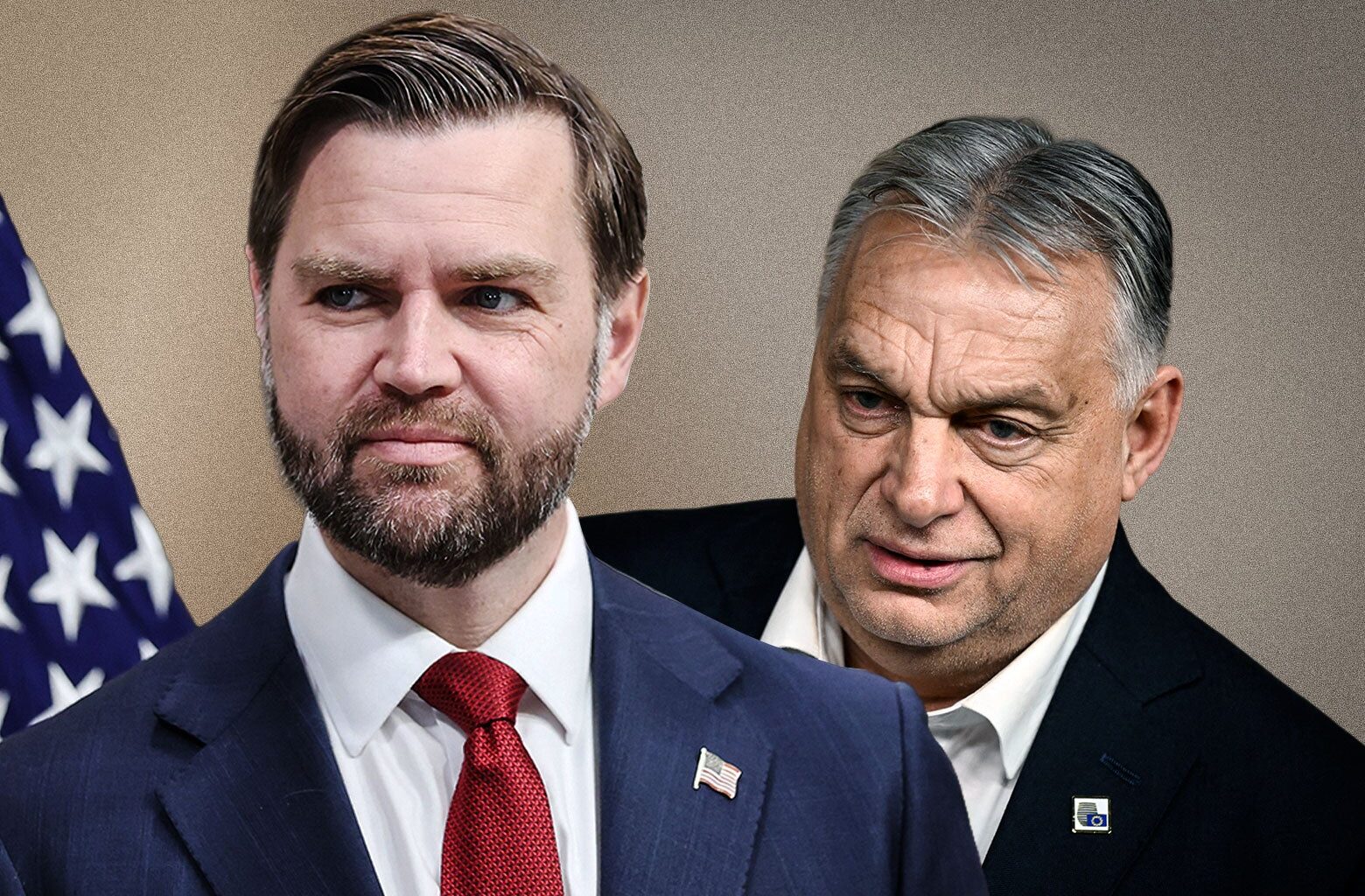
On a stage in Budapest, Hungary, on Tuesday afternoon, Vice President J.D. Vance had a remarkable request for the Hungarian people: reelect a dictator.
Vance knows that country’s prime minister, Viktor Orbán, has fostered rampant corruption, curtailed the independence of the country’s judiciary, attacked its universities’ academic freedom, spread antisemitic conspiracy theories, and promoted racial homogeneity. But Vance had one major justification for flying to Europe to personally campaign for Orbán’s reelection, as Orbán flags in the polls: Orbán was the United States’ partner in morality. “Because what the United States and Hungary together represent under Viktor’s leadership and under President Trump’s leadership is the defense of Western civilization,” Vance said on that stage. At another event that day, he called on people to vote for Orbán to preserve that morality: “Will you stand for Western civilization? Will you stand for freedom, for truth, and for the God of our fathers?”
It was not the first time the Trump administration had tried to help a foreign leader with their election. No need to obscure its ambitions with secret CIA operations: The Trump administration has stumped for far-right parties in Europe, including ones with Nazi sympathies; backed El Salvador’s President Nayib Bukele, who has turned the country into a harsh police state; and saved the right-wing populist President Javier Milei from an election loss in Argentina.
But even in this new era, Orbán is still a remarkable candidate for the presidential administration to support. That’s because Orbán isn’t just leading the most corrupt country in Europe; he’s also Russia’s primary asset inside of Europe. As recent reporting has found, Orbán has repeatedly called Russia’s foreign minister after closed-door meetings of European leaders to fill him in, leaking sensitive information. Orbán’s foreign minister has reportedly worked on Russia’s behalf to get an oligarch’s relative off of European sanctions lists. Publicly, Orbán portrays the E.U. as a sinister organization, and has even blocked military aid to Ukraine, which he has made out to be Hungary’s enemy. And as a result, Russia is working to keep Orbán in place. So when the Trump administration goes to bat for Orbán, they’re allying themselves with Vladimir Putin—and against pro-democracy politicians in Europe.
It’s an odd place for the United States’ presidential administration to intervene. But Vance articulated one primary reason why he would drop everything to fly to Hungary to help the prime minister there: to fight for Christendom.
There’s been a lot of talk, in recent years, of Christian nationalism in America. But Christendom, as an idea, dreams much bigger, beyond national borders. In its benign use, Christendom is an archaic label for the Christians of the world. But among a certain small cadre of conservative intellectuals and theologians, its relevant definition is its geopolitical one. In that use of the term, the regions populated by Christians unite as one single and powerful civilization. Doug Wilson, the prominent theologian behind Defense Secretary Pete Hegseth’s church, for example, has written a book advocating for a new Christendom in which laws are based on the Bible, and reward virtue and faith. (In a different book, in 2005, he called the Confederate South “the last nation of the first Christendom.”) He and other theologians have discussed the possibility of a “Christendom 2.0,” a term that has been used for certain patriarchal Christian conferences and ministry programs. Hyper-traditionalist Catholics sometimes use it to mean a return to strength of the old Catholic Church. Charlie Kirk, an evangelical, called Christendom the “American way of life,” a root to Western civilization, and something to wage “spiritual battle” over. (The conservative writer Rod Dreher in turn called Kirk a “man of Christendom.”) And as one popular commentator for Blaze Media wrote on social media, “Western civilization is another name for Christendom,” and “Christendom existed because Christian rulers held power and defended their people against the enemy.”
There are other code words that mean the same thing: “Christian civilization” or “Western civilization,” if you’re a certain kind of right-wing Christian, and “ethnonationalism” if you’re an academic. But Christendom most accurately captures the spirit of the idea: organizing the world along medieval civilizational lines. Christendom, as these conservative thinkers use it, is both a propagandistic way of describing majority-white countries as they exist now and an aspirational way of describing white countries in their ideal world: whole swaths of the Earth governed by Christian values, peopled by Christians with a European cultural background, and intolerant of secularism and of other faiths. Christendom, in the medieval world of the Crusades, was Europe against the Islamic world. Today, these traditionalist intellectuals are hoping for the same worldview to take over, but with atheists thrown in with the infidels. Christendom proposes a new international order, no longer built around shared concerns for democracy and human rights, and ties together any countries seen as having that same Christian DNA, regardless of their behavior.
As Vance put it in his speech, what unites the U.S. and Hungary, more than anything, is their “defense of the idea that we are founded on a certain Christian civilization and Christian values that animate everything.”
There have long been indications that Vance’s part of the MAGA movement—what some call the new right or post-liberal right—would prioritize such religious issues when it comes to foreign policy. But never before have we seen it stated so baldly and made so abundantly clear: Because of this shared image of a Christian world, Vance is advocating for Moscow’s interests over those of America’s more secular traditional allies. In his address to Hungarians, he accused Brussels of trying to “destroy” Hungary’s economy in “one of the worst examples of foreign election interference that I’ve ever seen.” (This was in reference to the EU’s decision to freeze funds to Hungary over concerns about corruption. It’s a topic central to the election, but there’s no evidence the EU is meddling in Hungary’s elections.) It was a shocking attack on European democracies.
And Hungary has become the focal point in this MAGA effort to remake the global order. For years, conservatives have looked to Hungary as a testing ground for their most radical policy ideas. With the freedom afforded by authoritarianism, Orbán has introduced religion classes into the national curriculum, banned Pride parades and other “homosexual propaganda,” and promoted policies that would encourage young Christian families to marry and have multiple children. He has articulated that policy as one meant to fight for the demographics of Europe—turning the tide of Islamic immigration. Orbán himself calls his government a “Christian democracy.” Conservatives in the U.S. often imagine Hungary as a rosy future, a country inhabited by Christian families holding firm to traditional ideas about gender and race. And they follow that vision: The Conservative Political Action Conference holds events in Hungary. The Heritage Foundation hosts events with its Hungarian parallel, the Danube Institute. Dreher, longtime writer for the American Conservative, relocated to Hungary permanently.
As Kim Lane Scheppele, who studies the rise and fall of constitutional governments at Princeton University, said, Hungary’s place in the MAGA imagination compares to Scandinavia for socialists. It proves that certain ideas can work.
So at a practical level, the MAGA movement wants Orbán in place because his government has shown American conservatives where they can go, should they be successful in convincing the political class to embrace overt Christian nationalism. Already, Scheppele said, conservatives associated with Project 2025 and similar entities were inspired by Hungarian policies and strategies when drafting their proposals.
But there’s something more. For Christian conservatives such as Vance, Hungary offers a vision of the world in which the United States would be one of a host of North American and European countries promoting a global Christian civilization. These could include the United Kingdom (through Reform UK and other right-wing parties), Germany (through the Alternative for Germany party), Italy (through Giorgia Meloni’s Brothers of Italy party), and, ultimately, Russia. Putin did revive the Russian Orthodox churches, after all.
“This is a trans-Atlantic Western European chessboard,” said Robert P. Jones, president of Public Religion Research Institute. “What they’re really looking to do is create a federation of Christian nationalist states.”
If you grew up in a very Christian part of the country, this all might seem a bit jarring: Individual freedom has been a major rallying cry of the Christian right for decades. And now, under this idea of forming a modern Christendom, the United States is throwing its lot in with authoritarian countries. But that’s what’s so emboldening about the idea of a European Christian civilization in need of protection: Large numbers of Americans have become convinced that the stakes for Christianity are existential, that they can’t afford to think in libertarian ways anymore, that they must start thinking not in terms of constitutional rights, but in terms of beating their spiritual enemies.
And one of the strengths of the concept of Christendom is its expansiveness. As long as you’re pushing Christianity, you’re in: Alliances can be formed among the United States’ Christian nationalist evangelicals, Hungary’s hard-line Roman Catholics, and Putin’s Russian state-backed Orthodox priests. Vance himself is most closely allied with Catholic Integralists—men who argue for a government ordered under a kind of Catholic monarchy—while Defense Secretary Pete Hegseth belongs to a Reformed evangelical network that is openly scornful of Catholicism and aspires to put the U.S. under a patriarchal theocracy. But while these two groups’ specific aims may seem mutually incompatible, both share a love of Crusader imagery and ideas.
“What they have in common is this idea that there should be a Christendom,” Jones said. “If it’s Christendom versus Islam and the infidels, then folks like Orbán can certainly come inside the tent. And Putin.”
Experts noted, though, that having a religious-based international order is threatening to more than just minority religions. It’s worth remembering that an essential part of Christendom is the idea not just that the people are Christian, but that the whole society is organized around Christianity, including the government. And that is an inherently anti-democratic idea.
“They share this common ‘culture war’ culture,” Scheppele said of the U.S. and Hungary. “But underneath it, it’s how to create power and hang on to it, so it’s not able to be wrested away.”
Both critics and supporters of Orbán’s policies have described his government as a kind of laboratory for illiberalism: politics that reject pluralism and see the government’s responsibility as creating a healthy society built on traditional values, rather than protecting minority rights and individual liberties. In an illiberal democracy, transparency and accountability aren’t major priorities. Orban hasn’t just boosted Christian institutions; he has also suppressed critics and held on to power very successfully.
So when Vance holds Orbán up as a model leader, he’s not just holding up his support for heterosexual marriage and Christian churches. He’s indicating the power itself is an inspiration.
“They recognize their power is tenuous,” said Sarah Riccardi-Swartz, a religion professor at Northeastern University who has experience studying right-wing Orthodox Christianity. “So aligning with leaders who already have good models for how to control their political environment is crucial for someone like Vance.”

Ian Prasad Philbrick
J.D. Vance Might Be in Trouble as Trump’s Heir Apparent. He Won’t Like Who Is Taking Up the Mantle.
Read More
At this point, as Riccardi-Swartz sees it, Trump’s affinity for authoritarian politics isn’t concerning to his base because these Christians have already bought into patriarchal structures as part of their understanding of a proper spiritual order. The wife obeys the husband; the husband obeys the government; the government obeys God. “This doesn’t read as strongman politics to them,” she said. “This is a man serving God, trying to make a moral society.”
DOJ Says Laws Congress Passed to Prevent Another Nixon Don’t Apply to Trump
There’s a New Dog Whistle Coming Out of Christian Conservatives’ Mouths. It’s Just One Word.
But that base may be fully misreading the situation. Talk of “Christendom” may appeal to a great number of Christians disillusioned by modern secular society, but it likely does little to motivate Trump himself, who is not particularly religious. Putin, certainly, is motivated by his own interests and not ideological ones. Orbán, too, sees Christian policy as a political tool and not a driver of action, Scheppele said. As Scheppele sees things, the U.S.–Hungary alliance, parallel to the Hungary–Russia alliance, shows how much the Trump administration prioritizes practical transactional matters over ideology. Previous presidents would have balked at having such bedfellows. This Great Christian Civilization talk is a ruse for power plays, she said.
“We’re so used to thinking all these alliances are mostly ideological, and it’s true the Trump and Orbán people repeat the same lines,” she said. “But I think the deeper connection is: Do the incumbents want to stay in power? And how do they learn to do that from the ones who have managed to pull that off?”
But the big question remains one about Vance. Trump may be a casual Christian, but Vance clearly is not. He will soon publish an entire book about his conversion to Catholicism. As a potential future presidential candidate, Vance may take the MAGA movement in a new, even more ambitious direction when it comes to promoting Christianity’s earthly dominance. Even if Trump himself cares only about secular power, Vance at least seems to have more spiritual concerns. Vance’s time in Hungary was an important reminder that Vance has a very particular understanding of the order of the world. It’s Christendom against the godless.

Sign up for Slate’s evening newsletter.