
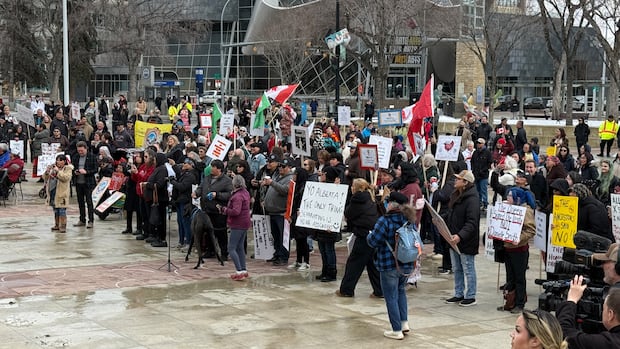
Signs and the flags of many nations filled Sir Winston Churchill Square in downtown Edmonton on Wednesday as roughly 200 First Nations leaders, community members and supporters gathered to oppose an attempt to force a referendum on Alberta separating from Canada.
Signs read “this is treaty land, honour the land, honour the people,” and “stand with First Nations,” as speakers stressed the ongoing relevance of treaty rights.
“We organized this event, you know, to bring some awareness to the non-Indigenous public as well,” said Treaty 8 First Nations of Alberta Grand Chief Trevor Mercredi. “Make sure that they understand that our treaty is here to protect, and that our treaty is not some mythical document.
“This is current history and we’re dealing with it today. We talk about separation here — people have to understand that these lands belong to us and we will not sit idly by.”
The rally was held on the second day of a hearing at the Edmonton Court of King’s Bench, where a trio of First Nations groups are seeking to shut down a petition calling for a referendum to be held on Alberta leaving Confederation.
“It’s important to stand with Indigenous leadership, especially our chiefs,” said NDP MLA Brooks Arcand-Paul, who was present at the rally. “They are standing up for treaty. They’re standing against separatism.
“They’re standing up for all of Canada right now. And right now it’s so important that all Canadians stand with them, especially Albertans with all of this separatist rhetoric.”
Inside the courtroom, the public gallery was once again filled with dozens of supporters as lawyers for Athabasca Chipewyan First Nation (ACFN) and the Blackfoot Confederacy presented arguments.
Jeffrey Rath, the lawyer for Mitch Sylvestre — the respondent in the case — was also present. Sylvestre is the head of Stay Free Alberta, the group gathering signatures for a referendum petition.
ACFN challenges referendum approval
In its challenge of Alberta’s citizen-initiated referendum process, ACFN’s primary argument is that the decision by the province’s chief electoral officer to approve a “renewed proposal” for a referendum on Alberta independence was unreasonable.
The First Nation’s legal team said the decision contradicts a December court ruling that found a similar referendum proposal would violate treaty and Charter rights. That ruling came less than 24 hours after the Alberta government introduced Bill 14, legislation that allows citizen-initiated referendums to proceed even if they may be unconstitutional.
Lawyers for the ACFN argued the chief electoral officer relied on an overly narrow and literal reading of the legislation, while ignoring the broader legal context, including that earlier court decision.
They also argued that the officer misinterpreted transitional provisions in the law by treating the original referendum proposal as if it had never been made, something they said improperly sidestepped the earlier ruling.
In addition, the ACFN lawyers argued there were procedural flaws in the approval process. They said the petition should not have been issued because a required $25,000 application fee was not paid for what they considered to be a new proposal.
A significant part of the ACFN’s argument centres on the Crown’s duty to consult.
The First Nation’s lawyers said the decision to allow the referendum process to move forward triggered that duty because it carries the potential to negatively affect treaty rights. They argued no consultation took place, despite what they described as clear and foreseeable impacts.
They also argued that an “international border would fundamentally change … [the] way of life [of the First Nation’s members].”
Since the ACFN is a Treaty 8 First Nation, lawyers noted that Treaty 8 territory straddles several provinces and part of the Northwest Territories. Lawyers said Treaty 8 commissioners promised their ancestors that they would be able to maintain their mobile way of life and be able to cross provincial and territorial borders.
The transformation of a territorial border into an international border would contravene these rights, argued ACFN lawyer Kevin Hille.
WATCH | First Nations members voice opposition to petition calling for Alberta to leave Canada :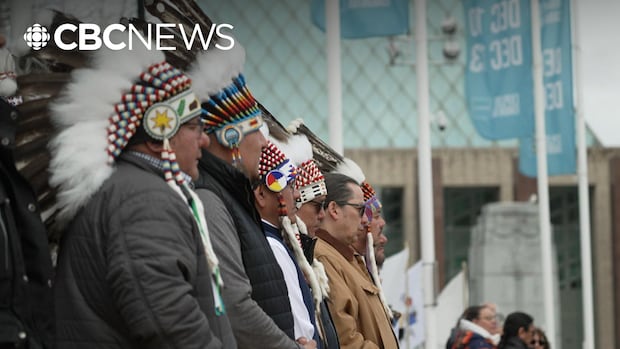
First Nations members voice opposition to petition calling for Alberta to leave Canada
A hearing continued Wednesday for Sturgeon Lake Cree Nation’s push to shut down a petition calling for a referendum on whether Alberta should leave Canada. As the CBC’s Tristan Mottershead reports, a rally in downtown Edmonton saw hundreds of First Nations people show up to voice their opposition.
The ACFN’s lawyers said that if the court determines the chief electoral officer had no choice but to approve the referendum under the legislation, then it will argue the law itself is unconstitutional.
They argued the amendments brought in through Bill 14 violate Section 35 of the Constitution Act, 1982, which protects Aboriginal and treaty rights, as well as the honour of the Crown.
The ACFN’s lawyers argued the legislation removes important safeguards, including constitutional screening mechanisms that would normally prevent initiatives that infringe on treaty rights from moving forward.
They argued this opens the door to what they described as “majoritarian encroachment,” where the rights of First Nations could be overridden by a popular vote.
The First Nation’s lawyers also told the court they believe the provincial government’s actions reflect a broader pattern of conduct that puts treaty promises at risk by advancing a referendum that a court has already found to be unconstitutional.
The ACFN is asking the court to alternatively “read down” the legislation so that it does not allow the chief electoral officer to approve a petition that has already been ruled unconstitutional.
They are also seeking a stay to pause the petition process while the case is being decided, arguing that allowing it to proceed would cause irreparable harm to treaty rights and the treaty relationship.
The case is being heard by Justice Shaina Leonard and includes arguments from Sturgeon Lake Cree Nation, the ACFN and the Blackfoot Confederacy.
On Tuesday, court heard from lawyers for Sturgeon Lake Cree Nation.
The Blackfoot Confederacy is expected to complete its arguments Thursday, followed by a response from Rath.
On Tuesday, Rath told reporters that he believes “no treaty rights are at issue through a petition process.”
“The petition itself isn’t legally binding,” he said. “The Supreme Court of Canada made it clear in the secession reference that even a referendum itself does not affect legal rights.
“Legal rights are not impacted until all of the parties, including the First Nations, come to the table to negotiate in good faith.”
Stay Free Alberta said last week that it had already collected more than the 178,000 signatures required to trigger a referendum with a month to go before it must submit the names to Elections Alberta.
Premier Danielle Smith’s government has said if the campaign organizers get enough names, the referendum question will be put to a vote.
On Tuesday, the office of Alberta Justice Minister Mickey Amery said the government recognizes and honours treaty rights but added that it wouldn’t comment further given the matter is before the courts.