
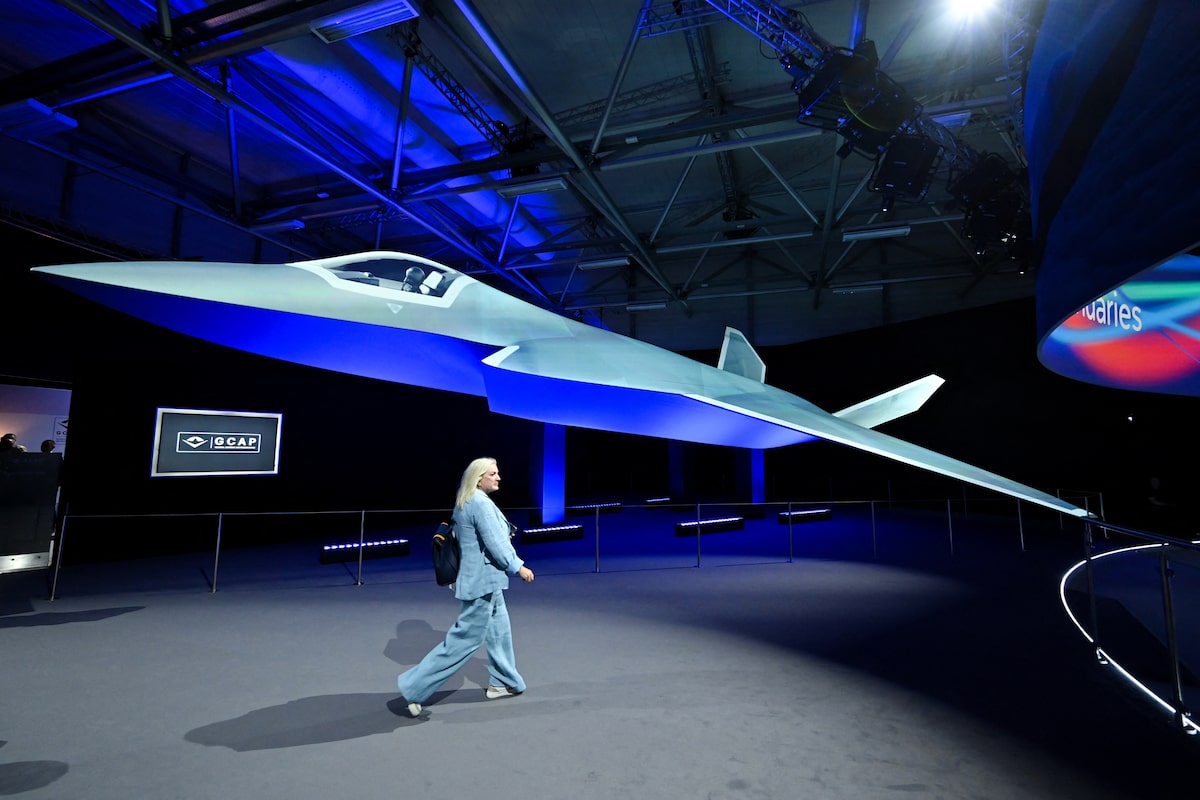
A Global Combat Air Programme (GCAP) 6th generation fighter jet concept design is displayed at the Farnborough International Airshow 2024, south west of London, July 22, 2024.JUSTIN TALLIS/Getty Images
Canada is talking to Britain, Japan and Italy about obtaining observer status in the Global Combat Air Programme, their joint initiative to develop a next-generation fighter aircraft, according to a senior Canadian government official.
Joining the program, even as an observer, is part of Canada’s efforts to diversify its defence ties and economic relations beyond the United States, the official said, and Ottawa is sending letters to all three countries formally requesting this.
It could also be a prelude to one day purchasing the sixth-generation aircraft produced by Britain, Japan and Italy or participating more fully in the program, the official said.
The Globe and Mail is not identifying the official because they were not authorized to discuss the matter publicly.
Right now, the federal government is still mulling whether to proceed with its full order of fifth-generation F-35 fighters from U.S. defence contractor Lockheed Martin or scale back its purchase and buy a different aircraft such as Sweden’s Saab fighter.
Ottawa’s pause on the F-35 order appears tied to the pending renegotiation of the United States-Mexico-Canada Agreement on free trade and likely won’t be resolved until those talks have concluded.
The generational labels that describe different eras of fighter aircraft are used by defence analysts and manufacturers to distinguish different levels of capability. Canada’s aging CF-18 fighters are often called fourth-generation aircraft. Characteristics of fifth-generation ones include stealth capabilities.
Sixth-generation aircraft are not in service yet and capabilities are still being developed but could include integration with drones, advanced stealth capabilities and/or an option for directed energy weapons such as lasers.
A shift away from American aircraft would reduce Canada’s reliance on its southern neighbour for defence at a time when the U.S. is seen as a less dependable partner than in the past. Experts have raised concerns that a hostile White House could withhold crucial spare parts or software updates for U.S.-made fighters.
Opinion: The idea of a mixed fleet of Canadian fighter jets should not take flight
Andrea Charron, director of the Centre for Defence and Security Studies at the University of Manitoba, said it’s essential for Canada to prepare for the next generation of fighters, noting Ottawa first became involved in the F-35 project as far back as 1997.
She said affiliating with the Global Combat Air Programme, or GCAP, could not only enable Canada to eventually buy the resulting jet but also offer Canadian defence contractors an opportunity to supply parts or services to the project.
Prime Minister Mark Carney has repeatedly outlined a vision of a much bigger defence industry in Canada, driven by significant increases in military spending as well as by increased trade.
Prof. Charron said that the Australians and Germans have also indicated interest in GCAP.
She said Canada associating itself with the British, Japanese and Italian fighter project fits well with Mr. Carney’s call for coalitions of like-minded middle powers working together in their own interest. The Prime Minister has talked of reducing reliance on the United States which has become more unpredictable under U.S. President Donald Trump.
“Partnering with NATO allies and other partners might also signal to the U.S. that there are other defence options out there,” Prof. Charron said.
Philippe Lagassé, an associate professor at Carleton University who researches defence policy and procurement, said GCAP could be a catalyst for Canada to develop more domestic know-how on fighter technology.
“We need to have a plan in place for a sixth-generation fighter and this aligns with the idea we should be diversifying our partnerships,” he said.
Canada doesn’t have a recent history of participating in international consortiums to build fighter jets other than the American-led F-35 development program. Ottawa did not join the Eurofighter program — a decades-long effort to build a combat fighter — for instance.
Prof. Lagassé noted however that Canada’s primary defence mandate – the defence of Canada and North America – means that what this country needs from jet fighters could be different from what Japan, Britain or Italy needs.
David Perry, president of the Canadian Global Affairs Institute, a think tank, said Britain, Italy and Japan are all F-35 customers. And Canada, even if it were to reduce its order, is still taking delivery of F-35s.
That means participants in the GCAP program will be at a common starting point, as this British-led project takes shape, when it comes to each country’s capabilities and future needs.
The GCAP aircraft, which grew out of Britain’s Tempest program, is still in development.
An early concept model, analyzed by the Australian Strategic Policy Institute in 2024, suggests a twin-engine fighter with an enormous triangular wing shape – a plane bigger than the F-35. The design appeared to prioritize range and payload, with its size implying room for large fuel tanks and room to carry more weapons or even drones.