
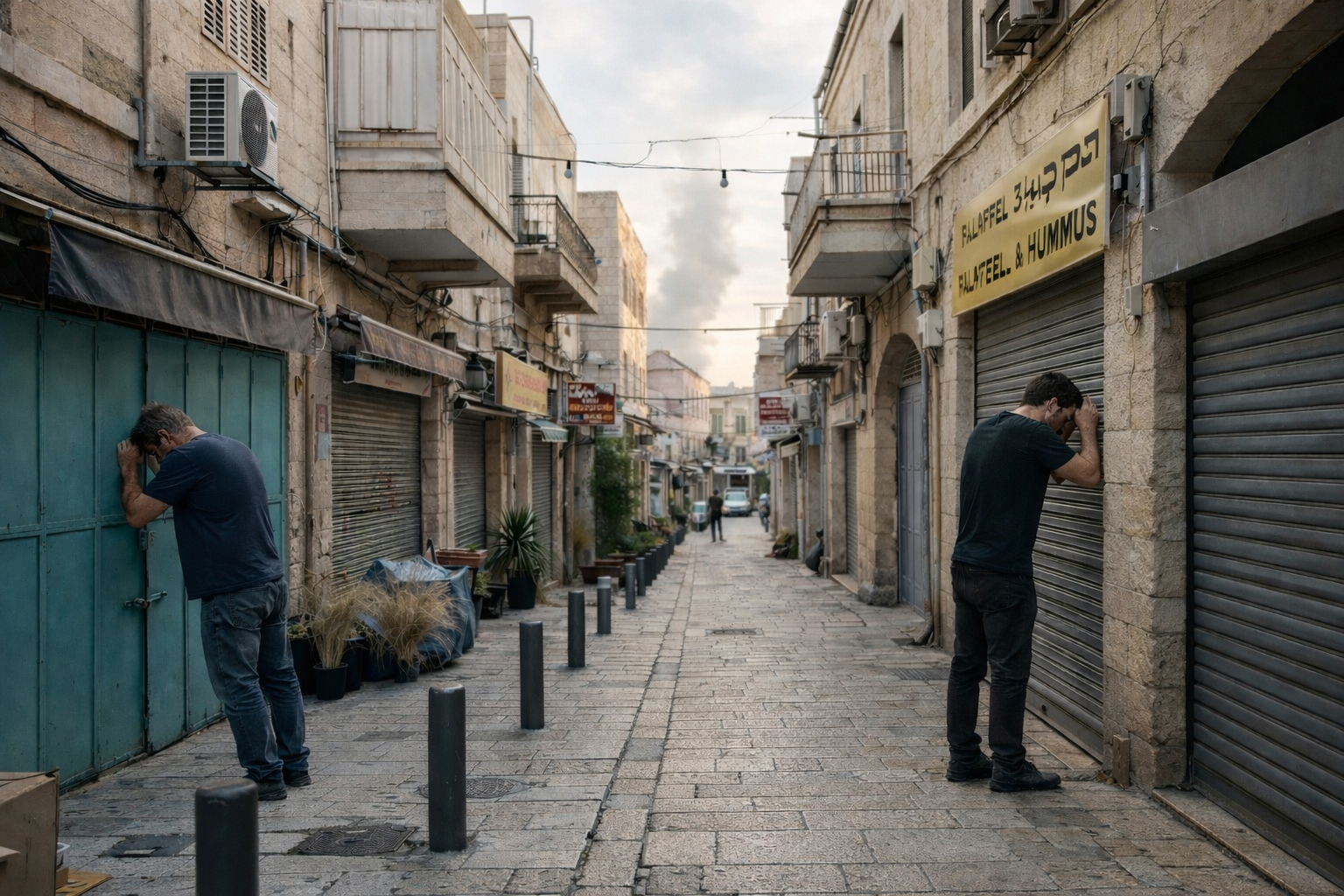
There is a quiet crisis unfolding in Israel — one that triggers no sirens, interrupts no broadcasts, and rarely makes headlines.
Yet it is no less real. For tens of thousands of self-employed Israelis, the war is not only being fought on the front lines. It is being fought in empty appointment books, canceled projects, and the slow, grinding erosion of income.
The numbers are impossible to ignore. According to data from the Israel Democracy Institute, nearly half of Israel’s self-employed report a decline in business activity since the latest escalation, with many seeing drops of 40 to 50 percent. For some, the loss is total — a complete halt in income. These are not temporary fluctuations. They are the kind of sustained disruptions that break businesses.
And this did not begin with the current war. For many, it is the continuation of a longer ordeal. Since 2020, Israel’s independent workforce has absorbed one shock after another: the pandemic, repeated rounds of conflict, prolonged uncertainty, and now yet another escalation. As noted in analysis published by The Jerusalem Post, this amounts to years of consecutive instability for the self-employed, without a consistent structural safety net.
What makes this moment especially dangerous is not only the scale of the disruption, but who is absorbing it. An entire layer of self-employed Israelis entered this escalation already fragile. Some were still recovering from the first phase of the war more than two and a half years ago. Others were operating on razor-thin margins, earning just enough to cover rent, expenses, and basic living costs. For them, a 30, 40, or 50 percent drop in income is not a slowdown to be absorbed. It is a break in continuity they do not have the reserves to survive. For many, this isn’t theoretical, it is whether rent gets paid at the end of the month.
In previous crises, the government has introduced compensation schemes and various forms of assistance. But those measures have often arrived too late to prevent damage, rather than in time to stabilize it, and have been too narrowly defined to match the reality on the ground. In the current escalation, the scope and timing of any support for the self-employed remain unclear, leaving many in a state of prolonged uncertainty. The gap between policy and lived experience remains wide.
At the core of the issue is a structural imbalance that has long gone unaddressed. Israel’s economy is far better equipped to protect salaried employees than to support the self-employed. When crisis hits, employees are buffered by employers, labor laws, and institutional safety nets. The self-employed have none of these. They stand alone in the full force of the shock.
Yet this group is far from marginal.
According to labor data, the self-employed make up a significant share of Israel’s workforce roughly one in eight workers — forming a vital part of the country’s economic fabric.
They are small business owners, service providers, clinicians, creatives, and tradespeople. In normal times they are the connective tissue of daily life. In times of crisis they are too often left to navigate survival by themselves.
This is not a call for charity. It is a call for recognition. A country that mobilizes so effectively to defend its citizens must also confront the quieter costs of prolonged conflict. Survival cannot be handled retroactively. Rent is not paid retroactively. Stability cannot be restored after the damage is done.
The question is no longer whether support should exist. It is whether support can be structured to meet reality as it unfolds — rather than after the damage is irreversible. Because if the expectation is that the self-employed will simply carry themselves through every successive crisis, then the current approach is not sustainable.
This is not simply a question of resources, but of priorities. The government has demonstrated that when it chooses to act decisively, it can mobilize significant financial support in targeted areas. The question is why that same urgency and clarity are so often absent when it comes to the self-employed individuals who form a core part of Israel’s economic engine.
At some point, the question stops being how they manage but becomes how much longer they can.
Maccabi Lev-Ari is the editor of The Maccabean and the Founder of Project Emet. His writing has appeared in The Times of Israel, The Judean, and human rights outlets, where he applies his “Three Pillars” framework — facts, credibility, and morality — to expose bias and defend truth in real time.