
“Health Canada closely monitors all supervised consumption sites across the country, reviewing the policies, procedures, personnel, and finances at each site,” the statement read.
“We are in close contact with Health Canada and actively working to provide the information requested so the suspension may be lifted.”
The next day, the Government of Saskatchewan announced plans to cancel two contracts with Prairie Harm, which related to mental health and addiction services, as well as social services like housing and other crisis-management support.
One contract with the Ministry of Health provided $346,000 in annual funding to Prairie Harm Reduction for “outreach, education and to increase access to take home Naloxone.” Naloxone is a chemical used to treat opioid overdoses.
Another $2.181 million was paid each year by the Ministry of Social Services for child and family programming, according to the statement.
The province stated it “does not fund supervised consumption sites.”
A 30-day notice of cancellation for those contracts was sent to Prairie Harm by the province on March 30. The province said no additional funding for the organization was being considered.
Speaking at the Legislative Building in Regina on March 30, Lori Carr, Saskatchewan’s minister of mental health and addictions, said the province has been “really clear” that it prioritizes recovery when it comes to addressing addictions issues.
“We never did believe that there was any safe use of illicit drugs,” Carr said. “We will continue to work with individuals moving forward, it just won’t be at that institution.”
Knight indicated on Thursday that the organization has been working with the Ministry of Social Services and community partners to “to ensure continued care, particularly for the youth that were in our care,” who are presently being transferred to alternative care options.
“They will have a roof over their head tonight and going forward, where specifically, I can’t speak to that,” Knight said.
Knight added that the province’s funding covered the entirety of several of the organization’s programs, including its youth homes.
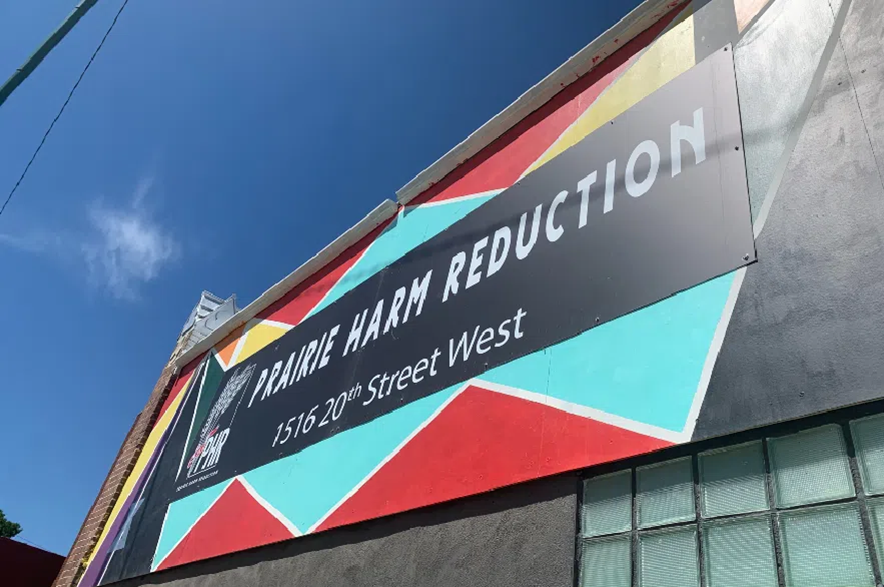
Prairie Harm Reduction, located on 20th Street West, first opened its doors on October 1, 2020. The organization temporarily closed in March of 2025 for about a week, citing staff stress, trauma, and burnout after a high number of overdoses.
Further information on financial investigation
A statement from Prairie Harm Reduction attributed its closure to the current financial situation of the non-profit organization.
In its release, it was shared that a financial review was completed, though a forensic audit was not.
“Such an audit would be required to identify causes and specific opportunities for mitigation. After the board received the financial review from PHR’s independent financial advisors, it was clear there was no viable path forward,” the release stated.
The PHR board reportedly spent “significant time and effort” to find alternate financing and consider alternative options, which it said were “limited.” The program funds he organization received for April 2026 were “insufficient to bridge the financial shortfall the organization is facing. PHR does not have funds to pay for staff or operations going forward,” the release stated.
Over the past month, Knight said, the PHR board has “continued to discover additional liabilities,” and was not comfortable naming a specific number, though he did out it in the range of “hundreds of thousands of dollars.”
Knight said the organization employed 70 full- and part-time staff and more than 50 casual employees. The closure is meant to limit undue distress on the organization’s staff and the people it served.
No funding moving forward and the financial hardships uncovered by the board were some of the factors that led to the organization’s closure, Knight disclosed.
“It is a scary time,” he continued. “It’s, I think, a situation where there’s a whole lot of uncertainty for people whose lives are marked by uncertainty. And it was, I think, one of the hardest decisions in the lives of many of us on the board to make the decision that we did, because we knew what was going to happen.
“PHR has worked tirelessly over the last 40 years to disrupt the systems and decisions that have created ongoing and growing disparities,” the statement read. “Notwithstanding the circumstances announced today, advocacy and compassion are needed now more than ever. We sincerely hope that one day a new organization will emerge to pick up where PHR left off.”
– with files from 650 CKOM’s Mia Holowaychuk