
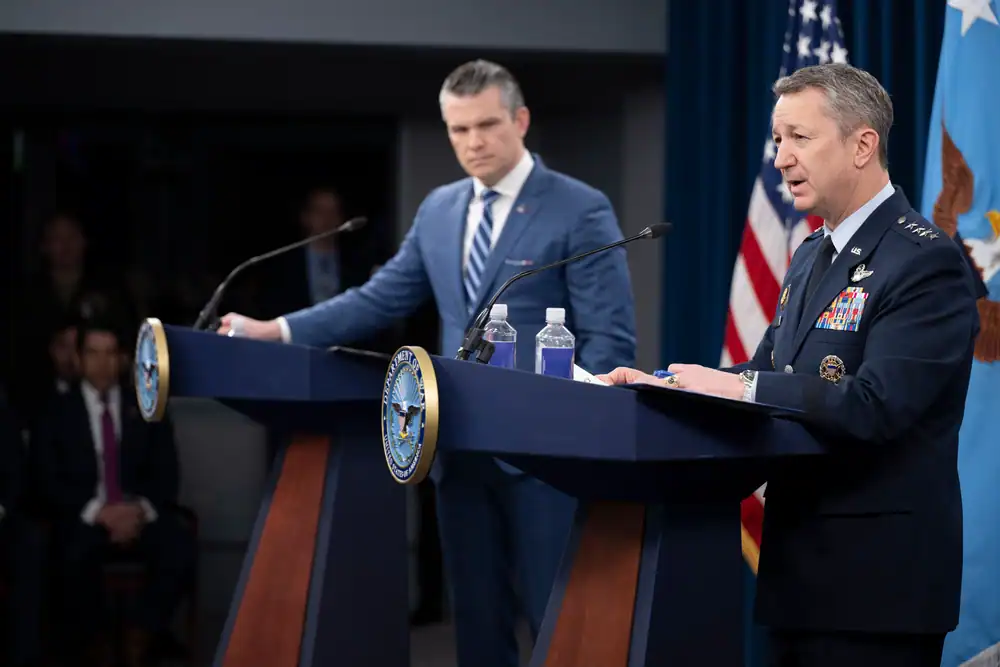
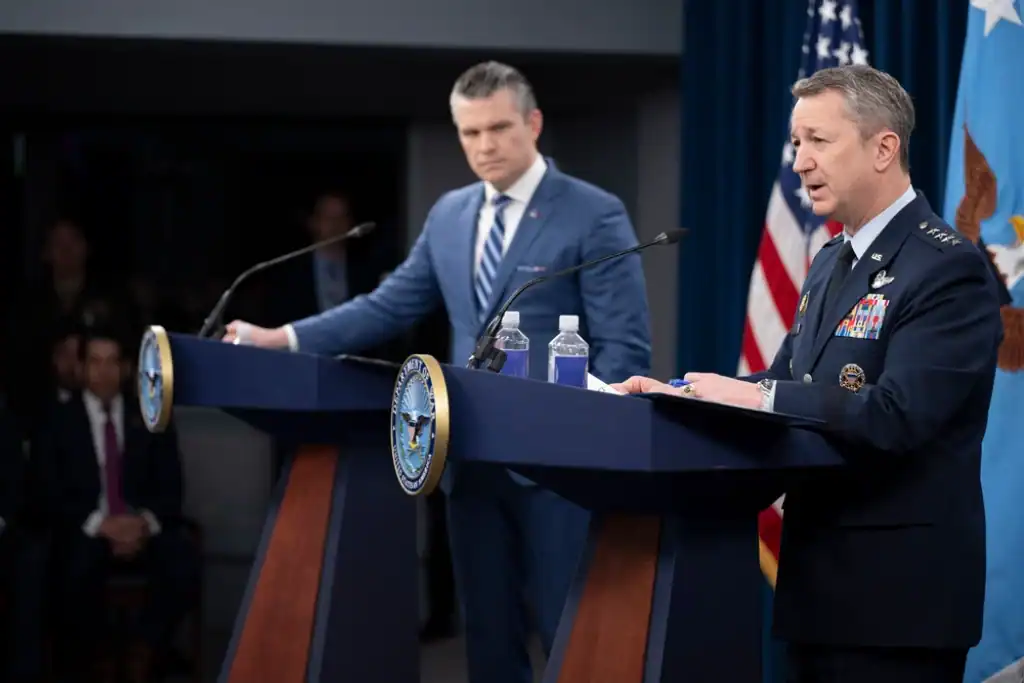
 Secretary of War Pete Hegseth (left) and Chairman of the Joint Chiefs of Staff General Dan Caine conduct a press briefing at the Pentagon on April 8. (Petty Officer 1st Class Eric Brann, Office of the Secretary of War Public Affairs)
Washington and Tehran are both arguing that they were victorious after 40 days of fighting. A detailed analysis, however, suggests a more nuanced picture in which American forces degraded Iran’s core military capabilities but failed to fully achieve some of the operation’s stated objectives. With negotiations in Islamabad potentially imminent, it remains unclear whether the United States will translate operational gains into durable strategic and political outcomes that advance American interests.
Chairman of the Joint Chiefs of Staff General Dan Caine stated on April 8 that the US military was tasked with accomplishing “three distinct military objectives” at the outset of the campaign: to “destroy” Iran’s ballistic missile and drone capabilities, its navy, and its defense industrial base to “ensure” that it “cannot reconstitute the ability to project power outside [its] borders.” He then said that the Joint Force “achieved” those military objectives.
On April 9, the commander of US Central Command (CENTCOM), Admiral Brad Cooper, similarly claimed that US forces had achieved their objective to “dismantle the Iranian regime’s ability to project power beyond its own borders” by “destroying” the regime’s missile, drone, and naval capabilities.
However, while the US and Israeli campaigns severely degraded these primary elements of Iranian military power, they fell short of “destroying” the capabilities entirely. Indeed, these objectives were likely always unrealistic, given the forces and strategies employed. Iran retains the power to attack ships in or near the Strait of Hormuz and the ability to conduct missile and drone attacks across the region. Certainly, those items qualify as the ability to project power outside Iran’s borders.
In addition to the above clear military objectives and the implied goals of destroying or severely degrading Iran’s command and control networks and air defenses, the administration inconsistently articulated several other objectives for the military campaign. These items included ending Iran’s support for terror proxies, ensuring that Iran “never” has nuclear weapons, setting the conditions for regime change, and “unconditional surrender.”
While the full extent of damage done to Iran in Operation Epic Fury is still unclear, it is possible to assess in broad terms how close the operation came to achieving the Trump administration’s goals. On April 8, Secretary of War Pete Hegseth and General Caine held a press conference in which they described the accomplishments of the previous 40 days. Comparing their post-ceasefire assessments with the various goals articulated by the president, high-ranking administration officials, and senior military leaders during the conflict reveals several potential gaps between aspirations and achievements.
Whether these objectives can be achieved at the negotiating table or in resumed military operations remains to be seen.
Military objectives
Throughout the campaign, Admiral Cooper articulated what he described as “well-defined” and “clear” military objectives: “eliminating” Iran’s missile, drone, and naval capabilities. These goals were reiterated by General Caine, along with the additional objective of destroying Iran’s defense industrial base, during the April 8 press conference, where he provided details on the effects of US strikes on these capabilities. It is necessary, therefore, to review the progress made against each of these elements of Iranian military power to properly analyze the US campaign.
To be sure, significant progress was made in accomplishing the first of these objectives by severely degrading Iran’s ballistic missile capability and capacity. According to Caine, CENTCOM struck over 450 ballistic missile storage facilities. He went on to describe Iran’s missile industrial base as “shattered,” saying that more than 80 percent of the regime’s missile facilities were “gone,” along with its ability to produce solid rocket motors.
Despite inflicting these severe blows, however, the destruction of the regime’s missile arsenal in little over a month of operations proved unattainable. Despite a drastic reduction in daily launch rates from Iran in the first week of the war, the regime proved capable of consistently launching attacks throughout the conflict, targeting Israel,Gulf countries, and US bases with hundreds of ballistic missiles.
Moreover, Caine’s statistics did not offer details about how many missiles Iran may still possess. Conflicting reports citing US and Israeli military and intelligence officials suggest that anywhere between a third to over half of the regime’s arsenal could have survived the campaign, while 20-50 percent of Iran’s missile launchers may remain intact.
Likewise, Caine’s comments did not differentiate between missile sites that were destroyed, damaged, or buried. These are important distinctions, because missiles stored in damaged facilities could have survived strikes, and Iran could gain access to deeply buried facilities that US and Israeli attacks temporarily blocked by collapsing and/or burying entrances. The New York Times reported last week that Iran had already begun efforts to dig out underground missile bunkers and silos.
Similar to Iran’s missile capabilities, the regime’s drone arsenal was significantly degraded but not eliminated. US and Israeli forces targeted Iran’s drone capabilities extensively throughout the campaign, with CENTCOM striking roughly 800 one-way attack (OWA) drone storage facilities. Caine stated that “every” factory that produced Shahed OWA drones was struck, as well as “every” factory that produces their guidance systems—but again did not differentiate between sites that were damaged or destroyed, nor did he specify how many drones Iran may have left.
US intelligence officials reportedly estimated last week that up to half of Iran’s drone arsenal may have survived. Whatever remains, Iran clearly retained the ability to conduct long-range OWA drone strikes throughout the conflict, reportedly firing over 2,000 at the UAE alone. Unlike missiles, drones pose the added challenge of being easier to disperse and store in discrete locations, making them harder to find and strike. While doubtlessly degraded, Iran retains considerable drone capabilities and capacity.
The progress against Iran’s naval capabilities is perhaps the easiest to quantify. Caine assessed that 90 percent of Iran’s “regular” fleet was “sunk,” including all of its major surface combatants, along with half of the IRGC Navy’s small attack boats. That means the Islamic Republic retains the other half of its small attack boats, which can lay mines and attack vessels. He went on to say that more than 20 naval production and fabrication facilities were also damaged or destroyed.
Caine also stated that over 95 percent of Iran’s naval mines were destroyed, but he did not say how many remained. The Defense Intelligence Agency assessed in 2019 that Iran possessed over 5,000 naval mines. Assuming the regime entered the conflict with roughly that number, Iran could retain over 200 mines, surely enough to threaten the Strait of Hormuz.
While the success of US strikes against Iran’s naval capabilities is tangible and numerically impressive, the operation did not stop Iran from projecting power in the maritime domain. Indeed, with the regime continuing to hold the Strait of Hormuz hostage, Iran is, at the very least, currently perceived as exerting more power in the maritime domain than it did before the conflict. If this situation endures, it will have serious negative implications for US interests, both regionally and globally.
Finally, Caine said that destroying Iran’s defense industrial base was an objective that was “achieved.” However, he stated in the same briefing that 90 percent of “weapons factories” were “attacked,” leaving 10 percent unhit. It is unclear whether “weapons factories” are synonymous with Iran’s “defense industrial base” or the extent to which the attacks damaged or destroyed their associated targets.
Implied objectives
While not explicitly stated as objectives, destroying or severely degrading Iran’s command-and-control (C2) capabilities and air defenses were clearly priorities for the US military, given the degree to which they were targeted. Leaving C2 intact would have allowed Iran to better organize and direct retaliatory measures, while degrading Iran’s air defenses was a necessary precondition for conducting a large-scale air campaign at acceptable levels of risk.
Caine stated that Iran’s C2 networks were “devastated,” with “more than 2,000 command and control nodes” destroyed. Numerous top Iranian military leaders were killed, including the minister of defense, chief of staff of the Iranian military, and commander of the Islamic Revolutionary Guard Corps (IRGC). However, Iranian forces continued to conduct combat operations throughout the conflict, likely reflecting the regime’s strategy of delegating authority to local commanders in the absence of centralized leadership.
Additionally, there is some evidence that Iran was able to reconstitute at least a portion of its C2 capabilities. Some Iranian attacks appeared to be calculated responses to specific strikes. For example, Iran struck Saudi Arabia’s Jubail petrochemical complex on April 7, which it claimed was in response to strikes the previous day on Iran’s Asaluyeh petrochemical plants. This implies that Iran’s leaders were able to learn which of their assets were struck, pick a corresponding target in the region, and communicate an attack order to their forces. Despite the number of targets hit and leaders killed, Iranian C2 appears to have remained at least partially functioning by the time the ceasefire began.
On air defenses, Caine estimated later in the press conference that approximately 80 percent of Iran’s air defense systems were “destroyed” after more than 1,500 such targets were struck. While the Islamic Republic’s air defenses were undoubtedly heavily degraded, it remains unclear what types of systems the remaining 20 percent were composed of and where they were located. If the remainder includes a significant portion of Iran’s mobile and capable systems, the destruction of Iran’s air defenses was not complete.
Concerningly, Iran seems to have had some success against US aircraft as the conflict continued. While the loss of aircraft was less than many would have predicted, given the number of sorties, at least one F-35 multirole stealth fighter was reportedly damaged by Iranian fire, over 20 unmanned MQ-9 Reaper drones were reportedly lost, and an A-10 attack aircraft and an F-15E fighter were shot down by Iran.
Additionally, US B-52 bombers were photographed departing RAF Fairford loaded with what appeared to be cruise missiles in early April. This would suggest Iran likely retained some of its more capable air defense systems if the US military was employing expensive standoff munitions rather than risking certain types of high-value aircraft that far into the conflict.
Additional objectives
In addition to the stated and implied military objectives, the Trump administration articulated several inconsistent and, at times, conflicting objectives. These included “sever[ing] [Iran’s] support for terrorist proxies,” ensuring Iran “never acquires a nuclear weapon,” allowing Iranians a chance to “take over” their government, and achieving the regime’s “unconditional surrender.”
Regarding proxies, US forces engaged in combat operations against Iran-backed militias in Iraq, striking their headquarters and several key leaders. Despite receiving blows, the militias were able to strike the US Embassy in Baghdad and other high-value targets, such as radars and aircraft. The impact of US operations against the militias remains unclear, but there is no evidence that they were removed as a threat, nor that Iran has ceased support for them.
Lebanon’s Hezbollah almost immediately entered the conflict against Israel, launching over 6,500 rockets since March 2. Israel had struck over 3,500 Hezbollah targets, and multiple Israeli divisions were operating in southern Lebanon as of March 31. Hostilities continued after the ceasefire between the US and Iran was announced, leaving the outcome uncertain.
The Houthis in Yemen largely stayed on the sidelines of the conflict, perhaps due to losses they suffered in 2025 from US and Israeli strikes. However, they did launch ballistic missiles and drones at Israel starting on March 28. No significant US or Israeli operations were reported against the Houthis, and the group remains a threat.
On the nuclear front, Caine stated that “nearly 80 percent of Iran’s nuclear industrial base was hit.” These targets included weaponization-linked sites, a uranium processing plant, and the Arak heavy water production plant. Caine did not specify which components of the nuclear program remained, nor the extent to which the damage lengthened Iran’s pathway to a bomb. Unfortunately, the destruction of Iran’s nuclear program was not total, and Iran retains its stockpile of highly enriched uranium (HEU). After the ceasefire, Hegseth called on Iran to turn over the HEU.
Regime change, which was hinted at and even claimed as an accomplishment, was not achieved. While many leaders were killed, they were replaced in short order, with the position of supreme leader now belonging to Ali Khamenei’s reportedly injured son, Mojtaba Khamenei. Time will tell how the war will impact the regime’s medium- to long-term stability .
Iranian unconditional surrender, which President Trump called for on March 6, was clearly not achieved, as evidenced by ongoing negotiations.
The folly of quantifying ‘victory’
A simple accounting of sorties flown, strikes conducted, munitions dropped, targets struck, or enemy capacity attrited alone is insufficient to judge an operation’s success. US and Israeli forces conducted an impressive campaign that significantly degraded the primary elements of Iranian military power. The operation did not, however, destroy these capabilities outright nor eliminate Iran’s ability to project meaningful power outside of its borders. Indeed, completely “destroying” these capabilities was likely always unrealistic.
Whether or not these initial operational successes can be translated into concrete strategic and political gains that secure American interests remains to be seen. That is up to America’s civilian leaders. The US military has done its part for now and paid a cost in American blood.
Over 380 soldiers, sailors, airmen, and Marines were wounded in the operation. Appropriately, Admiral Cooper concluded his remarks on April 9 by “remembering and honoring” the 13 American service members who made the ultimate sacrifice during the first 40 days of Operation Epic Fury.