
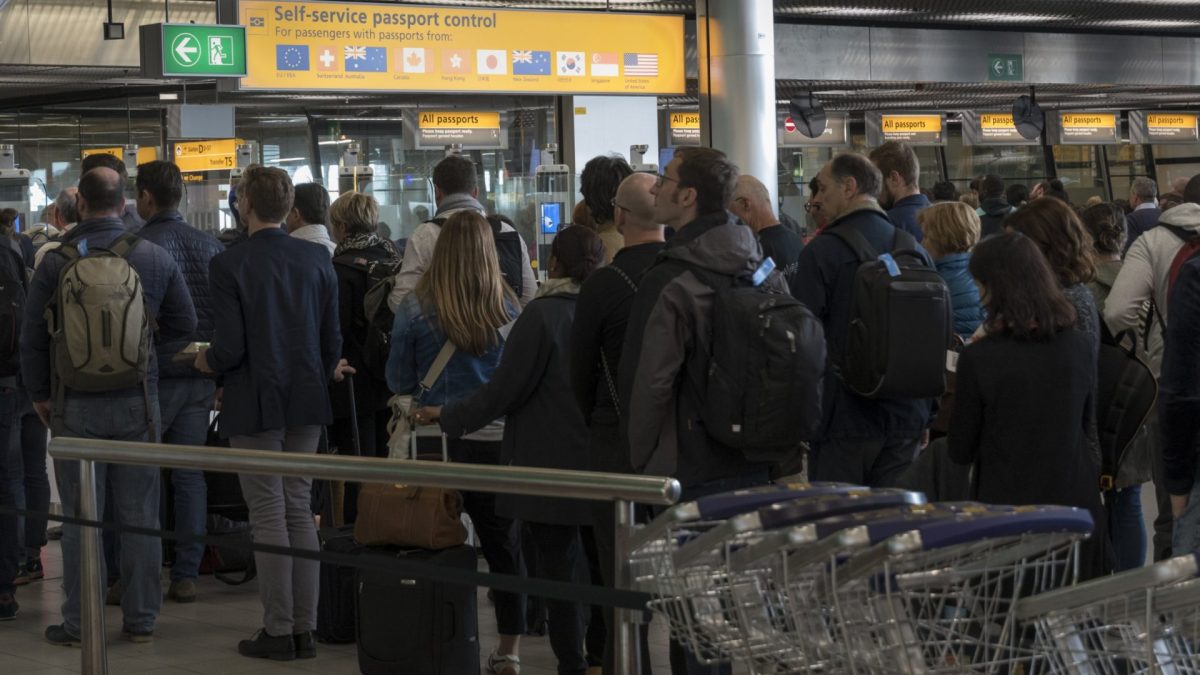
Hundreds of thousands of travellers on 4,000 flights into the UK this weekend will be subject to new Brexit border checks that could delay their trips.
Passengers have faced queues of up to four hours during a chaotic phased rollout of the EU’s new biometric Entry/Exit System – or EES – which occurs at passport control when arriving at or departing from a country within the Schengen area and becomes fully operational on Friday.
Popular holiday destinations Amsterdam, Malaga, Paris, Alicante and Palma de Mallorca will see the most travellers departing Schengen airports for the United Kingdom between Friday and Sunday, when many British families are returning from Easter holidays.
New FeatureIn ShortQuick Stories. Same trusted journalism.
Even if people were not subject to EES checks on their way out of the UK, they will be checked on the way back in. The new checks involve people having their fingerprints and faces scanned.
However, the rollout has been hit by delays because of issues with the tech needed to record this biometric and fingerprint data, or due to a lack of border staff to cope with the increased processing time for travellers.
Eurostar at St Pancras, Eurotunnel at Folkestone and the ferry port at Dover have been allowed to postpone the start of biometric checks due to technical delays at French border control. Passports will still be stamped at these ports.
Data provided by aviation analytics firm Cirium shows a total of 4,754 flights are scheduled to be departing Schengen airports for the United Kingdom this weekend, 10, 11 and 12 April.
Anticipating delays, the European Commission, responsible for the rollout, is even warning airports that “there are fallback solutions that member states can rely on if needed”.
Countries can partially suspend EES at peak travel times until September, which would mean recording people in the system but not taking their photos or fingerprints.
However, airports that do halt the EES may have to manually upload the biographical data contained in the passports if the system is temporarily not operating at a given border crossing point – which could create its own delays.
Airlines UK has told European countries to “take a pragmatic approach and make full and effective use of the permitted flexibilities for as long as needed while EES is implemented, to avoid border delays for passengers”
But Mark Tanzer, Chief Executive at Abta, said travel agents and tour operators are warning passengers face “inconsistency” in how the system is applied across different EU destinations, because some countries are more prepared than others to start processing “third-country nationals”, including British travellers.
“While some journeys are smooth, others involve longer waiting times and uncertainty at the border, particularly during busy periods,” he said.
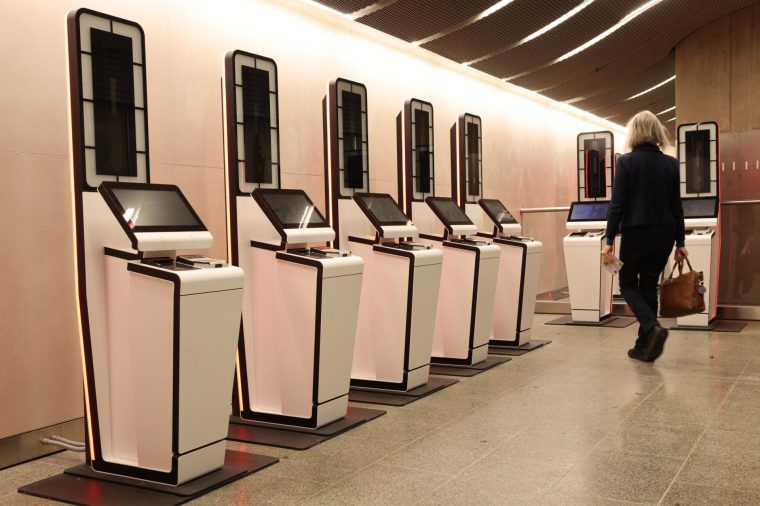 EES kiosks have been set up at St Pancras International for the Eurostar but won’t be in use this weekend as tech on the French side is not ready (Photo: Adrian Dennis/AFP/Getty)
“Member States do have access to a range of permitted provisions intended to help manage passenger flows and minimise disruption at the borders. However, the industry is increasingly concerned that these measures are not being applied consistently in practice, which can add pressure on operations.
“Additionally, as part of the phased introduction, passport stamping has remained in place at most ports and airports ahead of the full transition, with biometric checks being introduced incrementally. However, Abta understand that manual passport stamping will continue at the UK’s juxtaposed border in the coming weeks.
“It is therefore critical that there is greater clarity and consistency in how the system is implemented, alongside appropriate staffing and planning, particularly as we approach the peak summer travel period.”
The International Air Transport Association (Iata) has warned passengers to prepare for greater waiting times for entry and exit checks if travelling from today.
“If it looks like a large queue might be ready to form, then we strongly encourage states to apply the flexibility available to them to partially and temporarily suspend EES. This means that for up to six hours in every 24 hours they can suspend the collection of biometric data – like face and fingerprint scans – which will reduce the time taken to process each passenger and thus hopefully minimize delays,” the Iata said.
“Even in this scenario, passengers will still have to register their biographic data and answer the entry questionnaire when they arrive. So it is vital that the kiosks and automated border control gates are working properly, the app is functioning, and that borders are adequately manned, to minimize delays.”
Flights into the UK this weekend
On 10 April 2026, there are scheduled to be 1,616 flights from Schengen airports to the UK, which equates to 293,778 seats.
The most popular routes will be Amsterdam (113 flights, which equates to 16,173 seats), Malaga (64 flights, which equates to 12,206 seats), and Paris Charles de Gaulle (60 flights, which equates to 9,903 seats).
On 11 April 2026, there are scheduled to be 1,536 flights departing Schengen airports to the UK, which equates to 282,360 seats.
The most popular routes will be Amsterdam (82 flights, which equates to 11,738 seats), Alicante (78 flights, which equates to 14,914 seats), and Palma de Mallorca (67 flights, which equates to 12,425 seats).
On 12 April 2026, there are scheduled to be 1,602 flights departing Schengen airports to the UK, which equate to 293,336 seats.
The most popular routes will be Amsterdam (100 flights, which equates to 14,911 seats), Malaga (70 flights, which equates to 12,918), and Alicante (63 flights, which equates to 12,044 seats).
Data provided by aviation analytics firm Cirium.