
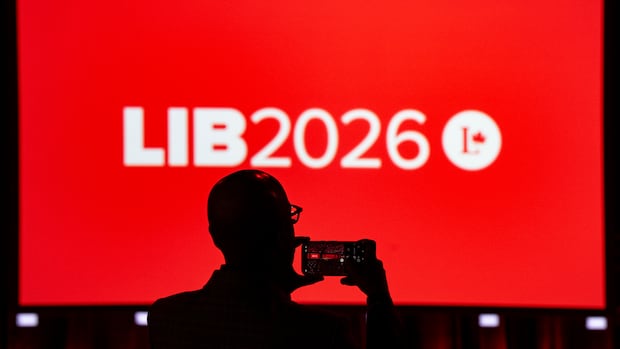
Liberal members voted in favour of restricting young Canadians’ access to social media platforms and artificial intelligence chatbots, as the national convention winds down in Montreal.
Grassroots are voting on 24 policy pitches Saturday, ranging from health-care system improvements to electoral reform.
Two proposals debated how to address the impact social media platforms and AI chatbots — tools that simulate human conversation — are having on teenagers and kids.
One resolution calls for a law similar to one Australia passed late last year that would set a “minimum age of 16 for creating social media accounts” and put the onus on companies that run the platforms to “prevent underage users from holding accounts.”
Another calls for anyone under the age of 16 to be banned from accessing “all AI chatbots and other potentially harmful forms of AI interaction,” including OpenAI’s ChatGPT.
“These technologies have been shown to limit desire for interaction with peers, pushed some young people into sexual conversations and have even recommended suicide to vulnerable youth,” states the resolution.
Both were adopted by members.
Taylor Owen, the Beaverbrook Chair in Ethics, Media and Communications at McGill University in Montreal, says he’s glad Liberals are debating social media’s societal impact but warns against a permanent ban.
“It’s punishing the kids for something that’s our fault. They didn’t cause these problems. The problems are designed into the products they’re using,” he said.
Ban wouldn’t keep kids offline, expert says
“It’s signalling that we think these products can never be safe. And we know that’s not the case. The companies are choosing to make them unsafe and we are allowing them to be unsafe by not regulating them.”
Owen also said teens will find other ways to access platforms or move to private chats where they could be even more unsafe.
Owen, who sits on the government’s expert panel on online safety, has been pushing for Ottawa to establish an independent regulator, which would require risk assessments and public transparency from companies that build special media platforms.
While policies from the convention floor aren’t binding, Prime Minister Mark Carney has said an age of majority for social media is part of the discussion the government is already having as it develops new online harms legislation.
During a news conference in Tokyo last month, he said he hasn’t made his mind up yet.
 Liberal Party members are debating two policies looking at how to address concerns about young people online. (Summer Skyes photography/Flickr)
“I think this is something that merits an open and considered debate in Canada,” he said at the time.
In an open letter to Carney, the advocacy group Unplugged Canada urged his government to adopt a minimum age of 16 for social media access. The letter is signed by some 4,000 supporters, including the Canadian Medical Association, the BC Pediatric Society and the Ontario Psychiatric Association.
“Social media companies should face the same obligation as any other industry: to only offer products to youth that are demonstrably safe for them,” reads the letter.
“Consider road safety: We engineer safer vehicles, establish an age minimum, assign a regulatory body and require driver education…. Digital safety demands the same comprehensive approach for youth safety: age guardrails, platform accountability and digital literacy.”
With the Liberals poised to reintroduce elements of the Online Harms Act, which died on the order paper, Owen said AI chatbots need to be discussed.
WATCH | How Australia’s social media ban for kids is working out:
Is Australia’s social media ban for kids working — and is Canada next?
Months after Australia brought in the world’s first social media ban for users under 16, CBC’s Deana Sumanac-Johnson goes there to talk to parents and kids about how it’s working and examines the growing global momentum, including in Canada, to implement similar laws.
OpenAI, the company behind ChatGPT, is under scrutiny after it acknowledged it flagged and banned an account belonging to the shooter in the February Tumbler Ridge, B.C., shooting a half a year before she killed eight people, most of them children — but did not alert police.
“It’s very difficult to justify an online harms bill that does not include the type of digital product that citizens are most concerned about right now, and those are chatbots,” Owen said.
A recent poll suggests the government, if they do adopt an age restriction for social media, would find public support.
The Angus Reid Institute released a poll late last month that suggested “banning those under 16 from platforms would be well received by the vast majority of Canadians.” Seventy-five per cent of those surveyed said they support a “full ban on social media use for anyone under the age of 16.”
Call to curtail use of the notwithstanding clause
Another resolution that made it to the convention floor calls on the federal government to restrict use of the notwithstanding clause in instances where provinces use it to bypass Charter rights before their law has been tested in court.
Some provinces have been accused of using the lever as a political weapon. They’ve argued it’s a part of the Charter.
Last year, Alberta used the notwithstanding clause to shield three laws affecting transgender rights from challenges. Quebec also invoked the clause for its contentious secularism law, still known as Bill 21, which bans public sector workers, such as teachers, from wearing religious symbols at work.
That Liberal policy appears dead on arrival.
Justice Minister Sean Fraser told reporters in March he has “no intention” of invoking disallowance, whereby the federal government could veto a provincial or territorial act, and that doing so would not “be a helpful thing for the federation.”
There are many areas where the provinces “are best positioned to make decisions,” he said. Disallowance hasn’t been used by a federal government since 1943.
Just because a policy is approved at the convention doesn’t mean the cabinet is obliged to bring it into law. But the debates and resolutions serve as a way for the grassroots to try and influence party platforms and party brass where members’ views are at.
Some of the other proposals include:
Eliminating the visitor visa requirement for Ukrainian citizens who come to Canada for short-term stays.Establishing a national rail strategy.Affirming the recognition of Indigenous rights.Requiring a candidate to receive at least 50 per cent plus one vote to win, which could be achieved through ranked ballots or run-off systems.Adopting a proportional representation system.
Carney is expected to address the crowd — the largest for a policy convention in Liberal history, organizers say — this afternoon.
Then, the Liberals’ full attention shifts to Monday’s byelections, where they are hoping to secure their sought after majority government, which would have ramifications for how the House of Commons operates.