
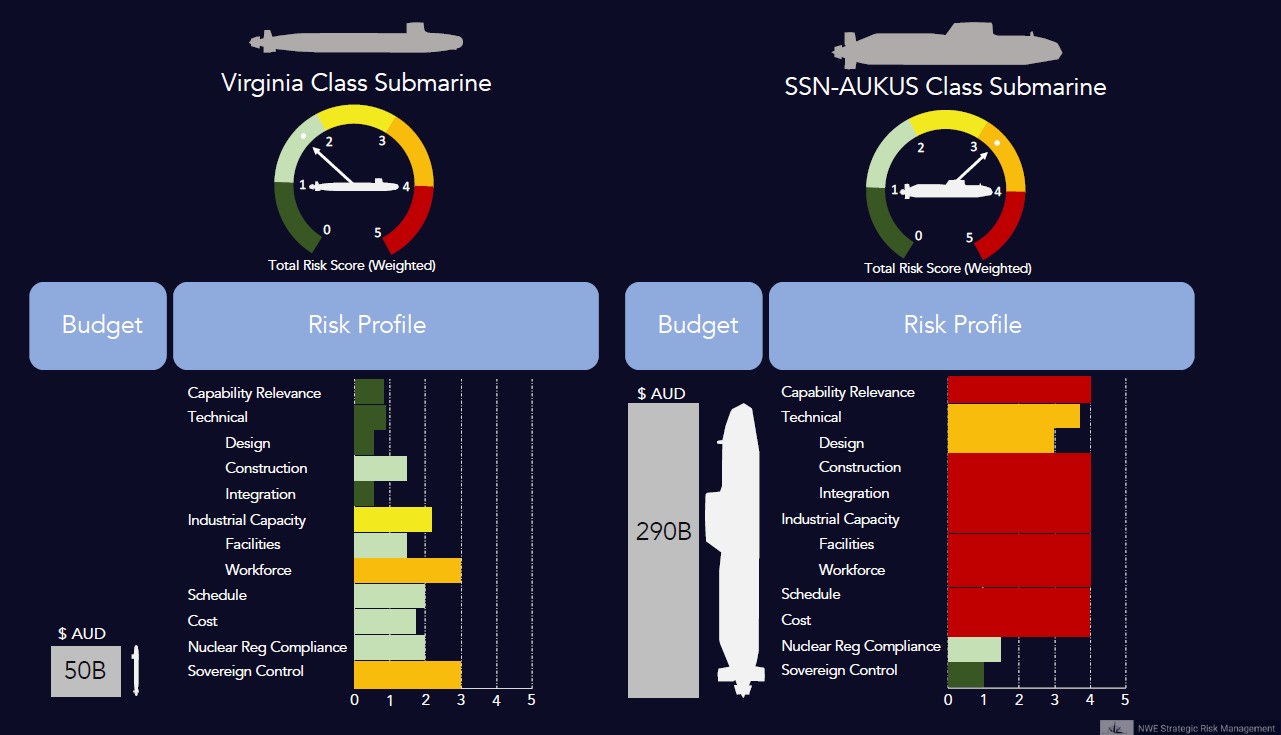
Australia should withdraw from the SSN-AUKUS program to double down on a larger Virginia Class submarine fleet, according to a newly published risk report.
The report, titled AUKUS Pillar 1 – Submarine platform risk comparison, is an independent white paper published earlier this month and authored by NWE Strategic Risk Management principal Peter Robinson.
You’re out of free articles for this month
The report primarily focused on a risk analysis comparison of Australia acquiring Virginia Class from the United States and SSN-AUKUS nuclear-powered submarines under the AUKUS trilateral agreement. The risk assessment considered factors such as capability relevance, technical relevance, industrial capacity, schedule, cost, nuclear propulsion compliance and sovereign control.
It’s recommended that the Australian government mitigate sovereign control risks associated with the Virginia Class submarines through robust bilateral agreements and leverage long-standing alliance commitments such as ANZUS.
In a major variation, Robinson also recommended that Australia withdraw from the SSN-AUKUS Class program and commit long term to the Virginia Class Block IV boat, increasing fleet size to seven or eight boats to meet capability depth requirements (with net saving to the taxpayer of AU$233 billion).
“At AU$368 billion, AUKUS Pillar 1 is by far the largest investment Australia has ever committed to … and Defence is insolvent as a result,” Robinson said.
“A clinical view of the cost versus risk profile is vital if we are to make objective business-case decisions in the best interest of our nation.
“Whist the budget breakdown is opaque, the risk differential is clear: SSN-AUKUS submarines are a massive gamble at a gigantic price that we should tactfully withdraw from.
“If there is a nugget of goodness we can take from the AUKUS deal, it is the acquisition of a small fleet of exceptionally capable Virginia Class Block IV submarines … with a programmatic saving of >$230B1.
“A cost-risk factor (budget x total risk score) produces a 10-times ratio in favour of the US-built submarines. An increased commitment to the Block IV pathway will provide an outstanding capability outcome … without bankrupting Defence.
“This saving could be offset against further debt expansion or redirected to national priorities including bolstering broader Defence capability through a reinvigorated Integrated Investment Program.”
The paper also argued that due to the original security restrictions around the AUKUS trilateral security pact, the current AUKUS deal did not get “sufficient consultation for such a massive commitment of taxpayer funds”.
In addition, Australia will likely be taking on significant construction risk because it has never built a nuclear submarine and its shipyards will require massive upgrades to handle the physical and regulatory demands of nuclear work.
The paper also argued that UK facilities are already stretched and in need of significant remediation, which could result in delays in technology transfer.
“The sole UK nuclear submarine production facilities (at Barrow-in-Furness) have been under-resourced and neglected for many decades,” Robinson said.
“The last major infrastructure build was the construction of the Devonshire Dock Hall (DDH) in the early 1980s – a vast indoor assembly facility that remains the centrepiece of submarine construction today, almost half a century later. It wasn’t until 2014 that a modest £300 million government-funded redevelopment was announced to prepare the yard for the Dreadnought Class build.
“Even then, this modernisation effort merely addressed known bottlenecks rather than future-proofing the facility. Subsequent funding in 2016 added 225 million (pounds), but this too was reactive and limited in scope.
“The result is a strategically vital site that has been forced to operate at the edge of its capacity, with terribly outdated infrastructure and minimal scalability. While the program’s intent is to build the Australian SSN-AUKUS boats at Osborne in SA, it would be naïve in the extreme to dismiss the significant reliance that will be placed on Barrow, especially during early-stage production.”
“(In regard to workforce) Australia currently lacks a nuclear-qualified maritime workforce and growing one domestically will take decades, even with training pipelines and international secondments.
“Experience from the UK Astute Class and US Virginia Class programs shows that even established nuclear nations struggle to maintain a sufficiently deep talent pool between major programs.
“Any shortfall in workforce availability will create quality assurance issues, increase rework and jeopardise the ability to sustain multiple boats concurrently. This is further exacerbated by competing shipbuilding programs such as the Type 26 Future Frigate that could cannibalise the local talent pool.”
In addition, Australia will likely face significant cost risk through the SSN-AUKUS program with potential for design changes, increased exposure to inflation, exchange rate fluctuations, material and labour costs over time.
“Unlike conventional platforms, nuclear submarines involve a compact reactor that must be designed, constructed, operated and disposed of under the highest levels of international and domestic scrutiny,” he said.
“For Australia, which currently has a tiny civilian nuclear industry and is without an existing regulatory authority for naval nuclear propulsion, this risk is magnified by the need to create a comprehensive legal and institutional framework from the ground up.
“This includes establishing independent nuclear safety regulators, ensuring compliance with International Atomic Energy Agency (IAEA) safeguards and securing public and political acceptance of nuclear activities in civilian ports and shipyards. Any gaps in regulatory readiness could delay construction milestones, submarine certification or the ability to deploy vessels operationally.”
Finally, Robinson addressed the global insecurity surrounding the US administration under US President Donald Trump.
“Nervousness currently abounds regarding the ambivalence of the Trump administration’s commitment to AUKUS, concerns over the transfer of precious Virginias (the ‘crown jewels’ of US strategic stealth capability) to Australia and the potential outcomes of the ongoing Colby review,” he said.
“However, it is unlikely that the US will totally upend the essence of the AUKUS arrangement as it generally falls in their favour (because) the financial commitment by Australia is significant and upfront.
“It sends a clear message to China of the US intent to bolster the capability of its regional alliance partners and, most importantly, it provides a forward basing and maintenance hub in the Indo-Pacific outside the standard envelope of current Chinese long-range fires.
“It is worth remembering that Australia is a vital link in the long-established US pivot to our region and the ability to operate nuclear-powered submarines from our continent is very appealing.”