
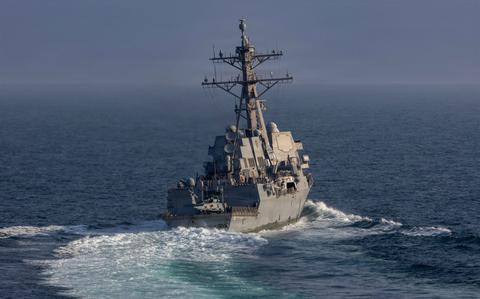
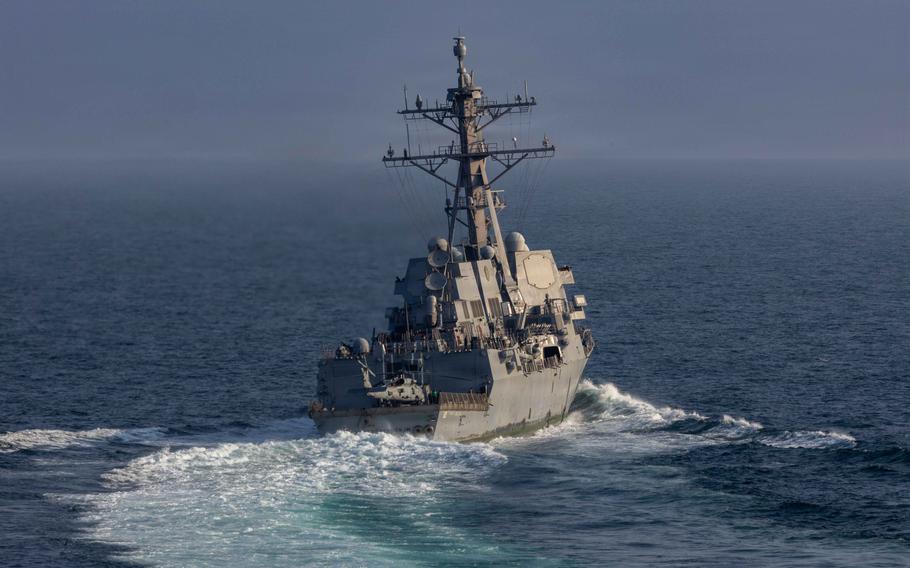
The Arleigh Burke-class guided-missile destroyer USS Frank E. Petersen Jr. sails in the Arabian Sea during Operation Epic Fury, March 18, 2026. U.S. Central Command said two destroyers, including the Frank E. Petersen Jr., were part of a mine-clearing operation in the Strait of Hormuz that began on Saturday, April 11, 2026. (U.S. Navy)
The U.S. military has begun a mine clearance operation in the Strait of Hormuz, U.S. Central Command said Saturday, as U.S., Iranian and Pakistani officials hold high-level talks aimed at stabilizing a fragile ceasefire and reopening one of the world’s most critical oil transit routes.
Two guided-missile destroyers, the USS Frank E. Peterson and USS Michael Murphy, transited the strait and operated in the Arabian Gulf as part of the effort, U.S. Central Command said in a statement on Saturday.
“Today, we began the process of establishing a new passage and we will share this safe pathway with the maritime industry soon to encourage the free flow of commerce,” said Adm. Brad Cooper, commander of Central Command.
The operation is aimed at ensuring the strait “is fully clear of sea mines previously laid by Iran’s Islamic Revolutionary Guards Corps,” the statement said. Additional U.S. forces, including underwater drones, will join the clearance effort in the coming days, it added.
The statement came after President Donald Trump said in a Saturday morning post on Truth Social that “we’re now starting the process of clearing out the Strait of Hormuz as a favor to Countries all over the World.”
In subsequent posts, Trump said the U.S. had “completely destroyed Iran’s military” and downplayed the threat posed by Iranian sea mines.
Meanwhile, U.S. officials and Iranian state media confirmed the start of the trilateral talks, led on the U.S. side by Vice President JD Vance and on the Iranian side by Parliament Speaker Mohammad Bagher Qalibaf.
The negotiations, held in Islamabad, represent the highest level face-to-face interaction in decades between the two sides, though it is far from certain whether a compromise can be reached to end hostilities that began in late February.
Iranian media signaled some progress in the talks. The semi-official Tasnim news agency reported the discussions had moved beyond broad principles and into technical negotiations on specific issues, with experts from both sides reviewing details. It said a one-day extension of talks was possible to continue expert-level discussions, though no final decision had been made.
Tasnim also denied reports of warships transiting, saying instead that a U.S. destroyer was headed to the strait but stopped after a Pakistani mediator relayed an Iranian warning.
The Financial Times on Saturday said the sides have hit a stalemate over the Strait of Hormuz, the strategic waterway through which a fifth of the world’s oil usually flows.