
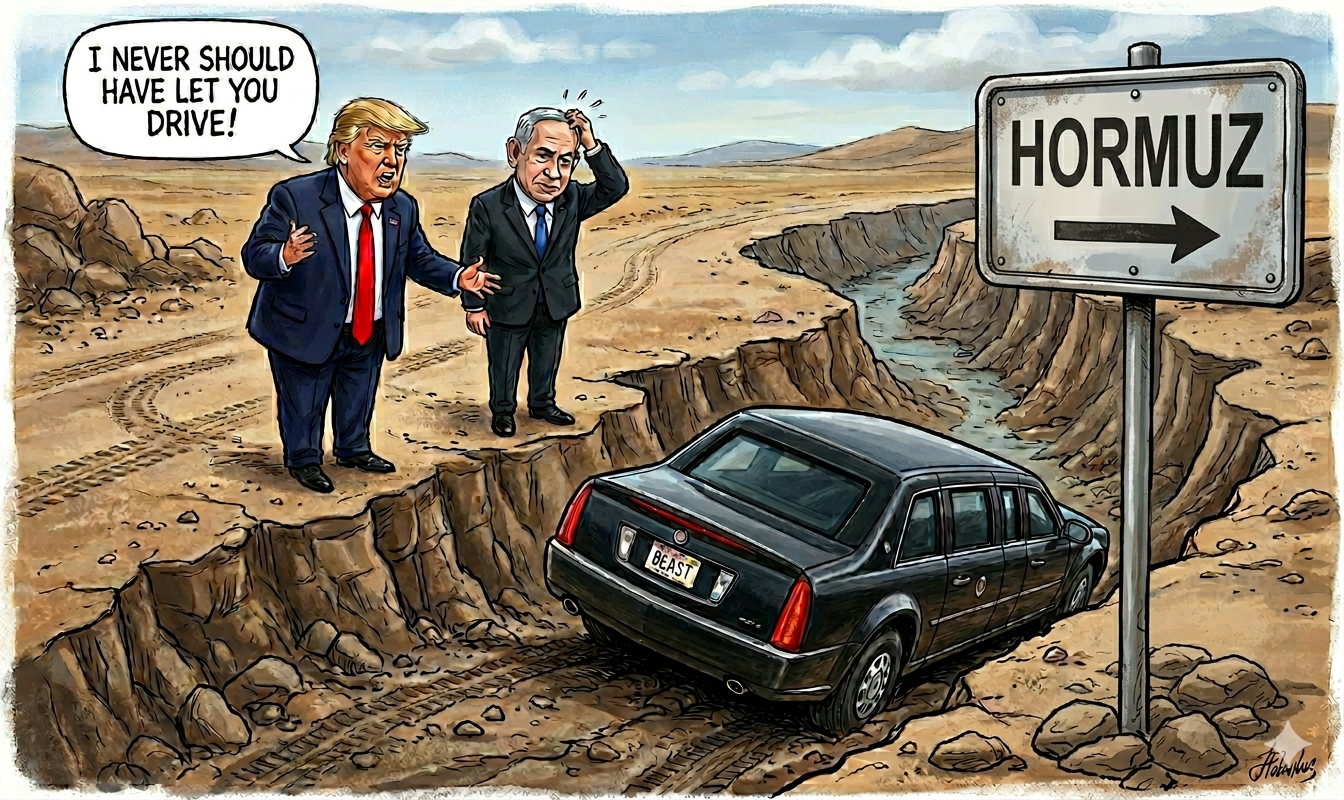
The decision by President Donald Trump to authorize a joint U.S.–Israeli strike on Iran in late February has prompted intense debate about how the choice was made and what shaped the president’s thinking. The most detailed reconstruction of events comes from reporting by Maggie Haberman and Jonathan Swan of The New York Times, two journalists widely regarded as deeply sourced within Trump’s orbit. Their account is drawn from reporting for their forthcoming book, Regime Change: Inside the Imperial Presidency of Donald Trump. It has not been confirmed by the White House, and administration officials have not authenticated the details. Still, their reporting offers the clearest available narrative of the internal dynamics that preceded the strike and the competing pressures that shaped the president’s judgment.
According to their reconstruction, the pivotal moment occurred on February 11, when Israeli Prime Minister Benjamin Netanyahu delivered a private briefing to Trump and his senior advisers in the White House Situation Room — a venue rarely used for in-person meetings with foreign leaders. Netanyahu had been pressing for months for the United States to agree to a major assault on Iran, and his presentation was framed as an opportunity to eliminate a long-standing adversary and reshape the strategic landscape of the Middle East. The gathering was deliberately kept small to guard against leaks; other top cabinet secretaries had no idea it was happening. Conspicuously absent was Vice President JD Vance, who was in Azerbaijan on a diplomatic visit and could not return in time for a meeting called on such short notice. Those present included Chief of Staff Susie Wiles, Secretary of State Marco Rubio, Defense Secretary Pete Hegseth, Joint Chiefs Chairman Gen. Dan Caine, CIA Director John Ratcliffe, Jared Kushner, and envoy Steve Witkoff.
Netanyahu’s Position
Netanyahu’s presentation was described as lasting roughly an hour, delivered in what attendees called a confident monotone. His pitch had four components: Iran’s missile capabilities could be destroyed within weeks; the regime could not close the Strait of Hormuz; street protests, with covert Mossad support, would resume and could produce regime change; and Kurdish fighters could open a ground front from Iraq. At one point, the Israelis played a video montage of potential post-theocratic Iranian leaders, including Reza Pahlavi — the exiled son of Iran’s last shah — who had been pressing hard for the United States and Israel to launch the war. Netanyahu maintained that Iran’s leadership was brittle, its military overstretched, and its population primed for revolt. He assured Trump that the risks were manageable and the strategic payoff immense, conveying a sense of urgency and inevitability. When others in the room raised possible risks, he acknowledged them but pressed a single central point: in his view, the risks of inaction were greater than the risks of action.
Trump’s Position
If Netanyahu was the hard sell, the reporting portrays Trump as the eager buyer. Trump’s views on Iran had long been hawkish. He had withdrawn from the nuclear deal years earlier, ordered a major strike on Iranian targets eight months before this meeting, and repeatedly described Iran as a terrorist state that needed to be confronted. When Netanyahu concluded his presentation, Trump responded with a simple endorsement: “Sounds good to me.” Advisers interpreted this as a near green light, and the reporting suggests that Trump’s reaction reflected both his preexisting hostility toward Iran and his tendency to respond favorably to strong, confident foreign leaders.
Haberman and Swan note that Trump has a pattern of discounting the caution of his own intelligence officials, whom he often views as overly nuanced or pessimistic. He has historically shown a preference for bold, simplified solutions and has sometimes placed greater trust in the assurances of assertive heads of state. The reporting implies that Netanyahu’s certainty aligned with Trump’s instincts, making the president receptive to the plan from the outset. Notably, by the time Trump formally polled his senior advisers one by one on February 26 — two days before giving the final order to strike — he had, according to multiple advisers cited by the Times, effectively made up his mind weeks earlier.
Hegseth’s Position
Defense Secretary Pete Hegseth was the most enthusiastic advocate for war among Trump’s senior team. Two days before Trump gave his final order, Hegseth told the assembled group: “We’re going to have to take care of the Iranians eventually, so we might as well do it now.” His posture stood in sharp contrast to the skepticism expressed by most of the other officials present, and the reporting frames him as the strongest internal voice pushing toward action.
Vance’s Position
Vice President JD Vance was not present at the February 11 Situation Room briefing; he was still in Azerbaijan when Netanyahu made his pitch. The following day, February 12, at a follow-up meeting of American officials only, Vance returned and joined a broader reckoning with Netanyahu’s plan. He was, according to the reporting, the only senior official who directly told Trump that going to war with Iran was a terrible idea. Vance warned of regional chaos, mass casualties, and the political risk of alienating Trump’s anti-interventionist supporters — voters who he said would view the decision as a betrayal. He also raised concerns about the munitions problem: a war against a regime with enormous will for survival could leave the United States in a far worse position to fight future conflicts.
The reporting captures an evolution in Vance’s position as Trump’s course became clearer. He was initially for no strikes at all. Once it appeared that some form of intervention was inevitable, he tried to steer toward more limited action. And once a large-scale campaign seemed certain, he argued that it should be carried out with overwhelming force in the hope of achieving objectives quickly. Despite his objections, his dissent did not alter the president’s trajectory.
Rubio’s Position
Secretary of State Marco Rubio expressed clear skepticism about the feasibility of regime change. At the February 12 follow-up meeting, after CIA Director Ratcliffe called the regime change scenarios “farcical,” Rubio cut in and said bluntly: “In other words, it’s bullshit.” Yet Rubio did not directly oppose Trump’s decision or press his objections to the president forcefully. The reporting describes him as ultimately deferring to the president’s instincts, as did most of the more skeptical members of the war cabinet.
Caine’s Position
General Dan Caine, Chairman of the Joint Chiefs of Staff, offered some of the most operationally grounded warnings. He told Trump that Netanyahu had “oversold” what could be achieved by the bombing campaign, and said plainly: “Sir, this is, in my experience, standard operating procedure for the Israelis. They oversell, and their plans are not always well-developed.” Over the following days, Caine shared what the reporting calls an “alarming military assessment” with Trump: waging war with Iran would drastically deplete U.S. weapons stockpiles, which were already strained by commitments in Ukraine and Israel — particularly supplies of missile interceptors. Caine also flagged the enormous difficulty of securing the Strait of Hormuz and the risks of Iran moving to block it. Trump dismissed this possibility, assuming Iran would capitulate before it came to that.
Ratcliffe’s Position
CIA Director John Ratcliffe dismantled the assumptions underlying the Israeli plan methodically. He judged the idea of achieving regime change through a rapid strike as “farcical,” arguing that Iran’s political system was resilient and its security apparatus deeply entrenched. His assessment reflected the intelligence community’s longstanding view that Iran’s regime, while unpopular, is structurally durable. Ratcliffe’s briefing on February 12 broke Netanyahu’s presentation into its four component parts and offered a frank verdict: while killing Khamenei and degrading Iran’s power-projection capabilities were deemed achievable, regime change was not a realistic objective. The reporting suggests that Trump discounted these warnings, as he has historically discounted intelligence assessments he views as overly complex.
Conclusion
Although Netanyahu was the hard sell, Trump was the eager buyer. His views on Iran were already hawkish, and he had ordered a major strike on Iranian targets eight months earlier. The reporting’s most consequential finding is that Trump allegedly ignored the warnings of his own advisers and intelligence officials on three specific points: the feasibility of regime change, the likelihood that Iran would close the Strait of Hormuz, and the time and costs required to achieve strategic objectives. On at least one of those counts — the Strait of Hormuz — events have since proved his advisers right and his judgment wrong.
This pattern aligns with earlier accounts of Trump’s decision-making, in which he has often dismissed intelligence assessments he views as overly complex and gravitated instead toward bold, simplified answers offered by leaders he regards as strong. In this case, the reporting suggests that Netanyahu’s confidence met a president predisposed to say yes, a Defense Secretary eager to act, and a war cabinet whose skeptics — with the stark exception of Vance — ultimately deferred rather than confronted. The consequences of that dynamic are still unfolding.