
People pass in front of a pro-government political mural on April 12, 2026 in Tehran, Iran [Getty]
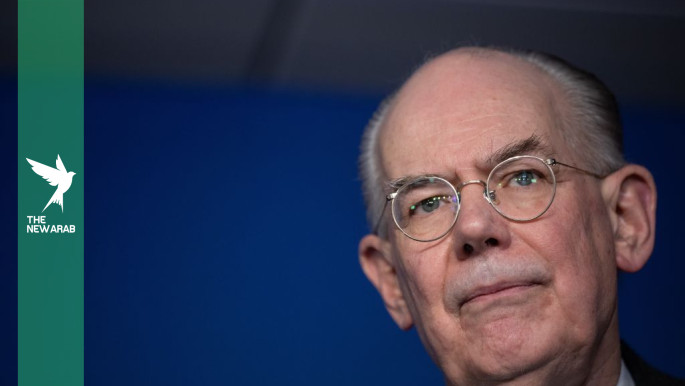
At the sidelines of the 11th annual conference of the Arab Center Washington DC, John Mearsheimer spoke to The New Arab to comment on the war between the United States, Israel, and Iran, and its implications for global order.
A leading realist scholar and co-author of The Israel Lobby, Mearsheimer offered a stark assessment of the conflict, arguing that it represents a strategic defeat for Washington and a turning point in how the United States is perceived by allies and adversaries alike.
Mearsheimer’s central argument is that Iran has emerged as the clear victor in the war, forcing the Donald Trump administration into an eventual ceasefire and negotiations from a weakened position. He contends that the war was not driven by oil or traditional strategic necessity, but by Israeli security priorities, with Benjamin Netanyahu playing a decisive role in persuading Washington to pursue regime change in Tehran. While he expects diplomacy to follow the fighting, he argues that any settlement will reflect Iran’s advantage on the ground. More broadly, he frames the conflict as the third major US failure in the region after Iraq and Afghanistan, one that will make future American military intervention in the Middle East far less likely.
On the political front, Mearsheimer draws a sharp distinction between enduring policy influence and shifting public opinion in the United States. He argues that while pro-Israel lobbying power will remain strong in shaping government decisions, public discourse is already turning markedly against Israel, with declining support across key demographics.
This divergence, he suggests, will strain US-Israel relations, particularly as Trump absorbs the political costs of a war he believes he was led into. The fallout, he adds, will extend beyond bilateral ties: relations with European allies and NATO are set to deteriorate further, while Gulf states may increasingly view the United States not as a guarantor of security, but as a source of instability after a conflict that exposed the risks of relying on American power.
Below is the text of the interview edited for brevity and clarity
Do you think the United States and Iran will eventually reach an agreement?
I think the Trump administration understands that it is playing a losing hand in this war, and the Trump administration has a vested interest in shutting the war down, putting an end to it.
I think at some point the Iranians and the Trump administration will work out an arrangement, and then once you have a ceasefire, they’ll begin to negotiate. And it’s very hard to say what kind of agreement, if any, they will come to. But regardless, it’s quite clear that Iran has won this war, and the final settlement will reflect the fact that Iran, not the United States, has won the conflict.
Will the current war have an impact on the future relationship between Israel and the United States? And How?
I think that it is going to have a negative effect, in large part because people in the United States fully recognize, or let’s put it differently, they will fully recognize that the United States has lost this war, that it has been a disaster for the United States. And they will also understand because the evidence is now very clear, that Israel led us into this war, that the Israeli Prime Minister Benjamin Netanyahu played a key role in convincing President Trump that we could win a quick and decisive victory.
President Trump went to war for Israel. People understand that. So if you go to war for Israel, and the war turns out to be a disaster, most Americans are going to say that Israel deserves a lot of the blame for this catastrophe, and that can only work to damage US-Israeli relations.
Despite the current public disapproval of Israel, the pro Israel lobbies as well as the groups that control the political and economic powers still support Israel no matter what. How can this war change that situation?
Well, you have to understand that the lobby works at two levels. One is at the, one is at the policy level, and two is in terms of how it influences the public discourse about Israel. And you’re correct that the lobby is enormously powerful at affecting US policy. There’s just no question about that. And the lobby, the Israel lobby, will remain effectively very powerful in terms of influencing actual policy.
But in terms of the discourse, how the public, how the elites talk about the US-Israeli relationship, how they talk about what happened in this war, the lobby will have little effect on that discourse, and that discourse is going to be quite hostile towards Israel. You can already see a huge amount of evidence that public opinion in the United States, even among Christian evangelicals, even among Republicans under the age of fifty, is deteriorating in significant ways.
Support for Israel has never been lower in the United States than it is now, and I would estimate that it will, it will continue to decrease. So in terms of the discourse, how we talk about Israel, and in terms of public support for Israel, what you’re going to see is that the lobby is not going to be able to stem the decline in support or change the discourse, which again, is hostile towards Israel these days.
But again, in the end, the lobby will continue to have enormous influence at the policy level, whether it’s among Democrats or Republicans.
A woman passes in front of a pro-government political mural on April 12, 2026 in Tehran, Iran [Getty]
In your opinion, Can that be changed in the long run?
Well, it’s not going to change in the short term.
What about the medium term or the long term? That’s difficult to say. I would bet that in the middle term or in the midterm, over the midterm, the the lobby will continue to maintain significant influence at the policy level. I think if there’s any marked change in the lobby’s influence at the policy level, that will only happen over the long term.
But who knows for sure?
Steve Walt and I wrote the book on the Israel lobby-in 2007 and I don’t think either one of us ever imagined that in 2026, things would have changed so much, that people would be so aware of the lobby’s power, people would be so critical of the lobby, and that Israel and the United States would have been foolish enough to start a war like this, which has had catastrophic consequences for both countries.
Do you think this will be the last war the USA is involved in in the Middle East?
I would never go that far. You know, I think that one can’t say that this is the last war forever anywhere.
My guess is that after this war, the United States will be profoundly reluctant to get into another war in the Middle East.
We fought a number of wars, as you know, in the greater Middle East. Afghanistan and Iraq are the most — two prominent examples, and those birth- those were both disasters. So this is the third big disaster, Afghanistan, Iraq, and now Iran.
An Iranian family travels on a motorcycle past the ruins of buildings in a residential area in Tehran, Iran, on April 9, 2026 [Getty]
Trump mentioned that he wants a share of the Iranian oil similar to the Venezuelan oil, how can Trump’s approach change the international order and laws?
Well, first of all, I don’t think President Trump went to war against Iran for oil. I think this had nothing to do with oil. He’s now saying that he’ll take all of Iran’s oil-… but that’s just bombast, late in the game. This war is not about oil. This war is about regime change in Iran.
Prime Minister Netanyahu convinced him that we could win a quick and decisive victory in Iran. We could eliminate the regime, and that would work to Israel and to America’s benefit. That’s what caused this war. Of course, Netanyahu was wrong, and-… Trump was foolish to listen to Netanyahu. But I think the war is not about oil, it’s a war for Israel. Iran was not a threat to the United States. there’s no reason for the United States to go to war against Iran. Iran was not threatening the United States. Iran did not attack the United States. It was the United States and Israel that attacked Iran. The reason that we did it was for Israel’s security. Prime Minister Netanyahu has long been obsessed with what he thinks is the Iranian threat, and he’s wanted to, to get the United States to join in a war with Israel against Iran. And on February 28th, he got his wish and it’s led to disaster.
Trump and Netanyahu jointly started the war in Iran [Getty]
To what extent will this war leave an impact on the relationship between the United States and Israel as well as the relationship between the United states and the NATO allies?
Well, I think it’s quite clear that this war is going to have negative effects on the US-NATO relationship. It was already clear before February 28th that relations between the United States and Europe were in terrible shape as a result of differences over the Ukraine war and as a result of President Trump’s threat to invade Greenland and take it away from Denmark.
So even before the war, relations were in bad shape. Now that the war has happened, relations between Europe and the United States have deteriorated even further. With regard to US-Israeli relations, there’s no question that this is going to have a negative relation– negative effect on relations between those two countries. After all, President Trump has almost three more years in office, and he’s going to be angry at the Israelis, especially at Prime Minister Netanyahu for leading him into this disastrous war.
It’s quite clear that the Israelis played the key role in convincing Trump, to go to war. The Israelis convinced Trump that we could win a quick and decisive victory, and once we didn’t, we were in deep trouble. And this will surely poison relations, at least for a while, between the United States and Israel. There’s no question about that.
How will Trump’s reliance on the principle of force affect the interactions between the United States and the other countries worldwide in the long run?
Well, this war is going to have negative consequences for Trump’s presidency. It’s a major foreign policy failure that has hugely negative consequences of an economic and political sort for the United States. So there’s no question that it’s going to do great damage to his presidency. And in terms of America’s relations with the rest of the world, to include America’s East Asian allies, its European allies, and its allies in the Gulf, this is going to have seriously negative effects.
At this point in time, who can feel confident in relying on the United States? Who would want the American security umbrella over their head, given what’s happened over the past month and a half in the war against Iran? The United States has, if anything, shown that it is a liability to most of its allies. Just think about the Gulf States from their perspective.
They thought the United States was going provide security for them. They thought that having a military alliance with the United States was all for the good. But instead, what has happened here is the United States started a war, that has led Iran to attack those countries, do serious damage to them. And furthermore, it’s led Iran to take control of the Strait of Hormuz and shut off the flow of oil out of the Gulf, in ways that harm those GCC countries.
So from their point of view, being an ally of the United States is clearly a net negative.