
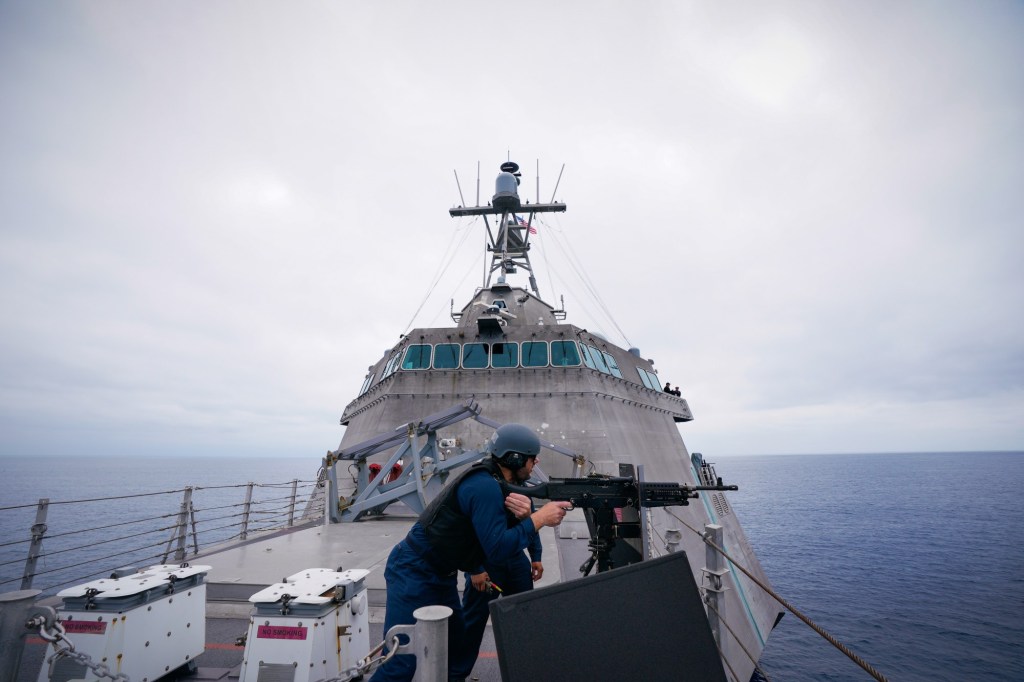
If war resumes with Iran, the U.S. could find it difficult to destroy sea mines in the Strait of Hormuz due to widespread problems with certain San Diego-based warships responsible for neutralizing such threats, according to military, government and industry experts.
It’s a matter of great urgency. President Donald Trump says removing the mines is an essential part of reopening the strait, a pathway for nearly 25% of the world’s petroleum and crude oils.
The Navy is experiencing the latest setback with its so-called littoral combat ships, or LCS, which were meant to be able to quickly and nimbly move into shallow, near-shore areas to sweep for mines, deal with enemy submarines, confront small surface craft and deploy special forces.
There are two classes of LCS, Freedom and Independence. Both have suffered major mechanical and design problems, huge cost overruns and difficulty carrying out their primary missions, leading the Navy to decommission some of the ships years early. Many sailors say the vessel’s initials stand for “little crappy ship.”
About 16 of the Independence-class LCS are homeported in San Diego. Three newer ones — the USS Canberra, USS Santa Barbara and USS Tulsa — are equipped with advanced mine countermeasure, or MCM, packages that were intended to be useful in areas such as the Persian Gulf, the site of many wars involving clashes in the littoral zone, or shallow coastal areas.
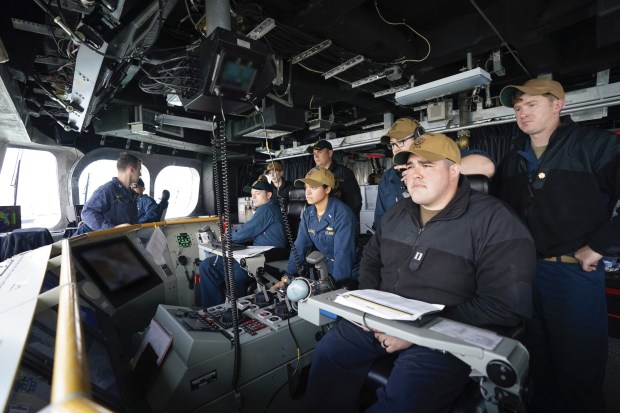 The bridge crew of the USS Jackson (LCS 6) maneuvers the ship out of San Diego Bay for a scheduled sea exercise. (Nelvin C. Cepeda / U-T file)
The Defense Department said last year it is not sure the Independence-class littoral combat ships in question are fully operational, including their ability to do mine-countermeasure warfare. The General Accountability Office said in 2020 that the aluminum-hull ships are not designed to defend themselves against heavy attacks.
And Defense and Security Monitor, among other military analysts, recently said that one of the ship’s key MCM assets “had challenges visually confirming mines, even when tested in the relatively benign waters of Southern California.”
Chief of Naval Operations Adm. Daryl Caudle disputed such concerns during a public speech in March, saying that LCS can be a “very, very good” asset when it’s performing properly. He and other top Navy officials have set aside little time to discuss such issues with the news media since the war began.
Caudle’s comments, in part, referred to the three San Diego-based LCS, which have yet to be tested in battle.
The San Diego vessels were working out of nearby Bahrain as the war began to unfold. The Navy quickly moved them beyond the war zone and has said little about what role they will play in the near future.
All of this comes about six months after the Navy decommissioned four old, wooden Avenger-class MCM ships that had been working out of Bahrain. They were replaced by the San Diego LCS, which the Navy described as better, safer platforms.
They can use an MH-60S Seahawk helicopter to find, identify and destroy mines. The aircraft is supplemented by in-water robots that find and classify a variety of mines at various depths, including some that are well hidden.
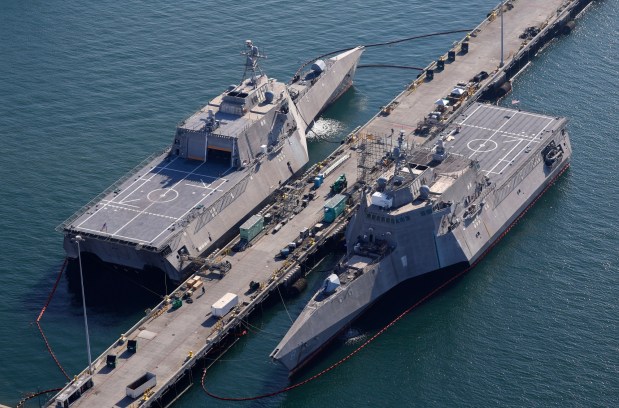 The USS Montgomery (LCS-8), right, and USS Jackson (LCS-6) are docked at Naval Base San Diego on Oct. 7, 2025. (K.C. Alfred / U-T file)
The upgrade has not impressed some defense and maritime analysts.
The package “arrived late, over budget, and operationally problematic,” the Foreign Policy Research Institute said in review published in March.
“The unmanned surface vessels that form the heart of the package have suffered repeated reliability failures in testing … The sensors have proven ineffective in turbid or shallow waters — precisely the conditions found in the Persian Gulf.”
The New Republic magazine recently expressed similar concerns, saying, “Mine-clearing is slow and deliberate work. To operate its unmanned sonar and neutralizing systems, the LCS must move in predictable patterns, making it an easy target for shore-based missiles, drones, and “swarm” attacks by fast-attack boats.”
It is unclear how many mines Iran has placed in the Strait of Hormuz, a 104-mile-long waterway that links the Persian Gulf to the Gulf of Oman. Its width ranges from 21 miles to 60 miles.
Citing unnamed sources, Reuters said that roughly a dozen mines have been added. But the number could be far higher. CBS News, citing unnamed U.S. sources, says Iran could have from 2,000 to 6,000 mines in its stockpile.