
Iran reportedly mined the Strait of Hormuz, appears to have lost track of the mines, and now cannot easily remove them. That reality helps explain why diplomatic efforts in Islamabad struggled and may have been doomed to fail from the start. No single nation can reopen one of the world’s most critical shipping lanes on any meaningful timeline.
As negotiations collapsed, the U.S. made its own strategic blunder when President Trump announced that the U.S. Navy would begin “blockading any and all ships trying to enter or leave the Strait of Hormuz” and would “seek and interdict every vessel in international waters that has paid a toll to Iran.” Thankfully, U.S. Central Command (CENTCOM) walked back that announcement, clarifying Sunday night that the U.S. Navy is not blockading the Strait, but is intending to block all maritime traffic entering and exiting Iranian ports, a restriction that begins Monday morning (10 a.m. ET).
Iran’s unlawful mining and other unlawful conduct created the crisis in the Strait. The U.S. blockade of Iranian ports, the operative action after CENTCOM’s correction, effectively ends the ceasefire. After all, a blockade is, by definition, an action taken by a belligerent State; it is not a peacetime operation. The ceasefire is over.
As I discuss below, whether the United States carries out the blockade in a legal manner will affect, among other things, allied States’ willingness to participate and the overall effectiveness of the blockade.
The stakes couldn’t be higher. Over 80% of global trade by volume moves by sea. The Strait of Hormuz alone accounts for 11% of global maritime trade and one-third of all seaborne oil. Transit passage is not a legal abstraction. It serves as the legal architecture that keeps the global economy functioning. Iran’s attempt to convert that right into a managed, tolled, IRGC-controlled corridor is not merely a violation of international law. It is a frontal assault on the legal order that has governed global commerce for decades. The consequences extend well beyond the Strait. If transit passage rights wither away in the Strait of Hormuz, then every chokepoint in the world is potentially exposed.
Uncontrolled Naval Mining and the Breakdown of Legal Compliance
New reporting suggests that Iran mined the Strait haphazardly, failed to record mine locations, and lacks the capacity to conduct effective clearance operations. Until those mines are found and removed, the Strait is practically closed.
While it is unclear how many mines, exactly, Iran has positioned in the Strait, just the threat of a naval mine strike is enough to shut down Strait traffic for the foreseeable future. At the start of the war, Iran reportedly possessed between 2,000 and 6,000 naval mines in its total inventory, though the number deployed in the Strait remains unknown. According to U.S. officials, Iran used small, fast boats to lay mines at the conflict’s outset. The boats appeared to have operated in the dark, without mapping the mine placement, and in ways that allowed some to drift from their original positions.
Since the conflict began, Iran’s Islamic Revolutionary Guards Corps (IRGC) has issued warnings that “ships could collide with sea mines,” and transit passage through the Strait has come to a standstill. What little traffic that has made its way through has been diverted north through Iranian waters, and away from the 3-mile shipping lane in the middle of the Strait. Meanwhile, Iran has declared that vessels seeking to transit the Strait must do so in “coordination” with Iranian armed forces, subject to unspecified “technical limitations.” The result is a mined international strait, the full extent of which is unknown to anyone — including the very State that mined it. This is not merely a tactical failure. It is a compounding international law violation with consequences that will far outlast any ceasefire and complicate ongoing negotiations in Pakistan.
Naval mining in an international strait is not unlawful per se, but placing mines in a manner that effectively denies transit passage to neutral shipping violates both the law of naval warfare and the law of the sea. The 1907 Hague VIII Convention, one of the earliest codified rules of naval warfare, imposes specific obligations on States that lay mines. States must take all possible precautions for the security of peaceful shipping, notify mariners of hazardous zones, and take active steps to render mines harmless once their military purpose has passed. None of that occurred here.
Furthermore, Hague VIII requires that certain unanchored contact mines be rendered harmless within one hour of losing control of them. Legal prohibitions on mining international straits are reinforced in both the San Remo Manual on International Law Applicable to Armed Conflicts at Sea and the Newport Manual on the Law of Naval Warfare.
First, Iran cannot locate all the mines that it laid in the Strait—a reckless, decentralized operation conducted without systematic tracking. This does not look like the conduct of a State taking “feasible precautions” to safeguard civilians during an armed conflict. Iran appears to have treated a globally critical international waterway as an expendable tactical asset.
Second, rather than notifying mariners of hazardous zones as international law requires, Iran compounded the danger. The IRGC warned any vessel attempting to transit without express authorization that it would be “targeted and destroyed.” Iran did not merely mine the Strait; it weaponized the uncertainty around the mines to consolidate control over maritime access. The IRGC has since published navigational charts designating narrow corridors through Iranian-controlled waters. But these corridors route ships under direct IRGC surveillance, and Iran’s planned operations include charging a $2 million toll per vessel to use those routes. This is neither a safety measure nor navigation management; it is coercive extraction enabled by unlawful conduct.
On advance notification of mining operations, the International Court of Justice reached a similar conclusion regarding U.S. mining of Nicaraguan harbors in 1986, finding the U.S. failure to give notice of the mining was a violation of customary international law.
Third, and perhaps most importantly, Iran cannot comply with its legal obligation to render mines harmless. Iranian officials have pointed to vague “technical limitations” to restrict traffic through the Strait. Reference to “technical limitations” might be an acknowledgement that Tehran lacks both the situational awareness and the specialized capability to conduct rapid mine clearance operations. A State that lays mines without tracking their locations, in a 21-mile-wide international Strait through which 20 percent of the world’s oil transits, and then cannot remove them, has created a humanitarian and environmental hazard of its own making that it cannot undo. Of all the violations, this is the one that continues to metastasize and compound over time. A mine that cannot be found cannot be rendered harmless. Every moment the Strait remains mined is a continuing legal breach.
Finally, the IRGC’s declaration that the Strait will “never return to its previous status” should be understood for what it is: a formal repudiation of the transit passage regime under the United Nations Convention on the Law of the Sea (UNCLOS) and customary international law. Iran does not own the Strait of Hormuz. No nation does. The right of transit passage belongs to the world, and no State may extinguish it through mining, coercion, or toll collection. Remarkably, rather than rejecting Iran’s toll regime outright, the Trump Administration has floated the idea of sharing in the proceeds. Hence, any U.S. statements of a possible “Joint Venture” should be a non-starter.
The free and open passage of the Strait should be the starting and ending point of all future negotiations. Iran and the United States cannot negotiate on this or otherwise agree to limit access; transit passage is a right enjoyed by the entire world. Indeed, Article 44 of UNCLOS clarifies that States bordering straits cannot hamper or suspend transit passage rights, rights that are enjoyed by all other States.
Imposing a permanent access fee on vessels exercising a right they already possess under international law is similarly unlawful. Converting an international strait into a controlled chokepoint through unlawful mining is itself unlawful. And declaring that a waterway carrying one-fifth of the world’s oil supply will never return to its prior legal status is not a strategic posture — it is a confession of ongoing violation. All three actions violate binding rules of international law that Iran, as a State bordering the Strait, is legally obligated to respect.
Why the Strait Cannot Reopen Easily
The inability to account for the mines has become a factor in Tehran’s failure to meet Trump administration demands and has complicated already tense negotiations. Removing naval mines is significantly more difficult than laying them. The United States faces its own minesweeping deficit, the product of short-sighted decisions that expose a gap in a core capability for the world’s most powerful Navy. One month before the conflict began, four Avenger-class minesweepers left their home port in Bahrain to be decommissioned. The U.S. military lacks robust mine-removal capabilities, relying on Littoral Combat Ships (LCS) equipped with mine-sweeping equipment. By its very words, the U.S. Navy acknowledges that without dedicated minesweepers, “LCS will always struggle to achieve the same level of Mine Countermeasure proficiency.”
That gap has a solution if allies are willing to provide it. It is also why Iran’s legal exposure grows with every passing day, and other nations with comparably stronger minesweeping capabilities—such as NATO members and Japan—may have to play a role in opening the Strait of Hormuz. By one estimate, Europe has between 150 and 170 active minesweepers and minehunters, and Japan has 20 dedicated mine countermeasure vessels as part of its Maritime Self-Defense Force. With the United States scrapping its dedicated minesweepers, Japanese and European support will likely be crucial to open the Strait. The United States finds itself relearning Winston Churchill’s warning the hard way: “There is only one thing worse than fighting with allies, and that is fighting without them.” Nowhere is that lesson more concrete than in mine countermeasures, a specialized, unglamorous capability that the United States has systematically dismantled while European navies and Japan have preserved and expanded it.
The U.S. Blockade Ends the Ceasefire and Creates Enormous Operational Risks
CENTCOM has clarified that the U.S. blockade targets Iranian ports along the Arabian Gulf and Gulf of Oman — not the Strait itself. That distinction matters legally, but the blockade remains an act of war. Further, CENTCOM stated that “forces will not impede freedom of navigation for vessels transiting the Strait of Hormuz to and from non-Iranian ports.” CENTCOM’s clarification appears to supersede President Trump’s earlier social media post announcing a blockade of the Strait itself. The blockade announced in specific terms by CENTCOM ratchets up pressure on Iran while creating enormous operational risks.
For a blockade to be legally valid, it must meet certain criteria.
First, the blockade can be established only by the government of a belligerent State. Blockade is not a peacetime operation. By establishing the blockade, the United States is exercising a belligerent right under the laws of war, effectively ending the ceasefire.
Second, it is customary for the State establishing the blockade to notify all affected States of its imposition. The form of the notification is not material, so long as it is effective. CENTCOM has announced the blockade via social media and has stated that “[a]dditional information will be provided to commercial mariners through a formal notice before the start of the blockade.”
Third, to be valid, the blockade must be effective. This means that blockading forces must exert force to render ingress or egress of the blockaded area dangerous. While the Commander’s Handbook on Naval Warfare states that “effectiveness does not require every possible avenue of approach to the blockaded area be covered,” an ineffective blockade is an illegal blockade under the law of naval warfare and the San Remo Manual. This will be challenging. This blockade is a massive undertaking for the U.S. Navy, which appears to be operating without naval partners. After all, the Iranian coastline stretches roughly the coastal distance from Boston to Savannah —about 1,100 miles.
At the time President Trump’s version of the blockade had been announced (not the modified CENTCOM version), Admiral James Stavridis, former head of European Command, estimated that an effective blockade would require two full aircraft carrier strike groups as well as a dozen destroyers. That would represent a substantial commitment of naval firepower, and even then, effectiveness would not be guaranteed — a threshold that matters legally, not just operationally. It’s fair to assume the scope of the blockade announced by CENTCOM will also require a very substantial force. These operational realities bear directly on whether the blockade can satisfy the legal effectiveness requirement under the law of naval warfare — a threshold that, if not met, renders the blockade itself unlawful.
Further complicating matters, warships may have to position themselves along the Iranian coastline. If so, that will require several ships to navigate the Strait of Hormuz itself, a risky proposition made even riskier with the ceasefire ending and unaccounted-for mines lurking about.
Fourth, a blockade must be applied impartially to the vessels and aircraft of all States.
Finally, the blockade must not bar access to or departure from neutral ports and coasts. This requirement may become salient if the blockade has the practical effect of restricting neutral access to regional ports.
During the ceasefire, two U.S. Navy Arleigh Burke-class destroyers reportedly transited the Strait of Hormuz on April 11. This transit reinforced the importance of transit passage rights through international straits under UNCLOS. U.S. Central Command stated that the transit was part of a broader mission to clear mines and establish a safe passage for commercial shipping. Whether the destroyer transit constitutes mine clearance, freedom of navigation, or blockade enforcement may ultimately turn on how the United States operationalizes its Strait posture in the coming days — but the legal distinction matters enormously. The United States’ own legal characterization of its operations will matter for how neutral third States respond and whether allied naval forces can participate.
From Mining to Targeting: Escalating Violations Against Neutral Shipping
Iran’s mining campaign must be understood in conjunction with its sustained attacks on neutral merchant vessels. Since Feb. 28, 2026, the IRGC has launched 21 confirmed attacks on merchant ships, which were non-belligerents to the armed conflict, according to the United Nations’ International Maritime Organization. These vessels – flagged to Thailand, Japan, the Marshall Islands, and others – are neutral parties to the conflict. Attacks on neutral civilian shipping are not collateral damage. They are violations of the foundational principle of distinction under international humanitarian law. The law of armed conflict prohibits targeting civilian objects, and neutral merchant vessels do not become military objectives simply because they transit a contested strait.
Iran has offered no clear legal justification for these strikes, and none is apparent. These vessels were not carrying contraband, were not bound for belligerent ports, and were not supporting military operations. The destruction of neutral commercial shipping produces no cognizable military advantage, let alone one that would justify the harm to civilian mariners as a legal matter or to the global economy as a policy matter. Iran’s attacks on neutral shipping compound its legal exposure and underscore why a negotiated resolution, absent mine clearance, cannot alone restore lawful conditions in the Strait.
Conclusion
The ceasefire’s central condition, as President Trump has framed it, is the “complete, immediate, and safe” reopening of the Strait. Under international law, it is what Iran was legally obligated to provide from the moment it laid the first mine. Instead, Iran has placed itself in a diplomatic cul-de-sac of its own making: it mined an international strait, lost control of the hazard it created, and cannot now restore the transit passage rights it was legally bound to preserve.
The United States has responded with a port blockade of Iran that ratchets up the risk while ending the ceasefire. Blockade is a legally cognizable belligerent act under the law of naval warfare, but one that formally ends the ceasefire and creates its own operational risks. Whether the blockade satisfies the effectiveness requirement will be tested quickly. An ineffective blockade fails militarily and legally.
Minefields do not disappear through diplomacy, and transit passage rights cannot be negotiated away by the States that happen to border a strait. The legal architecture that keeps 11 percent of the global maritime trade flowing cannot be rebuilt alone with just two belligerent powers negotiating. What is required is a coordinated, multinational mine clearance operation at scale. That is the only path back to a Strait that is free, open, and lawful.
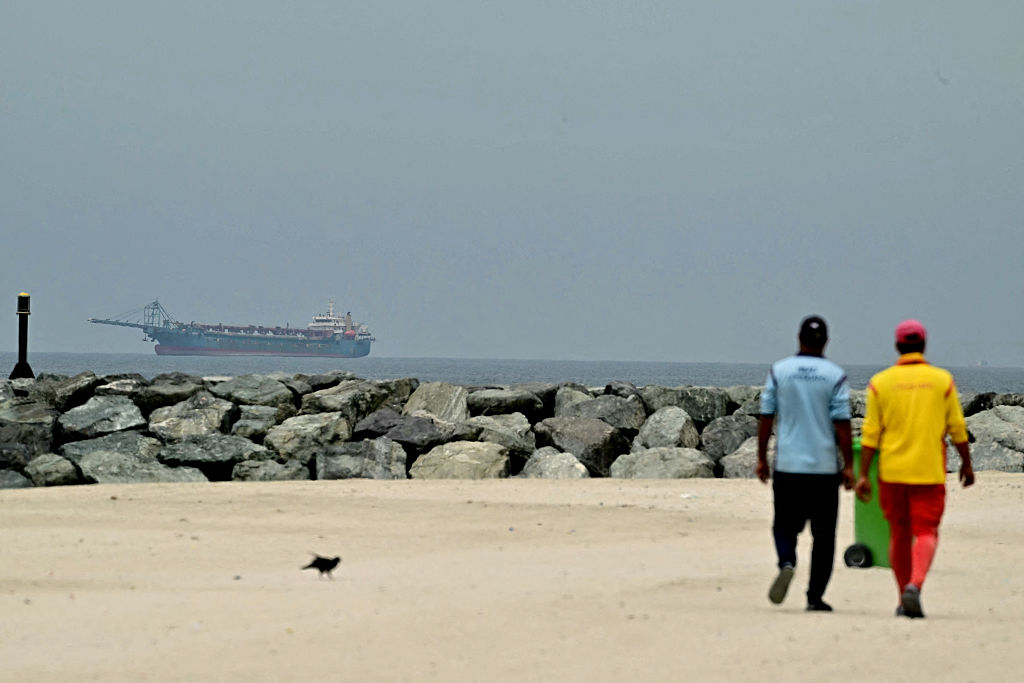
FEATURED IMAGE: A ship is seen in the Persian Gulf off the coast of Sharjah the day after the failure of U.S.-Iran peace talks on April 13, 2026. (Photo by AFP via Getty Images)