
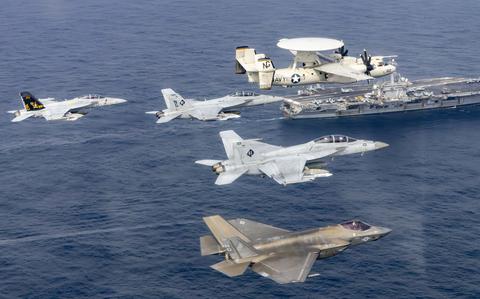
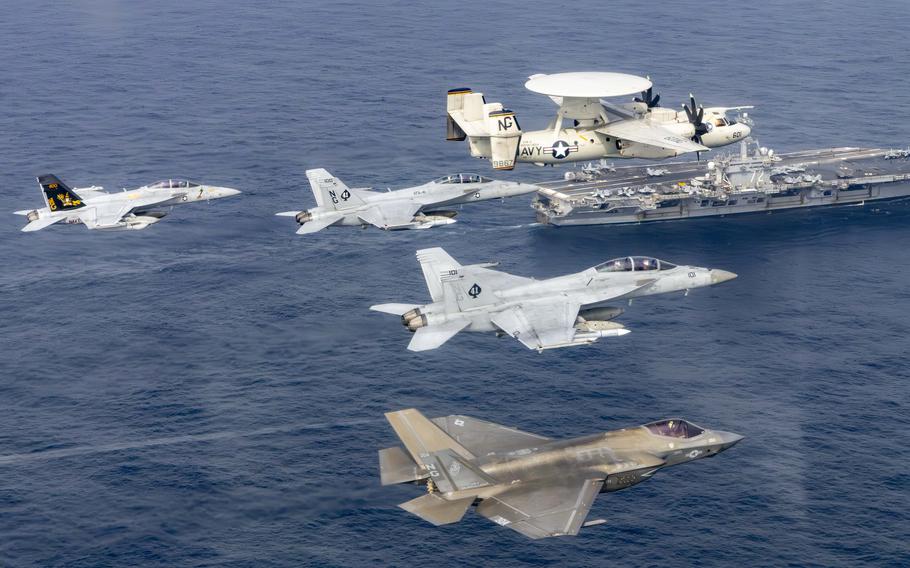
Aircraft with Carrier Air Wing 9 fly over the USS Abraham Lincoln in the Pacific Ocean, Aug. 24, 2025. U.S. Navy assets, including an aircraft carrier and mine-sweeping ships, grow in the Persian Gulf as it works to enforce the naval blockade against Iran and to assure commercial shippers have transit access through the Strait of Hormuz. (U.S. Navy)
American and Iranian officials are reporting progress in ongoing peace talks, with a potential second round of negotiations taking shape even as the U.S. military continues to enforce a naval blockade on Iranian ports.
The prospect of further discussions comes as the U.S. exerts its grip on the Strait of Hormuz and as Europe, which has so far declined to join the mission, weighs an eventual role in helping secure the waterway.
On Tuesday, the U.S. Navy moved assets into position to enforce the blockade on Iranian ports, apparently an attempt by President Donald Trump to ratchet up economic pressure on Iran.
Some shipping is moving through the strait, whose importance as an oil transit route is immense. A Chinese-owned tanker appeared to complete its transit through the waterway Tuesday, according to ship tracking data that showed the vessel pushing its way into the gulf.
The Rich Starry, already sanctioned by the United States for past dealings with Iran, is carrying about 250,000 barrels of methanol that was loaded at a United Arab Emirates port, according to shipping data.
Since the ship wasn’t operating from an Iranian port, it was likely deemed not subject to the blockade.
So far, no European countries have indicated a willingness to join the U.S. blockade. Allies have come under heavy criticism from Trump for staying on the sidelines.
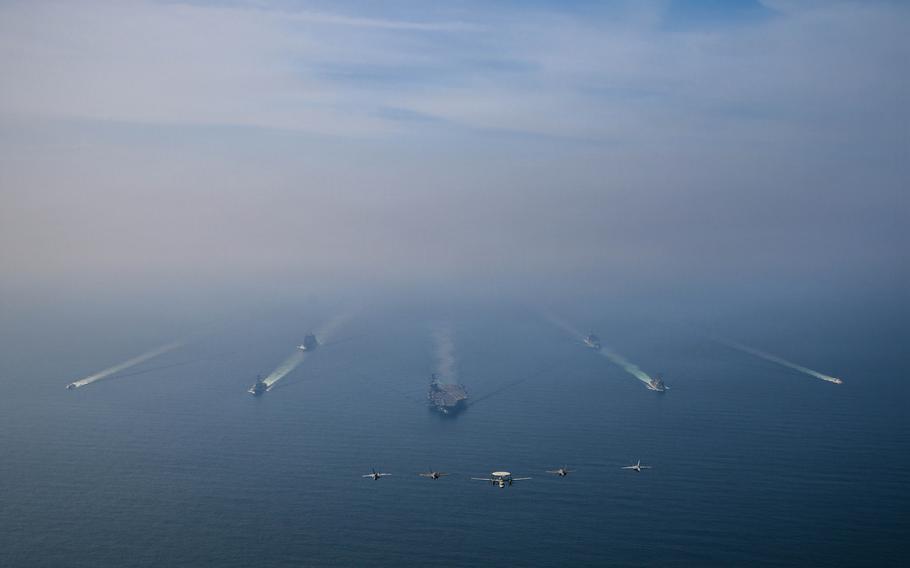
USS Abraham Lincoln and Carrier Air Wing 9 transit in formation in the Arabian Sea, Feb. 6, 2026. U.S. Navy assets, including an aircraft carrier and mine-sweeping ships, grow in the Persian Gulf as it works to enforce the naval blockade against Iran and to assure commercial shippers have transit access through the Strait of Hormuz. (Jesse Monford/U.S. Navy)
Oil prices dropped Tuesday in response to signs of more talks between Washington and Tehran. Brent crude fell by about 1% to $98.40 a barrel, down from over a over $100 a barrel after Trump ordered a blockade on Iran’s ports.
Officials in Pakistan, which helped mediate the first round of negotiations, told Reuters on Tuesday that diplomatic teams were preparing for a second round after last week’s meeting failed to produce a deal.
Iran’s uranium enrichment program is emerging as a key point in the negotiations. The U.S. has proposed a 20-year suspension of all nuclear activity, allowing Iran to claim it didn’t permanently forgo its right to develop nuclear fuel, The New York Times reported on Tuesday.
Iran countered with a proposal to suspend nuclear activity for up to five years, two senior Iranian officials and one U.S. official told the Times.
While it isn’t clear whether either side is willing to budge further, Vice President JD Vance painted a somewhat optimistic picture on Monday.
“We made a lot of progress,” Vance told Fox News. “But we also made clear, and I think this is part of the progress we made, what the terms (were) where the United States can make some accommodation, what terms we were flexible on and what things we absolutely needed to see in order for the president of the United States to feel like he was getting a good deal.”
“The big question from here on out is whether the Iranians will have enough flexibility,” he added.
Following the collapse of the initial talks early Sunday, Iranian Foreign Minister Abbas Araghchi said U.S. and Iranian negotiators had been “just inches away” from a memorandum of understanding, though he did not elaborate.
Meanwhile, French President Emmanuel Macron and British Prime Minister Keir Starmer will hold a conference Friday in Paris for countries willing to help restore freedom of navigation through the Strait of Hormuz when security conditions allow.