

Listen to this article
Estimated 3 minutes
The audio version of this article is generated by AI-based technology. Mispronunciations can occur. We are working with our partners to continually review and improve the results.
A day after sweeping three byelections in Ontario and Quebec that gave him a majority in the House of Commons, Prime Minister Mark Carney has announced that he is temporarily removing the federal excise tax on gas and diesel.
The move means that the cost of gas will drop by ten cents on a litre of gasoline and four cents per litre of diesel starting Monday and lasting until Labour Day.
The fuel tax holiday, which Carney said would also see the four cent per litre excise tax removed on aviation fuel, is expected to cost an estimated $2.4 billion.
WATCH | Ottawa shelving federal fuel excise tax until Labour Day, Carney says: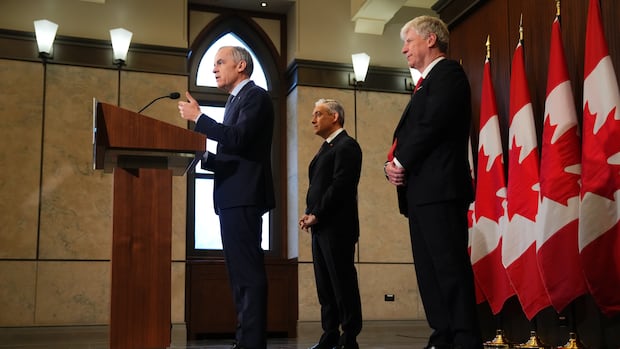
Ottawa shelving federal fuel excise tax until Labour Day, Carney says
Prime Minister Mark Carney announced the federal government is suspending the federal excise tax on auto and aviation fuels from April 20 to Sept. 7, which is expected to reduce prices at the pump by 10 cents a litre on gasoline and four cents a litre on diesel.
“We all know that because of the war with Iran fuel prices have increased sharply around the world including right here in Canada,” Carney said in Ottawa Tuesday.
The move will act as a bridge to help get Canadians over “short-term pressures,” he said.
“Today’s cut to the fuel excise tax is a responsible temporary measure consistent with what it takes to build a stronger economy, a more affordable economy combined with sound fiscal management.”
In a statement, the government said the move “is a responsible measure that will reduce operating costs for truckers and businesses in the food, agriculture, housing, construction, and delivery sectors.”
The current national average for a litre of gas is just over 176 cents, up from just over 126 cents a litre before the United States and Israel launched their attack on Iran and oil stopped flowing through the Strait of Hormuz.
About a fifth of the world’s oil transits through the strait from states in the Persian Gulf including Iran, but that passage has been all but shut by the threat of Iranian drones and mines since the conflict began.
When talks between the United States and Iran to end the war and reopen the strait failed, the U.S. announced it would begin a naval blockade of Iranian ports and attempt to reopen the straight to traffic from other countries.
That announcement saw prices dip slightly but the crisis in the strait continues and volumes have yet to resume to anywhere near the pre-war averages.
Carney expects Canada to avoid recession
Carney said the best way to respond to the “enormous shock” in the global economy created by the conflict is by tackling affordability issues at home, building more homes and accelerating the approval of large nation-building projects.
“Its absolutely clear and has been reinforced again by events in the Middle East: we have to make our economy stronger and more independent,” Carney said.
Quoting Tuesday’s International Monetary Fund (IMF) outlook, the prime minister said he expects Canada to avoid a recession.
“The expectation, even in the wake of one of the big economic shocks, is that Canada will be the second-strongest economy … in the G7 this year and next,” he said.
The IMF predicted Tuesday that the fastest-growing economy this year would be the U.S. at 2.3 per cent, followed by Canada at 1.5, France at 0.9, Germany and the U.K. at 0.8, Japan at 0.7 and Italy at 0.5.