
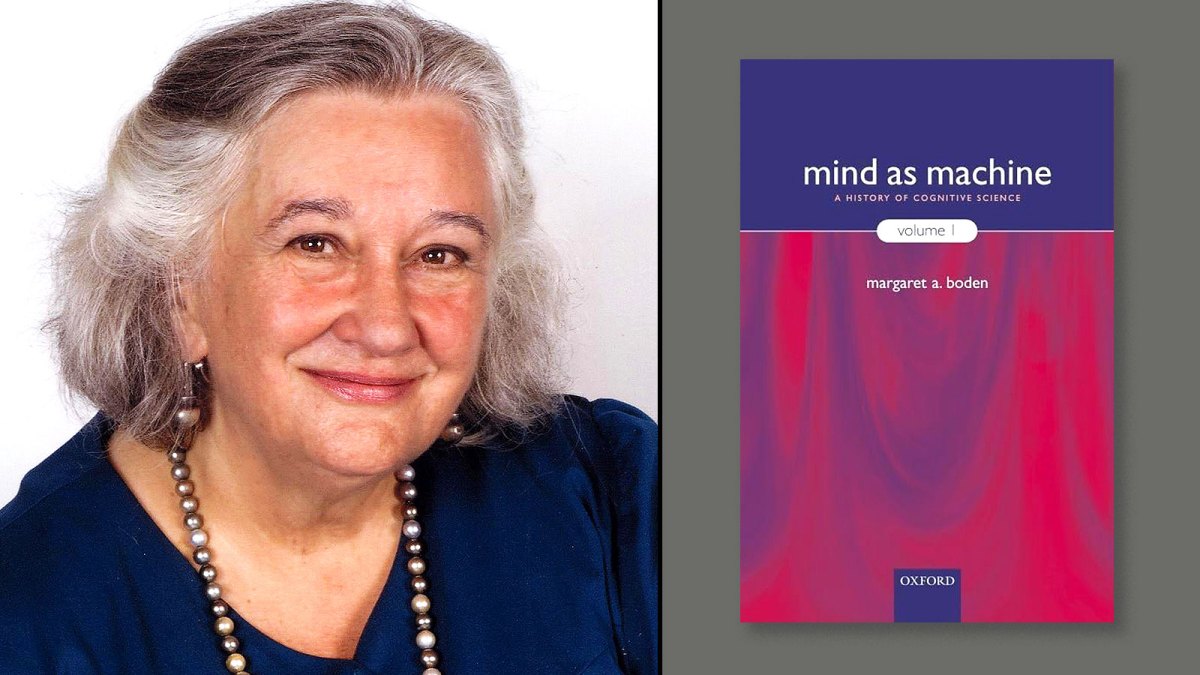
Maggie Boden’s eccentricity stretched beyond her personal habits, which included a chronic obsession with the colour purple, a penchant for collecting teddy bears and a high, explosive laugh, sometimes described as a “hoot”. “I am,” she said, “a very, very queer fish.”
In her work, too, Boden deviated from the norm. She once said that “science needs mavericks” and it was perhaps the most accurate label for someone so difficult to pigeonhole. At once a philosopher, psychologist and cognitive scientist, she wrote about artificial intelligence — on which she was a world authority — neuroscience and the origins of creativity, applying abstract philosophical frameworks to all three.
Her seminal book Artificial Intelligence and Natural Man (1977), the world’s first overview of AI, didn’t contain a single line of computer code but explored how consciousness arises from biochemical interactions within the brain. It became a set text at Harvard, MIT and the Open University. “If you ask me which side of the arts-science fence I sit,” she said, “my answer would be that I don’t sit on either side. I sit on the middle! I jump down to one side from time to time, and then immediately jump up and onto the other side. I identify with both sides and neither.”
What pinned her ideas together, and made her so original, was a lifelong fascination with how computer programming can be used to understand our most complex and mysterious organ, the brain, as well as creativity and the conundrum of free will. She was ahead of the curve, and not just because she was usually the only woman in the room (often mistaken for someone’s girlfriend or secretary, she would play along with the ruse for hours).
She was instrumental in founding the discipline of cognitive science — which viewed the mind in more abstract terms than neuroscience and more structural terms than psychoanalysis — and co-founded the world’s first cognitive studies programme, at the University of Sussex, which she chose as her place of work because of its commitment to unorthodox ideas (it was only four years old when she joined in 1965). “I wanted to do things that didn’t exist,” she said simply. “I wanted to do the philosophy of biology, the philosophy of psychology.”
Boden was working at the tail end of the so-called cognitive revolution of the 1960s, when “behaviourism”, which viewed the mind as a “blank slate”, was replaced by a focus on structural processes such as memory and problem-solving. Yet her theories were novel enough that they were seen as controversial. Critics said that connecting humans with machines was dehumanising (her best-known work, a two-volume history of cognitive science published in 2006 — with a purple cover — was called Mind as Machine) while supporters saw it as a window into the richness of what it means to be human.
Boden’s interest in cognitive science was first piqued by George A Miller, a key thinker of the cognitive revolution. Boden had been in America for a week — she was studying for a PhD at Harvard — when she stumbled across Miller’s book Plans and the Structure of Behavior, published in 1960. Though it had an unappealing brown cover — “My least favourite colour,” said Boden. “I’ll never know why I picked it up, it was a horrible object” — it was the first book that applied the idea of programming to psychology, and it changed Boden’s life.
Her own first book on the subject, the culmination of those early ideas, was published in 1972 (she once said that all of her books had “terrified me in one way or another”). The advance copy of Purposive Explanation in Psychology arrived on her desk three days after the birth of her second baby. “Both,” she noted, “were deep purple.”
Born in 1936 in north London, Margaret Ann Boden was gripped by concepts of faith, free will and psychology from a young age. Maggie was the only child of Leonard, a civil servant with the ministry of town and country planning, and Violet (née Dawson), who worked at Anglo-Iranian Oil Company in London before getting married, and most of her time was spent playing by herself; a brother, Keith, died before she was born.
As a teenager at the City of London School for Girls she would skip afternoon games to sit on the floor of bookshops on Charing Cross Road and read Bertrand Russell. She recalled a chemistry teacher once asking her “very nicely” on a field trip to stop asking so many questions about philosophy.
Boden won a scholarship to read medicine at Newnham College, Cambridge — she preferred the university’s signature colour, light blue, to Oxford’s dark blue — and planned to specialise in neuroscience, but when she stole into lectures she was bored. “I found the course of study very, very rat-oriented,” she said, “which was not my interest at all”.
Completing her medical science degree in two years rather than the normal three, she decided, against everybody’s advice, to study philosophy for her final year with Cambridge’s language research unit. It was run by the linguist and philosopher Margaret Masterman, one of the first people to research machine translation, and the course introduced Boden to concepts of artificial intelligence which she would revisit later on. She enjoyed it so much that she decided to stay for a fourth year, convincing St Thomas’ Hospital, which had offered her a clinical scholarship, to delay by a year.
A few weeks before she was due to take her finals and move to St Thomas’, Boden received a telegram from her professor asking her to pay him a visit. “He offered me snuff, and I said, ‘No, thank you’,” she recalled. “Then he offered me sherry. I said, ‘Yes, please,’ and he said they were interviewing for an assistant lectureship in philosophy at the University of Birmingham.”
She would stay at Birmingham for a short while — the degree was too orthodox, she said, and she was “very bored” — and in 1962 headed to Harvard, in another career U-turn, to complete a PhD in social psychology. Three years later she joined the University of Sussex as a lecturer in philosophy, where she co-founded the discipline of cognitive science.
She was appointed dean of the school of social sciences in 1985 — one of her first goals was to make the standard notepaper purple — and two years later founded the school of cognitive and computing sciences. In 2018 she was appointed to the advisory board of an all-party parliamentary group on AI.
At Sussex she met John Spiers, a postgraduate student, whom she married in 1967. He became an academic publisher and together they founded Harvester Press. They divorced in 1981. When an interviewer later asked if Boden had everything she wanted from life, she said: “No, because I haven’t got a good relationship with somebody who is there all the time, that one can talk to about the cat with green whiskers you saw in the high street.”
She is survived by their two children: her son, Ruskin, works in advertising and marketing, and her daughter, Jehane, is a design agent.
A commanding yet warm presence, Boden was fierce in argument but her voice was gentle, quixotic and cut-glass, rather like a young Emma Thompson. A good mimic and captivating storyteller, she appeared in Sussex’s annual Christmas pantomime. Her many obsessions included: soap operas (she knew every storyline from EastEnders), jigsaw puzzles (which littered her kitchen table), perfume bottles (she collected them en masse) and colourful clothes, stitched herself, ideally in purple. Her teddy bear collection was — like her work — meticulous and discriminating: they had to be classy and quirky, never mass-produced.
Professor Maggie Boden MBE, psychologist, philosopher and cognitive scientist, was born on November 26, 1936. She died on July 18, 2025, aged 88