
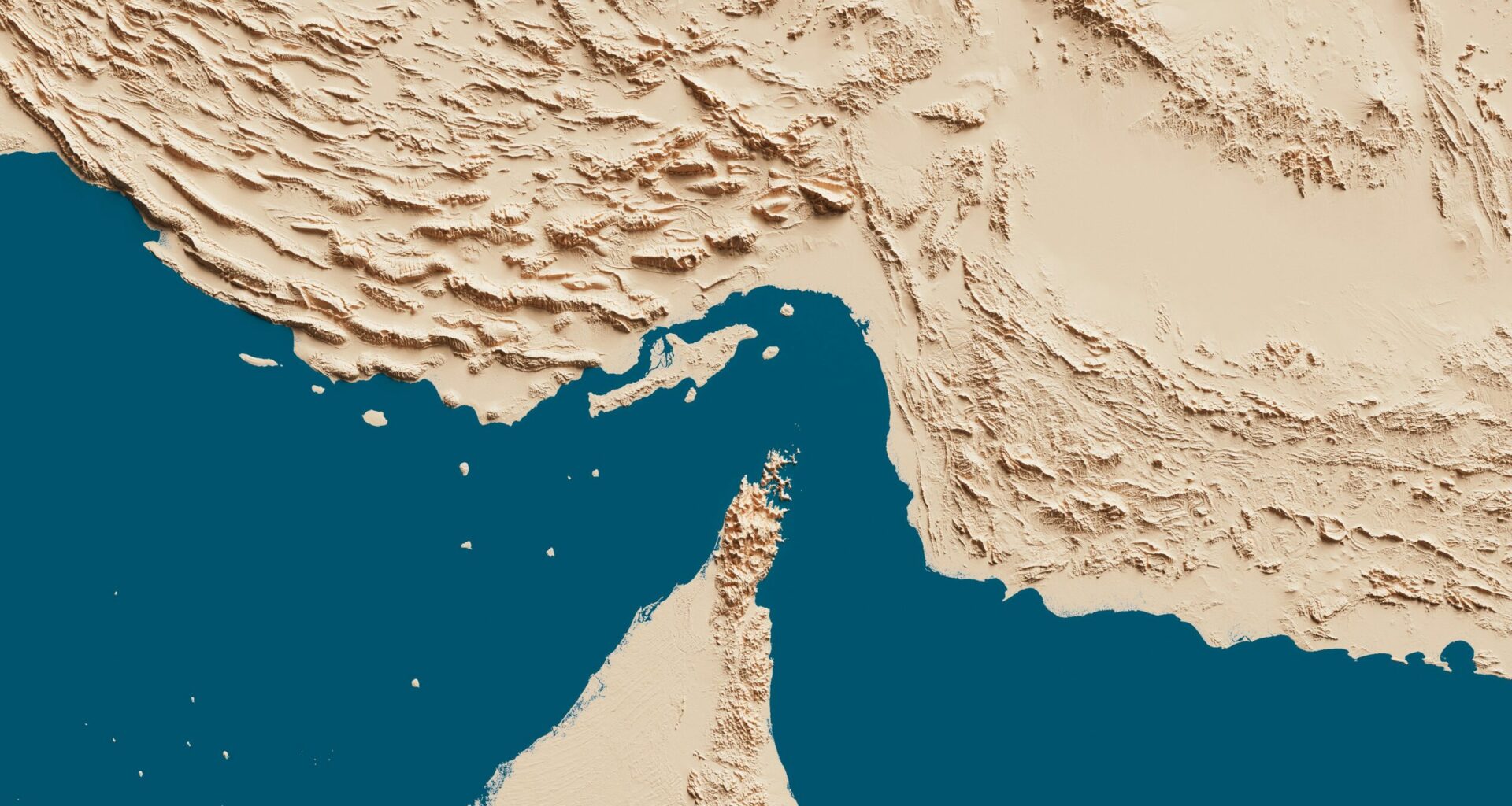
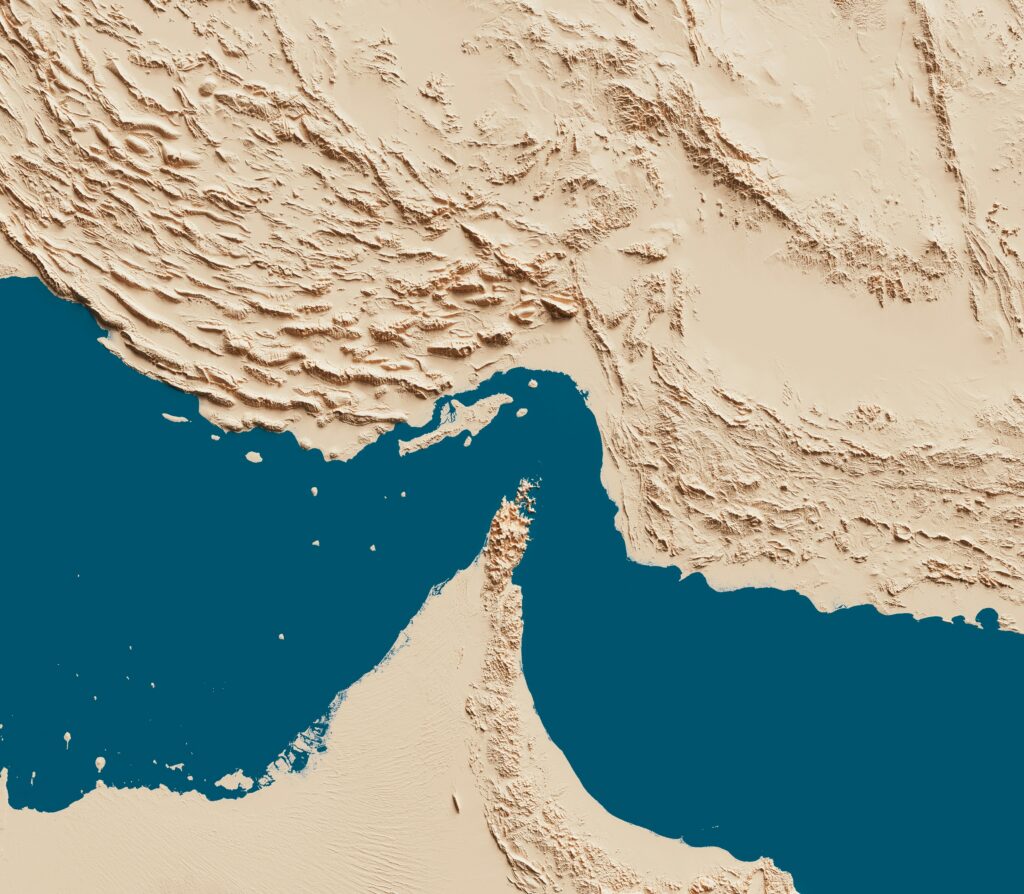
 Image of the Hormuz Strait, by Planet Volumes on Unsplash.
On Monday, April 13, a U.S. naval blockade of Iran focused on halting Iranian energy exports and crippling the Iranian economy went into effect.
Miad Maleki, an expert at the Foundation for Defense of Democracies (a think tank that typically has favored hardline policies on Iran), has detailed how Iran’s economy is dependent on seaborne shipping, with 90% of Iranian trade transiting through the Strait of Hormuz. “The blockade makes continued resistance economically impossible,” Maleki concludes.
Perhaps. Countries that are the targets of economic coercion continually surprise the countries that are attempting to coerce them. Naval coercion has often proved less decisive than naval powers have hoped. British strategist Julian Corbett cautioned in 1911:
Unaided, naval pressure can only work by a process of exhaustion. Its effects must always be slow, and so galling both to our own commercial community and to neutrals, that the tendency is always to accept terms for peace that are far from conclusive.
Why economic coercion of Iran is hard
Corbett’s caution is consistent with the broader finding in the economic coercion literature that sanctions tend to fail. We can think of a blockade as a specific type of sanctions enforcement. A blockade might be quite effective in halting trade at sea, but would be costly to implement because of the requirement of forward-deployed naval forces.
Economic coercion may fail because the targeted country expects the pain to be transitory. Indeed, the Prussian military theorist Carl von Clausewitz warned:
If the enemy is to be coerced you must put him in a situation that is even more unpleasant than the sacrifice you call on him to make. The hardships of that situation must not of course be merely transient – at least not in appearance. Otherwise the enemy would not give in but would wait for things to improve.
Some Iran experts believe that Iran perceives that it can wait the United States out. They point to examples of when Tehran weathered prior episodes of heightened economic pressure – notably, the first Trump administration’s “maximum pressure” campaign. Some of these analysts also observe that Tehran’s true economic hardship is only now beginning since Iran actually exported more oil in early 2026, compared to its average monthly exports last year. Reportedly, Iran also has in excess of 100 million barrels of oil floating in tankers around the world. The vast majority of this supply is beyond the reach of the U.S. blockade.
Other parties may be willing to evade the blockade
The pain of sanctions may also be lessened by what political scientist Bryan Early calls “sanctions busting,” namely third parties that continue to trade after sanctions are imposed. Sanctions (or blockades) create profitable arbitrage opportunities for countries that can find ways to avoid them, and fill the gap. This is especially the case if the economic coercer is unwilling to jeopardize their relations with the sanctions buster. In this scenario, for instance, would Trump endanger relations with China, Russia, or Turkey if evidence emerged that these countries were helping Iran evade the U.S. blockade?
There are many potential sanctions busters. Iran is reliant on seaborne trade through the Strait of Hormuz, but has maritime access to Kazakhstan and Russia through the Caspian Sea. Iran also has long land borders with Iraq, Turkey, Afghanistan, Pakistan, Turkmenistan, Azerbaijan, and Armenia. Many of these countries have already enjoyed lucrative sanctions-busting trade with Iran during the last four decades of U.S.-Iranian enmity. Indeed, as historian and political risk analyst Gregory Brew has speculated, the fact that the Islamic Revolutionary Guard Corps (IRGC) controls so many of these long-existing smuggling routes might boost IRGC influence, at least temporarily, if maritime shipments through the Strait of Hormuz ceased.
Another challenge for sanctions is that they can spur rallies around the flag. While politics are unpredictable, it is at least plausible that Iranian leaders might divert anger away from their own corruption as the causes of Iran’s economic woes and instead blame American-Israeli aggression. John Galtung, in one of the first scholarly treatments of economic sanctions, found exactly this response among white settlers in Rhodesia targeted by international sanctions. They became more politically integrated with the regime rather than opposed to it, Galtung argued.
What are Iran’s options?
Political science scholarship also offers a guide to think through Iran’s next steps in the face of a potentially crippling blockade. One option is to back down and concede to U.S. demands, which is obviously what the Trump administration hopes will occur. If so, one would expect this would unfold quickly. Countries can anticipate future pain and if they think it will be unbearable, they tend to capitulate early – even before the pain begins – rather than endure it unnecessarily. In a classic study, political scientist Dan Drezner found the threat of sanctions was often more effective than their imposition, a finding that Nicholas Miller has reaffirmed in his study of nuclear proliferation-focused sanctions.
Many economic coercion analyses do not include the possibility of military escalation by the targeted government. Yet that is clearly something Iran can and likely will consider. For example, Iran could attempt to strike U.S. naval forces directly and raise costs through damage to U.S. ships and harm to U.S. sailors. Tehran could violate the ceasefire – after all, a blockade is an act of war and arguably inconsistent with the ceasefire’s spirit. A resumption of Iranian strikes on energy infrastructure in the Gulf would be one way to raise the costs of the U.S. blockade. Or Iran could lean on the Houthis in Yemen to threaten the crucial east-west pipeline that has enabled Saudi Arabia to reroute a substantial portion of its total oil exports away from the Strait of Hormuz bottleneck. Press accounts suggest Saudi concerns over this latter scenario have led Riyadh to oppose the U.S. blockade – at least in private.
This perusal of Iran’s options should make it clear that if Tehran makes concessions, we should expect them soon. But if the coercive campaign drags on, U.S. hawks may underestimate Iran’s staying power. From all indications, Tehran has options, and the capacity to cause renewed global economic dislocation.
Related