
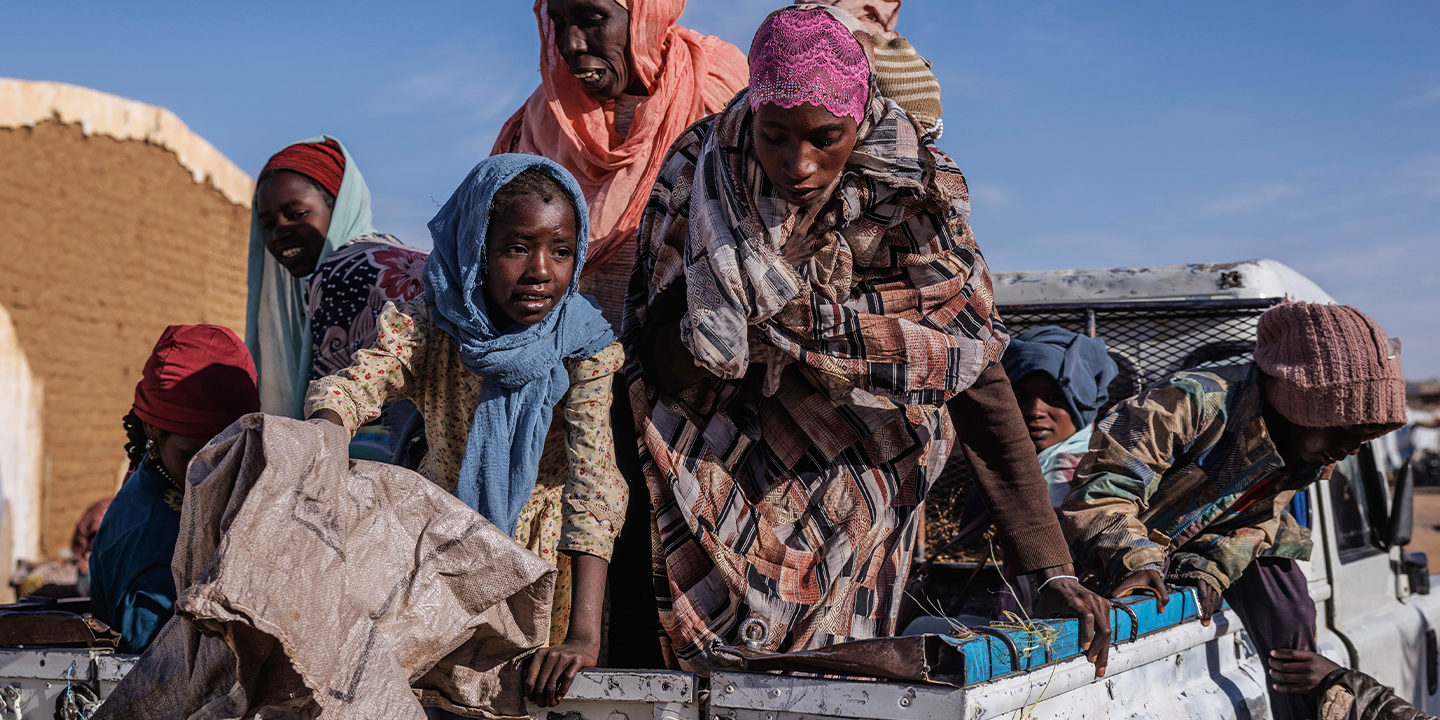
SUDAN MARKS THIRD ANNIVERSARY OF CONFLICT AS VIOLENCE AND ATROCITIES CONTINUE
Today, 15 April, marks three years since the start of the devastating conflict in Sudan, which has since evolved into one of the world’s most complex protection crises. The sustained hostilities between the Sudanese Armed Forces (SAF) and the Rapid Support Forces (RSF), alongside allied militias, have been characterized by atrocity crimes against civilians, unprecedented mass displacement and the deliberate and systematic destruction of civilian infrastructure and essential services. In Darfur, the RSF have committed genocide and other atrocities against non-Arab communities, including mass killings, widespread rape and sexual violence, door-to-door executions, deliberate starvation and forced displacement of entire communities into precarious and unsafe conditions. Despite repeated calls for ceasefires, hostilities have continued to spread and intensify.
The conflict is increasingly being shaped by external involvement. Credible reports indicate that the SAF and RSF are receiving political, financial and military support from regional and international actors. Most recently, on 8 April the Yale School of Public Health’s Humanitarian Research Lab reported satellite evidence from an Ethiopian military base in Asosa, suggesting possible Ethiopian military support linked to RSF operations in Sudan’s Blue Nile region. These dynamics contribute to further militarization and fragmentation of the conflict, including the growing sophistication and lethality of weapons used across multiple fronts.
Of particular concern is the increased use of drones in recent months, with both parties expanding their use for surveillance and targeted strikes, including in densely populated areas. Such attacks have repeatedly hit hospitals, markets and residential neighborhoods. According to the UN Office for the Coordination of Humanitarian Affairs, nearly 700 civilians were reportedly killed in drone strikes between January and March 2026. On 8 April at least 58 civilians – including 17 children – were killed in Kutum, North Darfur, when a suspected SAF-operated drone struck a wedding party.
Emphasizing that atrocity prevention must be central to international efforts, Denise Brown, UN Resident and Humanitarian Coordinator in Sudan, urged member states during a press conference on 13 April to scrutinize the war economy – including the resources sustaining the conflict and the continued flow of weapons – as a pathway to ending the violence. She also highlighted atrocities documented by the UN Fact-Finding Mission and the Office of the UN High Commissioner for Human Rights, asking, “Why is the world not outraged enough to act? What more has to happen?”
Against this backdrop of growing external involvement and intensifying violence, the third international conference on Sudan was held in Berlin today. The international community, including the UN Security Council, the African Union and UN member states, must urgently build on the commitments made in Berlin and use their leverage, diplomatic channels and sanctions to pressure the SAF, RSF and allied militias to immediately end the violence. External actors fueling the conflict must also be held accountable, particularly those providing political, military or financial support that heighten atrocity risks.
SIX MONTHS INTO THE GAZA CEASEFIRE, ATROCITY CRIMES AND RISKS PERSIST
Just over six months into the so-called ceasefire in Gaza, Israel has continued to obstruct humanitarian aid and carry out attacks across the enclave. At least 730 Palestinians have been killed and over 2,000 injured since the agreement took effect on 10 October 2025. UN High Commissioner for Human Rights Volker Türk stressed that half a year later, “Palestinians have no blueprint for survival: whatever they do or don’t do, wherever they go or don’t go, there is no safety or protection afforded to them. It is hard to square this with a ceasefire.”
While hostilities have decreased, similar to past ceasefires, the conditions for atrocity risks and crimes remain intact. Gaza’s population remains effectively confined to less than half of the enclave, facing near-daily attacks and continued risk of hunger and disease. On 8 April the UN Independent International Commission of Inquiry on the Occupied Palestinian Territory, including East Jerusalem, warned that the regional escalation following United States-Israeli strikes on Iran has drawn attention elsewhere and “eclipsed a surge in human rights violations against Palestinians,” expressing serious concern that “Israel continues to perpetrate genocidal acts” in Gaza.
Meanwhile, the continued operation of nearly four dozen international non-governmental organizations providing critical services remains under threat as they challenge attempts by Israel to ban them. Five leading humanitarian organizations produced a humanitarian scorecard assessing progress on civilian protection, aid access, reconstruction and economic development and freedom of movement and return that overwhelmingly concluded the ceasefire is failing.
Throughout Israel’s assault, approximately 92 percent of housing units and 70 percent of all structures in Gaza have been damaged or destroyed. Israel has heavily restricted the entry of shelter materials and blocked access for critical reconstruction materials. As a result, the majority of Gaza’s population remains unable to return to and rebuild their homes, with many sheltering in camps and makeshift tents that have come under attack by Israeli forces. Throughout March, Israeli airstrikes targeted several areas sheltering displaced persons, killing civilians, including children, igniting fires in shelters and resulting in repeated displacement of families. UN experts have denounced Israel’s “cycle of displacement, terror, and targeted attacks,” warning that “targeting areas known to shelter displaced civilians is a grave breach of international humanitarian law.”
The international community must unequivocally denounce Israel’s ongoing violations of the ceasefire and press for a complete cessation of hostilities, as well as full respect for the provision of humanitarian aid. Governments with influence must use all diplomatic, political and legal leverage to demand that Israel lift restrictions on life-saving aid and prevent further suffering for people in Gaza. States should also cease enabling Israel’s atrocities in Gaza and take consistent action to hold perpetrators accountable.
DEADLY AIRSTRIKE HIGHLIGHTS RISKS IN NIGERIA’S ONGOING COUNTERINSURGENCY EFFORTS
On the evening of 11 April the Nigerian Air Force carried out an airstrike on a crowded local market in Jilli village, northeastern Nigeria. While authorities have yet to confirm the official death toll, Reuters reported the figure may be as high as 200. The operation intended to target Islamist militants in Yobe State, near the border with Borno State. Islamist militants reportedly visit the market to purchase food supplies. In response to the airstrike, Amnesty International Nigeria stated, “Launching air raids is not a legitimate law enforcement method by anyone’s standard. Such reckless use of deadly force is unlawful, outrageous and lays bare the Nigerian military’s shocking disregard for the lives of those it supposedly exists to protect.”
For years, populations in the Borno-Yobe border region have faced acute protection risks due to protracted conflict involving the armed extremist groups Boko Haram and the so-called Islamic State in West Africa Province (ISWAP), alongside sustained counterterrorism operations by Nigerian security forces. Boko Haram and ISWAP militants operate across porous borders with Niger and Chad, exploiting weak state presence and difficult terrain to evade detection and hinder containment efforts.
In response, Nigerian security forces have intensified counterterrorism operations in affected areas. However, civilians have increasingly been caught in the crossfire. This pattern is reflected in a series of incidents since 2017 in which airstrikes have resulted in significant civilian harm, including at least 115 deaths in Borno State in 2017; more than 100 deaths across Nasarawa, Benue and Zamfara states between December 2022 and January 2023; and at least 85 deaths in Kaduna State in December 2023. In addition to unlawful use of force, the Nigerian Air Force has been implicated in misfires and unintended civilian casualties, often linked to intelligence gaps and coordination challenges between ground and air forces.
In February 2023 the then–UN Special Adviser on the Prevention of Genocide urged Nigerian authorities to ensure that counterterrorism operations comply fully with International Human Rights Law (IHRL) and International Humanitarian Law (IHL) and called for investigations. While the authorities have issued apologies or acknowledged responsibility for some deadly, erroneous airstrikes, minimal steps have been taken to seek justice or accountability.
The Nigerian authorities must ensure independent and transparent investigations into the airstrike in Jilli. Victims and survivors must be guaranteed access to justice and provided with adequate and effective remedies. The Nigerian military must urgently review and reinforce its standard operating procedures, including intelligence verification and target identification, to prevent civilian harm. Authorities should also improve coordination between air and ground forces, particularly in fast-moving counterinsurgency contexts where identifying legitimate targets is challenging. All relevant personnel should receive enhanced training on IHL and IHRL.