
Bridgewater, Virginia —
Tara Bowman lives on a farm in Woodstock, Virginia, a town of some 6,000 people nestled along the banks of the Shenandoah River’s North Fork.
But under a redistricting plan Virginia voters may enact next week, Bowman’s community would be in the same congressional district as wealthy Washington suburbs such as Fairfax and McLean some 90 miles away.
It’s part of a sweeping Democratic effort to dilute Republican votes across Virginia to help Democrats win 10 of the state’s 11 US House seats in November’s midterm elections – the latest and one of the last remaining fights in the coast-to-coast redistricting battle that President Donald Trump set off last year in Texas.
Currently, Virginia Republicans – including Bowman’s congressman, Rep. Ben Cline – hold five House seats and Democrats six.
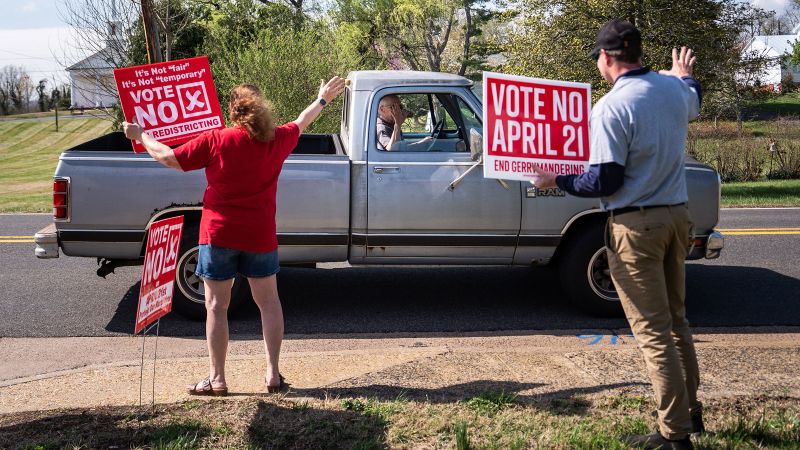
“We’re 100% rural. We have lots of farming, small business,” an incredulous Bowman said at a weekend rally organized by redistricting opponents. “I can’t believe they’re gonna give me a congressman from Fairfax.”
Saturday’s event, which drew hundreds to a hangar in an aviation park deep in the Shenandoah Valley, marked an intensifying campaign by groups opposed to the map to mobilize rural voters in the final sprint to Tuesday’s election.
A Democratic-controlled House “would turn all the committees of Congress into investigative bodies” and impeach President Donald Trump, House Speaker Mike Johnson told the audience, assembled in a county that supported Trump by a 40-point margin less than two years ago.
“You have the power to protect fair maps in Virginia and to protect, truly, the entire House Republican majority in the Congress,” Johnson said. “That’s in your hands right now.”
At the same event, Glenn Youngkin, the state’s Republican former governor, called the map a “monstrosity” that would “overwhelm and overcome the voice of the people.”

Opponents are heartened by a recent Washington Post poll that shows 52% of likely voters support the redistricting effort, despite heavy spending by Democratic-aligned groups and the state’s increasingly blue tint in national elections.
Despite the sky-high stakes for Trump and Republicans, however, Democrats have swamped Republicans in spending throughout the monthslong, multimillion-dollar redistricting campaign. Early on, the Republicans’ strategy focused heavily on trying to block the referendum in court. (A case over the redraw is still pending before the state Supreme Court, which opted to let next week’s vote proceed before deciding the merits of a lawsuit brought by opponents.)
As of Monday, Democratic groups had spent more than $48.2 million on the airwaves, urging a “yes” vote on the referendum, according to AdImpact, which tracks political advertising. Republicans have dramatically increased their advertising activity in recent days, but still lag in the ad wars, spending about $17 million.
A Johnson fundraiser held a few hours after the rally brought in $500,000 for the anti-redistricting effort, according to his team.
But some rural voters told CNN they were alarmed both by the map and the Democrats’ lopsided spending advantage.
“Other than a couple of shows like this with a few people, giving speeches, showing up, there has not been a significant push to offset what the Democrats are doing,” said Michael Clancy, a resident of Harrisonburg, who attended the Johnson rally.
“It seems like they want to lose the midterms,” Clancy said of Republican leaders.
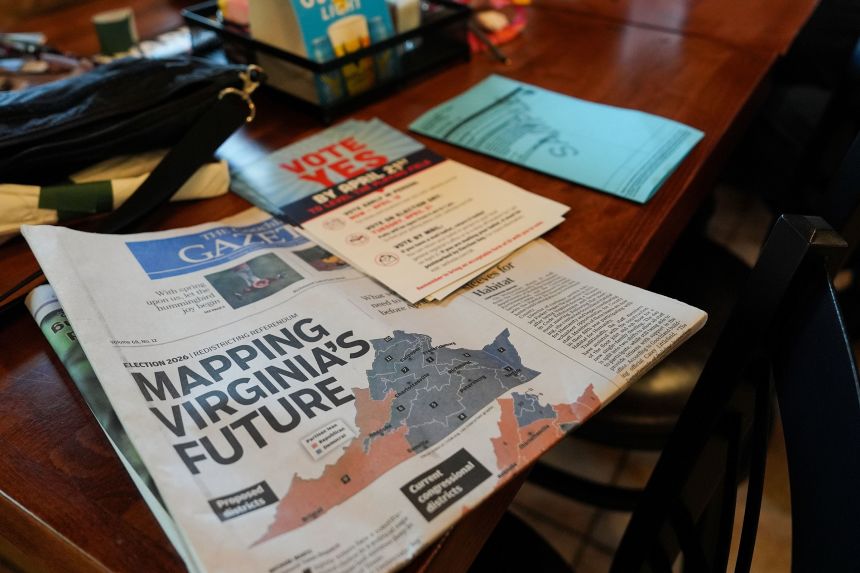
Misshapen district boundaries are not unique to Virginia mapmakers nor to one political party. Lawmakers in heavily Democratic Illinois and deep-red Tennessee have each drawn maps that carve up Chicago and Nashville, respectively, for partisan advantage.
Texas’ GOP-controlled legislature kicked off an unprecedented mid-decade redistricting gambit at Trump’s behest last year with a map aimed at flipping five US House seats. California responded by putting a map to the state’s overwhelmingly Democratic electorate last November that seeks to largely offset Texas’ move. More states have entered the fray and Florida still could.
So far, four Republican-led states have crafted new maps that give their party the opportunity to flip as many as nine House seats while Democrats have the chance of flipping six.
In Virginia, voters are being asked to amend the state’s constitution and temporarily suspend a provision that gives a bipartisan commission – rather than state legislators – map-drawing authority. Voters approved the bipartisan redistricting amendment in 2020.
Democrats want to snake districts out from Washington’s liberal suburbs, deep into rural territory, creating misshapen boundaries that Republicans have disparaged. For instance, opponents dubbed the proposed 7th Congressional District – where Johnson rallied voters Saturday – the “lobster claw” because it curves around another district like the pincers of a crustacean.
Democratic Rep. Jennifer McClellan, who represents the Richmond area in central Virginia, dismissed suggestions that the new maps would create an unfair urban-rural divide across the commonwealth.
“Whether you are in an urban city or you are in a rural area, you have equally been hurt by Donald Trump and his policies,” McClellan told reporters recently. “We have more in common than not, and we are fighting for rural Virginia just like we are fighting for urban and suburban Virginia. We will continue to do that after this redistricting referendum passes.”
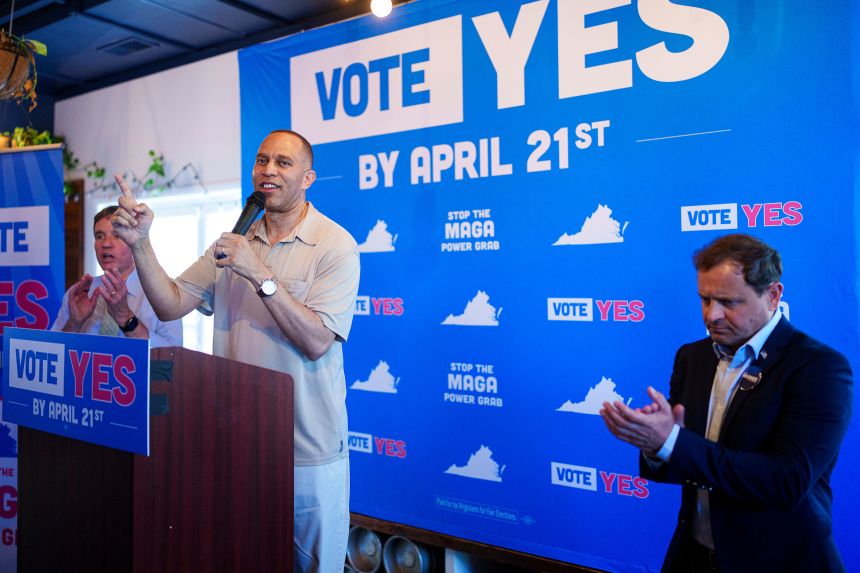
House Democratic Leader Hakeem Jeffries, who is poised to ascend to the speakership if his party flips control of the US House, also spent the weekend in Virginia rallying supporters.
“They thought that Democrats were going to step back,” Jeffries said at an event in Richmond. “Well, we’re making clear we’re not here to step back, we’re here to fight back.”
“Voting yes will stop the MAGA power grab,” Jeffries said. “Voting yes will level the playing field. Voting yes will stop Donald Trump’s scheme to rig the midterm elections.”
On Thursday night, Jeffries will join other top Democrats, including Virginia Gov. Abigail Spanberger, and US Sen. Mark Warner, and a slew of digital creators for a virtual rally aimed at boosting turnout.
Early voting ends Saturday. Election Day is Tuesday.
Data analyzed by CNN of the early vote so far suggests Democrats have an advantage in their push to enact the new map. Nearly 63,000 early in-person votes were cast on April 11, according to data from L2, slightly higher than the equivalent day ahead of last fall’s election in which Democrats swept all three statewide offices.
Republicans involved in the campaign against the map defended their decision-making and argue their chances are better than some observers think.
Virginia Republican Party Chairman Jeff Ryer told CNN that he’s “very happy” with the support he’s received from the Republican National Committee.
The RNC has helped finance ongoing court challenges, said Ryer, who took over the state party in February. The national party also has eight field staff working in the state, helping support thousands of GOP volunteers fighting the map, he said.
“We feel as though we’re getting our message out when voters are making up their minds,” Ryer added, pointing to the recent surge in spending by groups opposed the map.
“The Democrats have deployed over $50 million to rig Virginia’s Congressional maps and yet the referendum is extremely close, as all sides acknowledge,” Mike Young, campaign manager of the anti-referendum group Virginians for Fair Maps, said in a statement to CNN.
“That didn’t happen by accident or dumb luck.”