
This is a rush transcript. Copy may not be in its final form.
AMY GOODMAN: U.S. Secretary of State Marco Rubio hosted the Israeli and Lebanese ambassadors in Washington Tuesday in the first direct talks between Israel and Lebanon in over 30 years. The talks come as Israel continues to bomb areas across Lebanon and expand its occupation of parts of southern Lebanon. Israel says they’re focused on disarming and dismantling Hezbollah. More than 2,100 people have been killed and over a million displaced.
Hezbollah, which was not a party to the talks, made clear it will not abide by any agreement that results from the negotiations, and called the talks a “national sin.”
Speaking to reporters after the talks in Washington, Israel’s ambassador to the United States, Yechiel Leiter, praised the Lebanese government for standing up against Hezbollah.
YECHIEL LEITER: The head of Hezbollah warned the government of Lebanon yesterday not to participate in these talks, and the government of Joseph Aoun bravely said no to Hezbollah. And this is the beginning of a very strong and fortified, consistent battle against Hezbollah. They are weakened as they’ve never been. And together, we’ll continue to rid the threat of this Iranian proxy, which is so malign and so malignant in the region.
AMY GOODMAN: In a statement to Reuters, the Lebanese ambassador, Nada Moawad, described the meeting as “constructive.” She also called for a ceasefire, the return of the displaced to their homes, and measures to alleviate the humanitarian crisis.
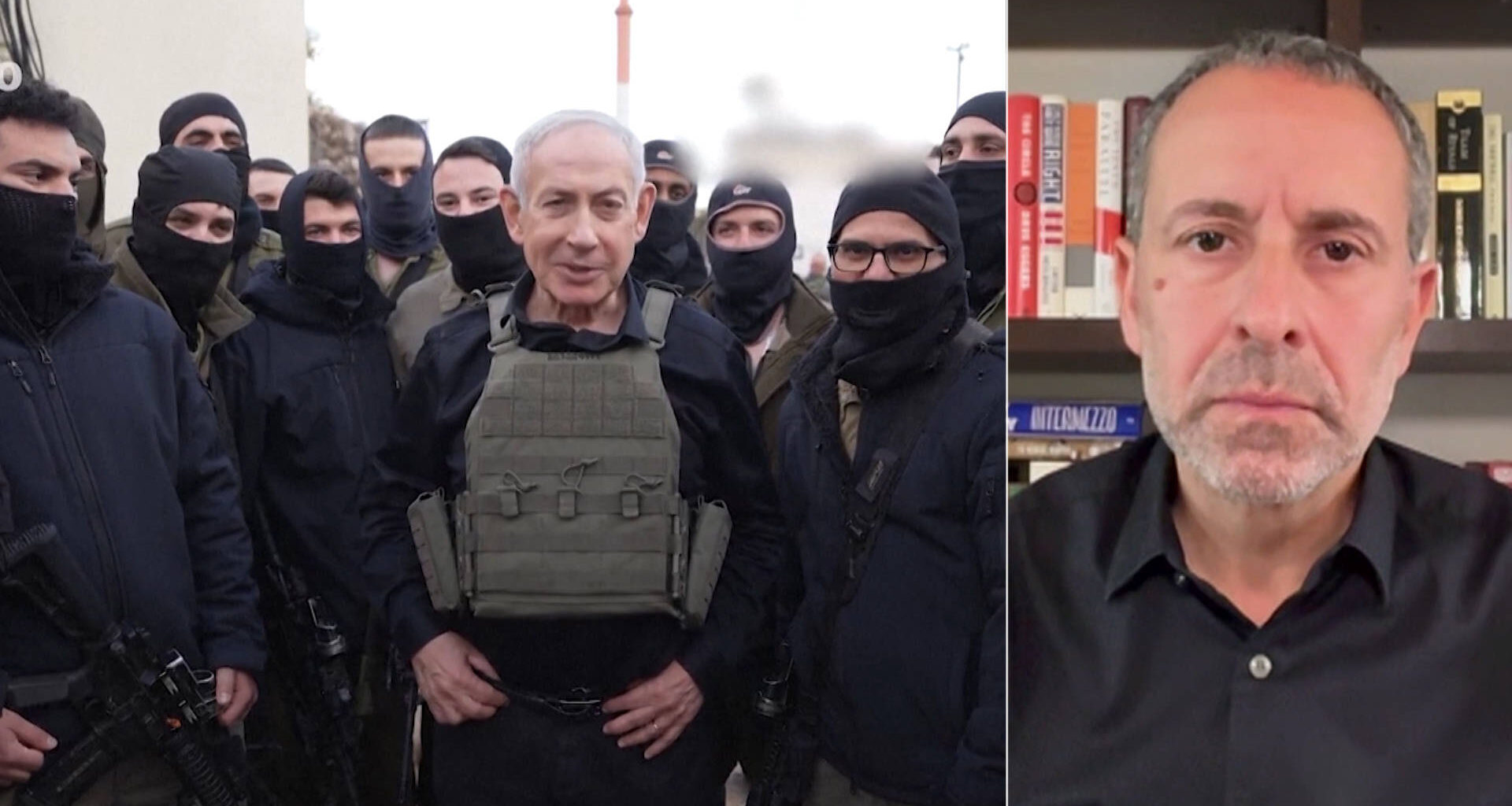
To discuss all this and more, we’re joined in London by Daniel Levy, president of the U.S./Middle East Project, former Israeli peace negotiator under two Israeli prime ministers. His recent op-ed for The Guardian is headlined “What Benjamin Netanyahu and the Israeli right really mean when they invoke ‘Greater Israel.’”
Well, let’s start there, Daniel Levy. What do they mean?
DANIEL LEVY: Good to be with you, Amy.
What I try to set out in that piece, that’s also on my Substack, is we tend to think, understandably, that Greater Israel is exclusively about territorial expansion and settlement. And, of course, that has been part of the story of Israel, and displacement of Palestinians has been the centerpiece of that. What I’m suggesting is there’s something additional, more geopolitical, more strategic, in play here, that Netanyahu is trying to turn Israel into a dominant regional power. It’s not just about the land you take. There’s a limit to, you know, small population, how far they can settle, how much sense that makes. But Israel understands that if it is going to be able to continue its policy of zero-sum eradicationism towards the Palestinians, it needs a quiescent region. And for that, it needs to be surrounded by states that have either been dismantled, that cannot, therefore, challenge Israel, or by states that have been coopted, in which Israel has created relations of dependency, and often that will mean weakening a state.
And so, I place that in the context of this war against Iran. It needs America to achieve that. It needed America for that war against Iran. If you can remove Iran as some kind of a power balancer and deterrent, if you can, for instance, weaken the Gulf and create relations of dependency of the Gulf states on Israel significantly more than you have today, then that power project begins to look possible. I think it’s overreach. Israel will tell us it’s deterrence, but it’s domination. Israel will tell us it’s survival, but it’s hegemony. I don’t think they can achieve it. But to understand what one is confronting, one needs to understand what is being attempted here by the Israeli side. And that is what I suggest they are trying to achieve.
AMY GOODMAN: So, talk about these rare negotiations that took place in Washington, overseen by the U.S. Secretary of State Marco Rubio, the first time Israel and Lebanon have held negotiations in over 30 years. Of course, they didn’t include Hezbollah, and Israel continued its attacks on Lebanon. One of Israel’s key ultimatums is the disarmament of Hezbollah. Can you talk about how these negotiations are unfolding?
DANIEL LEVY: Yeah, let me try and do that. There were, by the way, meetings in Naqoura, in Lebanon, at the end of last year of official Israeli and Lebanese teams, which were very unusual, in December and January, December ’25, January 2026. But I guess this kind of official termed as a negotiation hasn’t been seen for an awfully long time.
Now, what the Israeli side comes to this with is something that is designed to sound eminently reasonable. Of course, if there is a nonstate actor, that should not be able to carry arms and decide when the state of Lebanon is taken to war. And therefore, what could be more obvious than a disarmament in that context? Take a step back, and let’s understand why the position Israel is asserting is anything but reasonable.
You have a resistance in Lebanon, you have an armed group, and you have a very weak central state, partly because that’s a deterrent strategy by Iran, but it only is sustainable because Israel is a country that has invaded Lebanon — I think it’s seven times now — maintained a military occupation of the south of Lebanon and established its own proxy militia to run that for 18 years, 1982 to 2000, since then continues to violate Lebanese airspace, Lebanese sovereignty on a daily basis. Even since the ceasefire reached in November 2024, there have been, as of a couple of months ago, the U.N. counted, 10,000 Israeli violations, 300 Lebanese killed during the so-called ceasefire. If that sounds familiar from Gaza, well, it should.
And so, the idea that Israel can come to the table with clean hands, make these demands of a Lebanese government that it knows is in no position to implement that — it also knows that this Lebanese government did try and create the political conditions where you could begin to move towards at least a south of Lebanon, and then later the rest of Lebanon, where a political arrangement could be reached that Hezbollah would not carry on with this same capacity. Israel knows that what it is doing here is it is trying to put something that sounds reasonable on the table, but with the intention of embarrassing and humiliating the Lebanese government, which cannot carry these things through, because it, Israel, has created the conditions which makes that impossible. And it did so — let’s just remind ourselves — it did so off the back of one of the most violent, destructive and ugly military strikes against a country that has known very many bad days, Lebanon, on the day after the ceasefire was declared. So, Israel creates the worst possible conditions in which to make a demand which is intended to not be achievable, and it seems to throw Lebanon back into a civil war. That’s an outcome that Israel openly talks about.
Let me say something, Amy. When I was involved as a negotiator, the first thing I learned, the first thing I was told, is, if you’re going to have a successful negotiated outcome, not a diktat, not a military-imposed outcome, but a negotiated outcome, you have to think that each party needs to come away with this with a victory narrative that they can go back to their public with their dignity intact. And Israel is doing the precise opposite, including the words we heard from the ambassador yesterday, designed to embarrass his Lebanese interlocutor, designed again to embarrass the Lebanese government. This is not an exercise in problem solving. This is an exercise in trying to pursue a zero-sum agenda, which has nothing in it for the Lebanese side.
AMY GOODMAN: Finally, if you can talk about what’s continuing to happen in the West Bank and Gaza, the number of people who have died just in the last few days, let alone the hundreds since the so-called ceasefire?
DANIEL LEVY: Yeah, and I so appreciate you pulling us back to that, because that’s the story that so many people want to leave behind, move on from, pretend isn’t there.
We are told that there is a ceasefire in Gaza. During that ceasefire, in excess of 700 Palestinians have been killed. There have been killings every day. Israel continues to occupy directly over 60% of the Gaza territory. Israel continues to conduct daily military operations to prevent much of what is desperately needed, and simultaneously to pursue its most destructive campaign in the West Bank that we have seen in decades, probably since 1967. We’re hearing that, for instance, Marwan Barghouti, a prisoner in Israeli jails, has been roughed up, badly beaten on a number of occasions. Recently, we’ve seen images of Palestinians being allowed to return to refugee camps in Jenin for the first time in an awfully long time and seeing the destruction that has taken place there.
It only makes sense in the context of what Israel itself defines as the pursuit of what it calls “total victory,” which means the permanent displacement of Palestinians physically, but also displacement of the idea that a Palestinian national collective will ever have its rights, its basic freedoms. And that is all continuing from one very simple reason, that Israel has been emboldened and empowered. And that’s true on the Palestinian front, but it’s also true regionally. That’s why America was sucked into this war. Israel has been emboldened and empowered by the impunity with which it has been treated for decades, never held accountable, and that encourages what we see today, which is horrible to behold, not only in terms of what it is doing to Palestinians, Lebanese, the region, but also what it means in terms of the extremism inside Israeli society itself, how consent in society was manufactured for an ongoing genocide.
AMY GOODMAN: Daniel Levy, I want to thank you for being with us, president of the U.S./Middle East Project, former Israeli peace negotiator under Yitzhak Rabin and Prime Minister Ehud Barak. Thank you so much for joining us.