
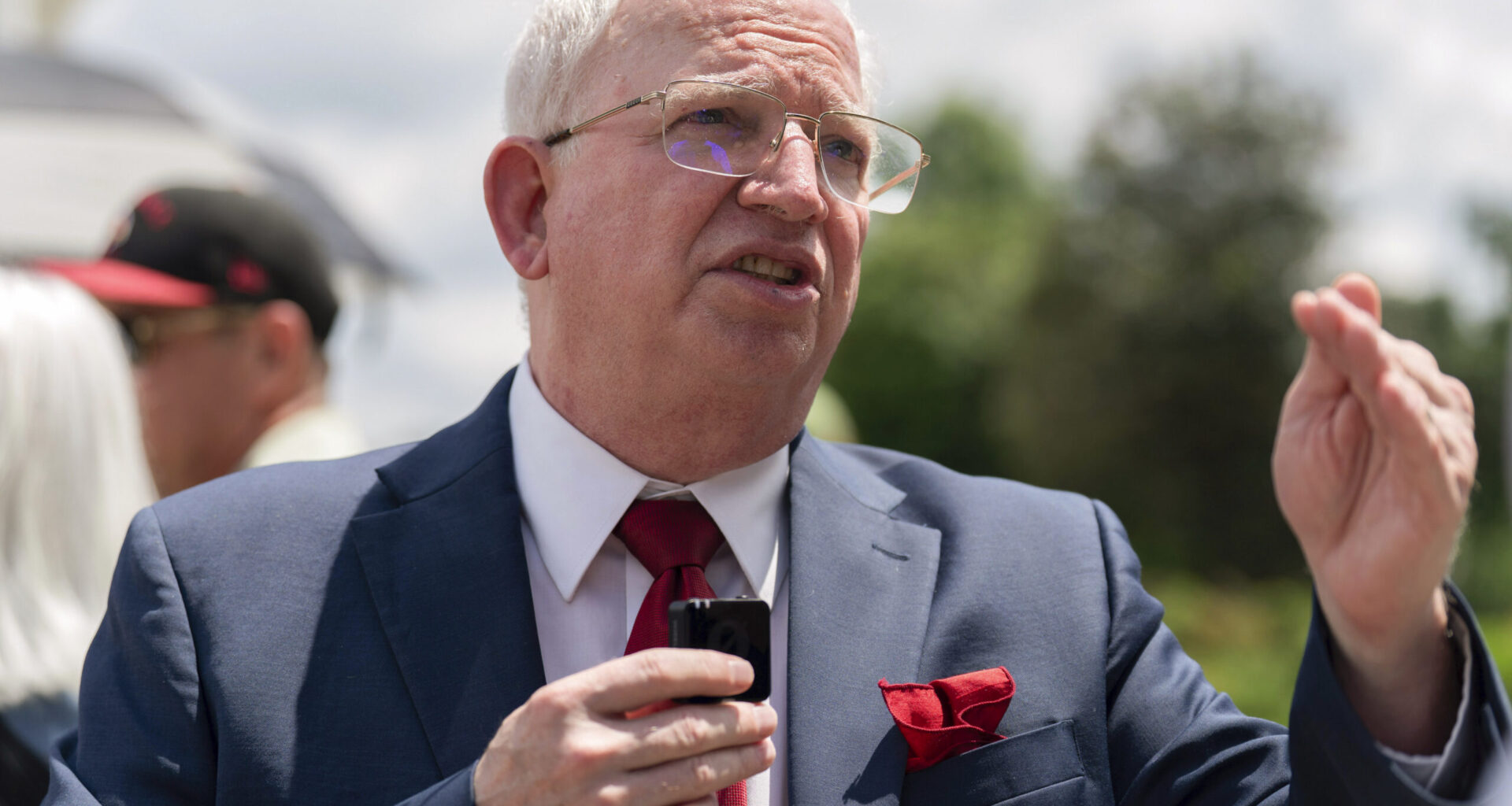
The California Supreme Court Wednesday permanently disbarred John Eastman — a key architect in President Donald Trump’s failed attempt to overturn the 2020 election — delivering one of the most consequential professional penalties yet for an election denier.
In a brief but decisive order, the high court declined to intervene after lower courts found that Eastman had repeatedly misled courts and advanced baseless claims in service of Trump’s last-ditch effort to cling to power after losing the presidency in 2020.
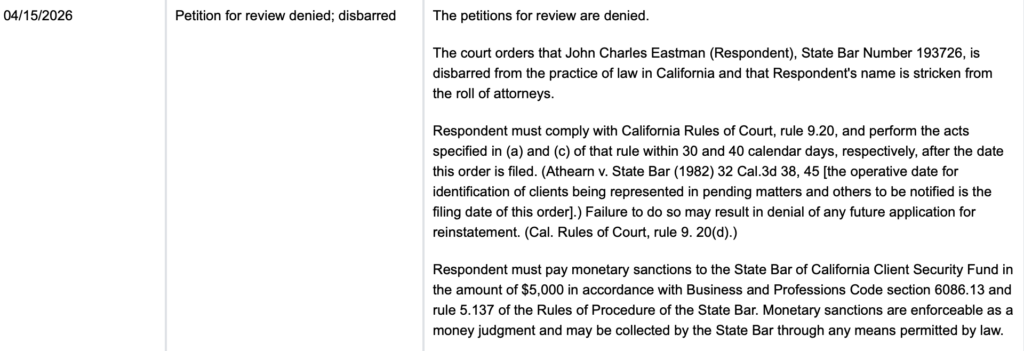
“The petitions for review are denied,” the court wrote. “The court orders that John Charles Eastman … is disbarred from the practice of law in California and … stricken from the roll of attorneys.”
The ruling marks the end of Eastman’s legal career in California and cements his status as one of the most prominent figures to face professional consequences for trying to subvert a democratic election.
Eastman is also currently suspended from practicing law in Washington, D.C., where disciplinary proceedings tied to his post-election conduct are ongoing.
Eastman was not a peripheral player in Trump’s election subversion strategy but a central figure.
In the weeks after the 2020 election, Eastman drafted a series of memos outlining a plan to block Congress from certifying President Joe Biden’s victory. At the center of that plan was a radical and widely debunked legal theory that suggested then-Vice President Mike Pence could unilaterally reject electoral votes from key battleground states.
The strategy was Trump’s final play to overturn the election — one that culminated in the Jan. 6, 2021 attack on the U.S. Capitol, as Congress met to certify the results.
Courts across the country repeatedly rejected claims of widespread voter fraud.
Pence refused to follow Eastman’s advice, acknowledging he had no authority to overturn the election. The plan collapsed — but not before it helped fuel a nationwide effort to delegitimize the results.
In the days after the Jan. 6 attack, Eastman also sought a pardon from Trump, despite not having been charged with a crime at the time.
In an email to Trump allies, he wrote, “I’ve decided that I should be on the pardon list, if that is still in the works.” The request came as his role in the effort to overturn the election was coming under increasing scrutiny from investigators and lawmakers.
California bar authorities later concluded that Eastman’s role went far beyond overzealous advocacy.
They found that he made false statements in court filings, promoted claims of election fraud without evidence and used his legal credentials to advance a strategy aimed at overturning a lawful election — conduct that violated the basic ethical duties of a lawyer.
Disbarment — the most severe penalty in the legal profession — is reserved for serious misconduct, particularly dishonesty or abuse of the judicial system.
By allowing that punishment to stand, the California Supreme Court has now effectively endorsed those findings.
Eastman’s disbarment is one of the clearest examples yet of accountability for the legal machinery behind Trump’s attempt to stay in power after losing. While much attention has focused on political figures, Eastman’s case underscores how lawyers — who play a critical role in the election system — can face repercussions.
“Eastman played a central role in the plot to overturn the 2020 election—pressuring state officials, advancing baseless claims in court, and promoting a fringe theory that the vice president could reject certified electoral votes. His unethical actions have had real, lasting consequences for our democracy, and we applaud the California Supreme Court’s decision to disbar him,” Christine P. Sun, Senior Vice President of Legal at the States United Democracy Center, said in a statement. “This decision is part of a broader reckoning for those who seek to undermine the rule of law in this country. While Trump tries to consolidate power, the states and courts continue to successfully check executive overreach and the unlawful actions of his administration.”
At the same time, Eastman has remained active in election denial circles, continuing to push conspiracy theories about voting and elections.
In recent days, he falsely claimed that a special election in Tarrant County, Texas — where a Democrat flipped a state Senate seat — was rigged.
“The forensic audits have identified flipped votes,” Eastman said. “What they discovered is somebody, whether an inside malicious actor or an outside actor, created ghost voting IDs based on actual Voter IDs.”
There is no evidence supporting those claims.
Eastman’s disbarment does not resolve the broader legal and political battles over the 2020 election — many of which are still playing out in courts across the country. But it represents a significant milestone that a top legal architect of Trump’s effort to overturn a democratic election has now been formally stripped of his ability to practice law.