
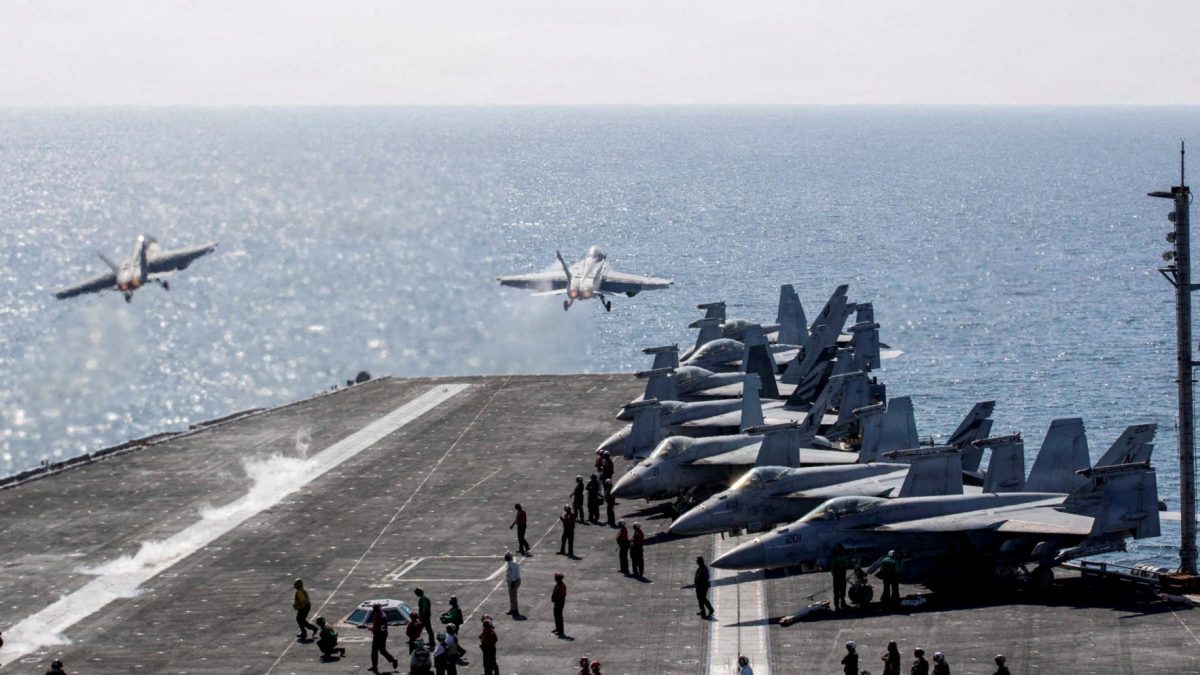
Two days into the US naval blockade of Iran, the effects are already becoming apparent. US Central Command (Centcom) reported on Tuesday that no ships originating from Iranian ports had so far attempted to run the gauntlet of blockading US Navy warships. Six complied with orders to turn around.
The US claims to have “completely halted” Iran’s trade by sea, while Tehran has threatened to shut off all shipping in the Red Sea and Gulf in retaliation. The effectiveness of the blockade will probably only increase as the US military settles into its new task.
While Iran condemned the move as “illegal” and an “example of piracy” the blockade of its ports is legal under the law of naval warfare – which would view both sides as belligerents – and makes strategic sense. Donald Trump wants to pressure Tehran economically so that it lifts its own blockade of the Strait of Hormuz, while also forcing it to negotiate seriously at the next round of talks, especially over its nuclear programme.
New FeatureIn ShortQuick Stories. Same trusted journalism.
The US President is also trying to put pressure on China, by far Iran’s largest oil customer, to help it persuade Tehran to give in to US demands.
The strategy of blockading an enemy’s ports was established by the Royal Navy in the 18th century. Then, as now, the aim was to dry up the resources of the adversary, weaken its economy, pressure its leaders and degrade its military capabilities.
As the threat of shore defences grew, navies evolved from close blockades designed to trap the enemy in port to “distant” blockades to strangle enemy commerce. These require more warships to enforce but reduce the risk of enemy attacks.
Blockades were used to great effect by Britain in the past, notably during the Napoleonic, Crimean and both World Wars.
After the initial confusion created by Trump, when he threatened – illegally – to blockade the whole of the Strait of Hormuz, the US has settled into a traditional distant blockade of Iranian ports, using warships predominately stationed outside the Gulf (supported by satellites and surveillance aircraft).
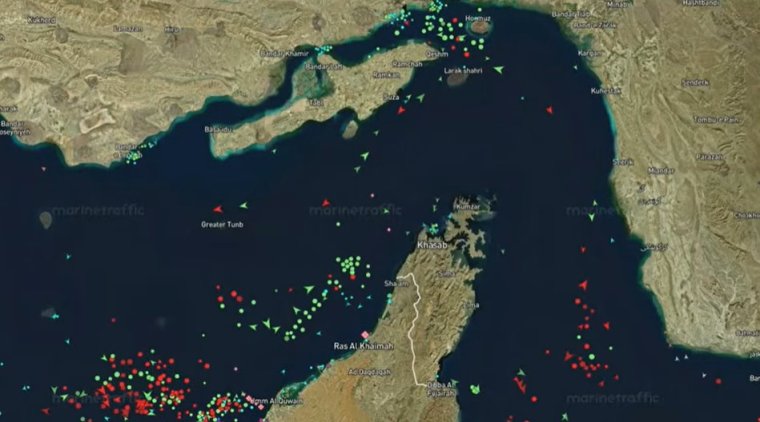 A vessel tracker shows marine traffic in the Strait of Hormuz after Donald Trump’s blockade (Photo: Marine Traffic/Reuters)
The US has said it will permit freedom of navigation for vessels sailing to and from non-Iranian ports, while also encouraging them to break Iran’s attempts to charge ships for transiting the Strait.
Iran is heavily dependent on the sea and is highly vulnerable to interruption of its trade by blockade.
Admiral Brad Cooper, the head of Centcom, has said that 90 per cent of Iran’s economy is fuelled by international trade by sea. Miad Maleki, a senior fellow at the Washington-based Foundation for Defence of Democracies, noted on X that oil and gas accounts for 80 per cent of Iranian government export earnings and 23.7 per cent of the country’s GDP.
Maleki also said that a successful blockade of Iranian ports could cost its regime around $435m (£320m) a day, far outstripping what it could ever hope to earn from charging a toll on ships transiting the Strait of Hormuz.
More than a dozen US Navy warships are currently positioned in the Gulf of Oman and the Arabian Sea to enforce the blockade, with more on the way. This should provide Trump with further options both inside and outside the Gulf, including the seizure of islands by US Marines if he so wishes.
Meanwhile, the US is ending its 30-day waiver of sanctions on Iranian oil already at sea, to further ramp up pressure.
Although Iran is vulnerable, blockades are historically slow to make themselves felt. Some have called them the “ultimate weapon of sea power“ but they require considerable patience, something Trump is not known to have. The Iranian regime may feel that it has endured what Trump has thrown at it so far and can stay the course, waiting until he changes direction again.
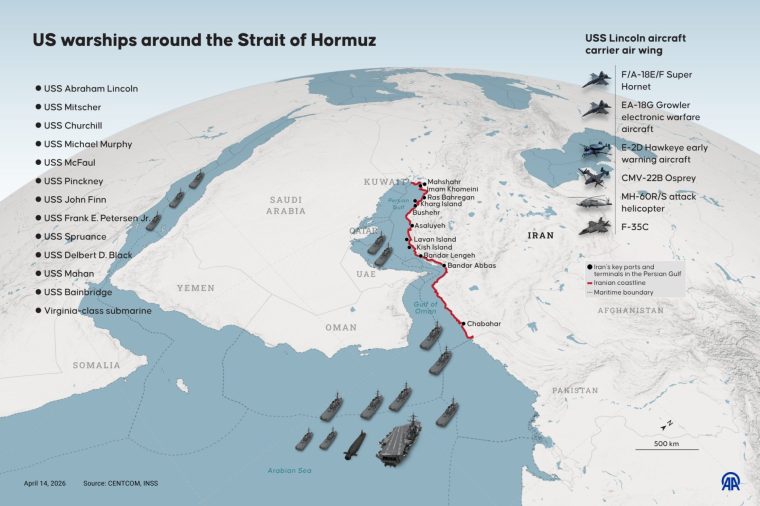 US naval power around the Strait of Hormuz (Photo: Yasin Demirci/Getty)
But Iran’s economy was already in terrible shape before the war and has only gotten worse since. Inflation has continued to soar, the currency has devalued and there is a risk of further mass unemployment due to damage inflicted on the economy.
Trump’s calculation is that the threat to export revenues and risk of further mass unrest will bring Tehran to its knees.
However, Iran may not be content to sit idly by and watch as its economy is slowly strangled. It can retaliate, both by resuming missile and drone attacks against its Gulf neighbours, as well as by targeting the handful of ships transiting the Strait of Hormuz. It could also use its Houthi proxies to attack commercial shipping travelling through the Bab el-Mandeb strait at the lower end of the Red Sea.
Even if it doesn’t, it will not be all plain sailing for the US. Blockades are expensive and require considerable and ongoing resources. They also raise the risk of attacks on your static vessels. Trump has struggled to persuade US voters of the rationale for his war and is likely to struggle in convincing his more virulent supporters that this is the way to win.
The US is also under pressure from its allies to resolve the conflict quickly, to limit further damage to the global economy. No country has so far supported the blockade or shown a willingness to participate it in. The UK and France are due to hold further talks this week about a “co-ordinated, independent, multinational plan” to safeguard shipping in the Strait of Hormuz, but notably only after the current conflict is resolved.
Trump appears to be trying to out-escalate the Iranians, both with the new distant blockade and the growing threat of further punishing strikes against its economic sites. In this struggle of blockade and counter-blockade, it may now be a question of who blinks first.