
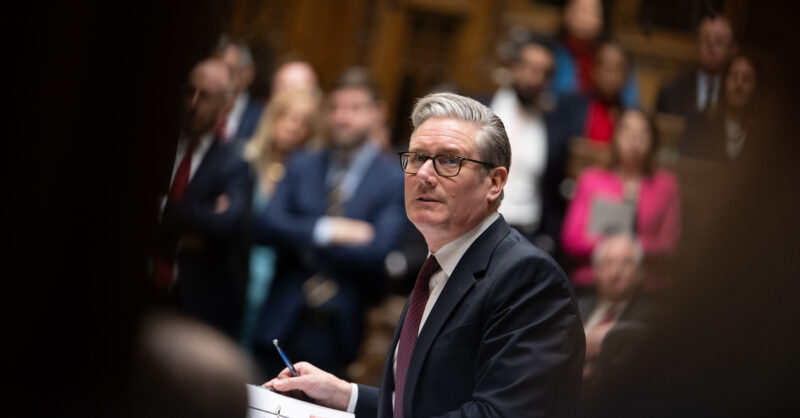
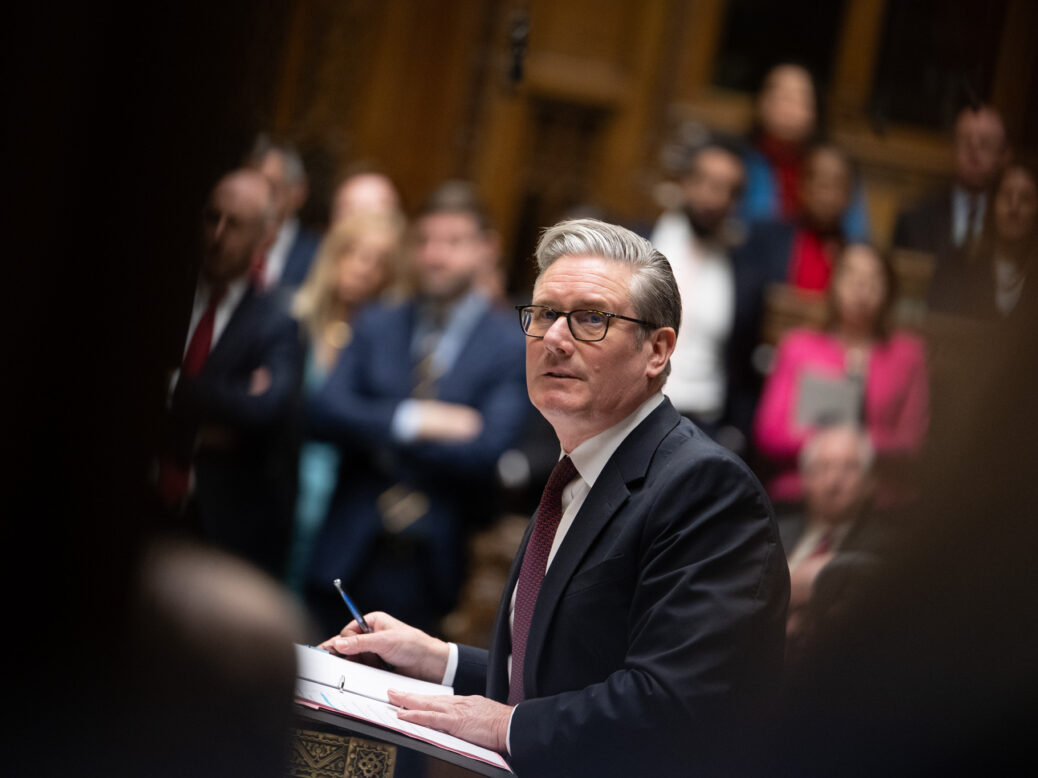
Photo by House of Commons
After a turbulent Easter recess – with escalating tensions in the Middle East keeping the world on edge – Keir Starmer faced MPs this afternoon for the first Prime Minister’s Questions in three weeks. As has often been the case in recent months, defence dominated the early exchanges.
The Conservative leader Kemi Badenoch tried to make use of an unexpected intervention by the former Labour defence secretary, George Robertson. During a speech in Salisbury last night, Robertson, who led the government’s strategic defence review, accused the government of “corrosive complacency” on defence spending. The former Nato secretary-general also warned: “We are under-prepared. We are under-insured. We are under attack. We are not safe… Britain’s national security and safety is in peril.”
It had all been going so well for the Prime Minister – his reluctance to support Donald Trump’s unpredictable march into conflict had set him apart from his right-wing opponents (both Badenoch and Nigel Farage initially appeared to suggest the UK should join the US’s war in Iran). But Robertson’s words have done the PM no favours. When it published the strategic defence review last summer, the government also promised a defence investment plan that has still not emerged.
Badenoch used all six of her questions to hammer Starmer on the Labour peer’s comments. “Robertson’s criticisms were of the PM,” she chirped, “our armed forces are at the end of their tether waiting for the government to fund the strategic defence review.” Starmer hit back: “I don’t agree with [Robertson’s] comments,” he said, before pointing to the government’s choice last year – at the expense of the “difficult decision” to cut the international aid budget – to increase defence spending from 2.3 per cent of GDP to 2.5 per cent of GDP by April 2027.

Subscribe to the New Statesman today and save 75%
Badenoch kept going, using Robertson’s complaints as a guide for her own attacks. Welfare spending – the albatross around this government’s neck – made a sorry return. In his speech, Robertson pointed out that the UK’s welfare budget is now five times larger than the amount it spends on defence. Badenoch repeated this critique: “He won’t fund our military because he wants to fund more welfare.” Starmer’s retorts were focused on Labour’s inheritance from the Tories: 14 years of Conservative austerity, a weakened defence system (“this is what they’ve left behind!”). He was soon rebuked by the Speaker for spending too much time on the opposition: “Prime Minister,” Lindsay Hoyle said, “it’s Prime Minister’s Questions.” (As Starmer left the chamber at the close of the session, the pair appeared to exchange some sharp words.)
Today’s PMQs also fell on the 37th anniversary of the Hillsborough disaster, in which 97 people were killed. The Hillsborough Law, which the Prime Minister has repeatedly promised to deliver, has not yet made its way on to the statute books because of a dispute between the government and the families over the law’s treatment of members of the security services. Starmer reiterated this promise in his opening comments.
Ian Byrne, the MP for Liverpool West Derby and parliamentary lead on the law, asked Starmer: “Will you commit today to rule out any carve-out for security services?” (Byrne was present at Hillsborough himself, and his father was injured.) The Hillsborough Law’s delivery is personal for Starmer; he was introduced by Maggie Aspinall, mother of one of the victims, before his speech at last year’s Labour Party conference. Negotiations are still ongoing between the government and the families, though one MP told the New Statesman it’s a shame the law was not passed ahead of the anniversary.
Elsewhere, the pressure from the cost-of-living crisis continues. People in Northern Ireland, where around 68 per cent of households heat their homes with oil, are increasingly worried about the impact of the Strait of Hormuz blockage on fuel prices. The government has pledged £17m to assist families in Northern Ireland, which critics have said is “not enough”. Both Sorcha Eastwood, the Alliance MP for Lagan Valley, and Gregory Campbell, the Democratic Unionist Party MP for East Londonderry, made impassioned contributions in PMQs, pointing to the dire situation faced by some of their constituents. As uncertainty in the Gulf continues, the impact on UK residents is beginning to become apparent.
[Further reading: Andy Burnham’s backers are trying a rebrand]
Content from our partners