
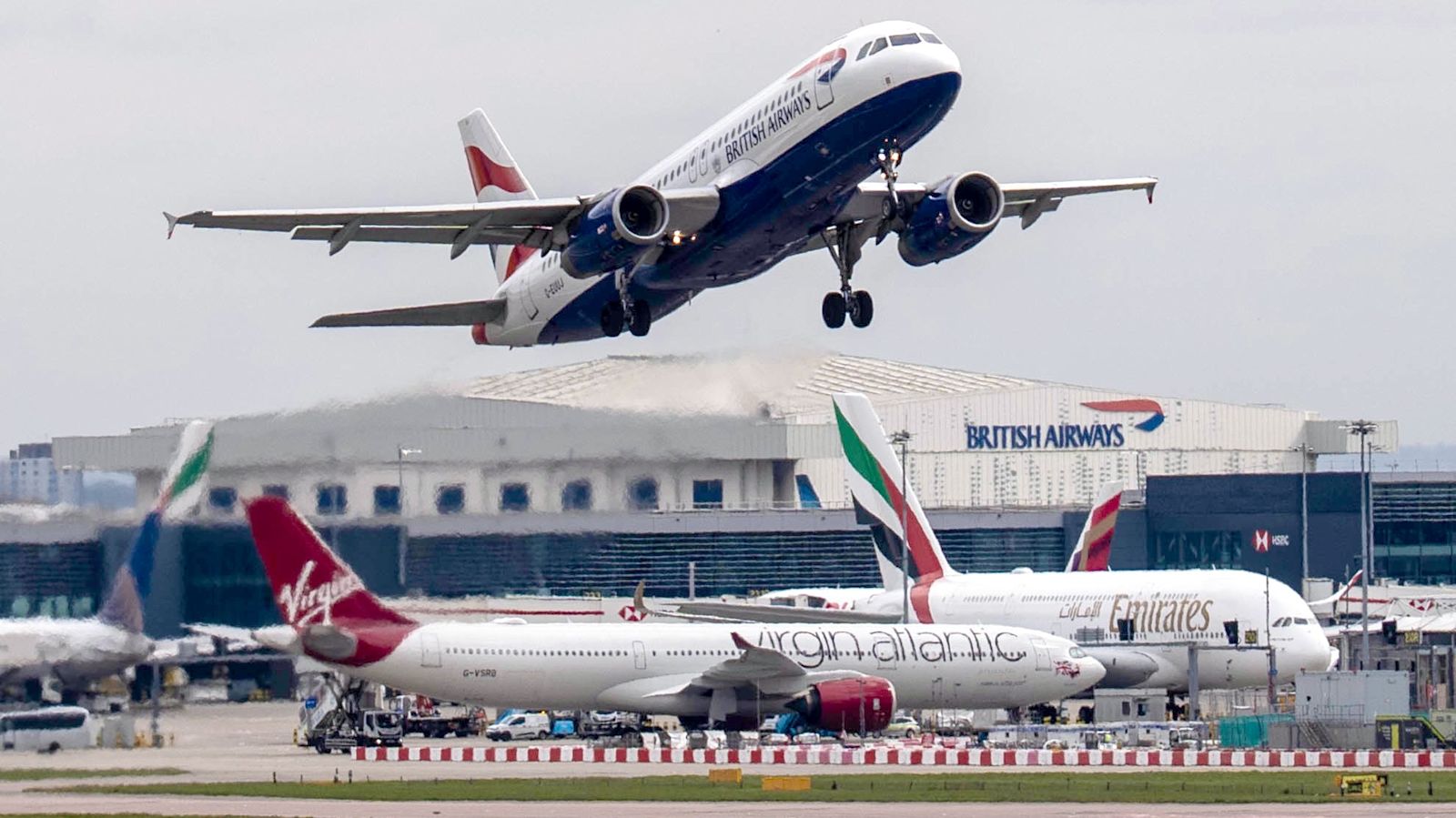
Europe has “maybe six weeks or so (of) jet fuel left” the head of the International Energy Agency said on Thursday, warning of possible flight cancellations “soon” if oil supplies remain blocked by the Iran war.
IEA Executive Director Fatih Birol said that the world is experiencing “the largest energy crisis we have ever faced,” stemming from the ongoing closure of the Strait of Hormuz, through which a fifth of global oil transits in peacetime.
“In the past there was a group called Dire Straits,” he said. “It’s a dire strait now, and it is going to have major implications for the global economy.
“And the longer it goes, the worse it will be for the economic growth and inflation around the world.”
The impact will be “higher petrol (gasoline) prices, higher gas prices, high electricity prices,” Birol told the Associated Press.
Subscribe free to our weekly newsletter for exclusive and original coverage from ITV News. Direct to your inbox every Friday morning.
Economic pain will be felt unevenly, with some countries “hit worse than the others,” he said, naming Japan, Korea, India, China, Pakistan and Bangladesh as being on the front line of the energy crisis.
“The countries who will suffer the most will not be those whose voices are heard a lot. It will be mainly the developing countries. Poorer countries in Asia, in Africa, and in Latin America,” he said. “Then it will come to Europe and the Americas.”
If the Strait of Hormuz isn’t reopened, he said European airlines would be forced to cancel flights.
“I can tell you soon we will hear the news that some of the flights from city A to city B might be cancelled as a result of lack of jet fuel,” he said.
His comments come after easyJet warned that the airline is expected to suffer a loss of £540 million to £560 million for the six months to the end of March, compared with a £394 million loss for the same period last year.
The airline said it remained confident in its fuel supplies for the near future until at least the middle of May.
They also noted bookings are down 2% for the three months to the end of both June and September compared with a year ago.
European airports have also been sounding the alarm over fuel shortages, with the Airports Council International (ACI), which represents more than 600 airports, last week issuing a letter to the EU outlining imminent issues.
The body’s director-general Olivier Jankovec wrote in the letter: “At this stage, we understand that if the passage through the Strait of Hormuz does not resume in any significant and stable way within the next three weeks, systemic jet fuel shortage is set to become a reality for the EU.
“The fact that we are entering the peak summer season… is only adding to those concerns.”
Ryanair’s boss Michael O’Leary said earlier this month that if the war continues, then there was a risk of “disruptions in Europe in May and June”, adding that “maybe 10%, 20%, 25% of our supplies might be at risk”.
Birol said more than 110 oil-laden tankers are waiting in the Persian Gulf and could help ease the energy crisis if they could escape through the Strait of Hormuz.
“But it is not enough,” he added.
The closure of the Strait of Hormuz is leading to fuel shortages around the world. Credit: AP
Even with a peace deal, strikes on energy facilities means it could be many months before pre-war production levels are restored, he said.
“Over 80 key assets in the region have been damaged. And out of these 80, more than one third are severely or very severely damaged,” he said.
“It will be extremely optimistic to believe that it will very quick,” Birol said. “It will take gradually, gradually, up to two years to come back where we were before the war.”
From Westminster to Washington DC – our political experts are across all the latest key talking points. Listen to the latest episode below…